

Three lattice crawlers handle piling and girder setting on a $32.5m flood prevention project near Minneapolis
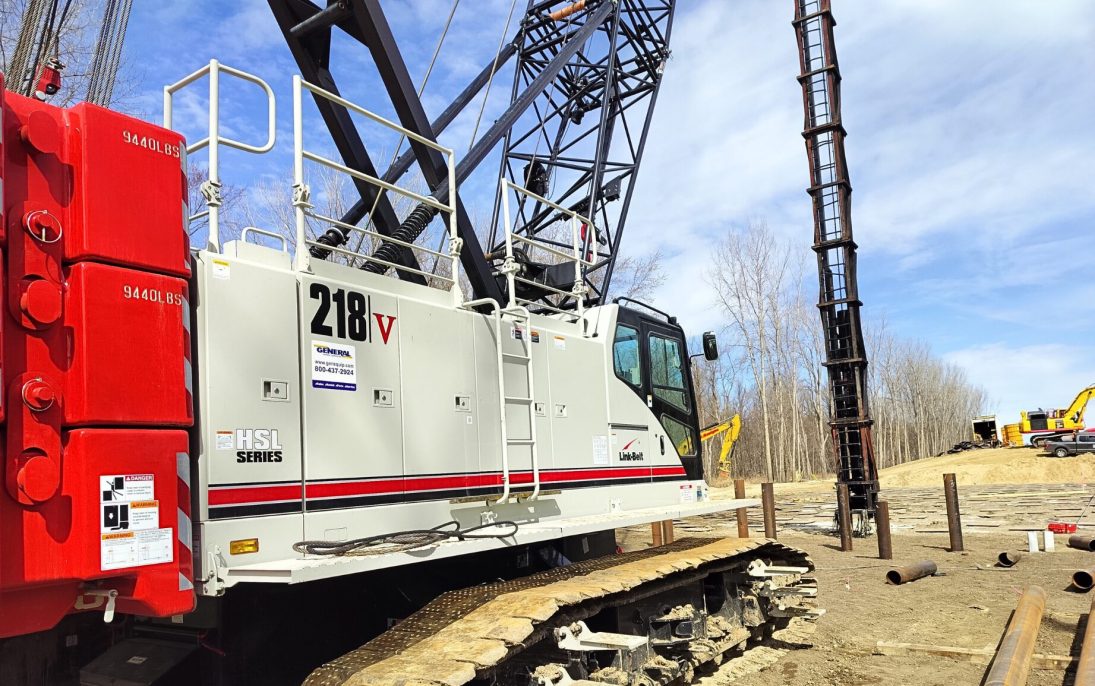
S.M. Hentges & Sons put three Link-Belt lattice crawler cranes on a $32.5m flood prevention project for the Minnesota Department of Transportation, driving close to 9,000ft of pile and setting bridge girders weighing around 75,000lb.
Bridges and a raised highway
The scheme, contracted by the Minnesota Department of Transportation (MnDOT) and led by S.M. Hentges & Sons of Jordan, Minnesota, covers three connected pieces of work: replacing the Rush River Bridge, building a new overflow bridge, and partially reconstructing Highway 93, raising it by up to 12ft to keep it clear of flood water.
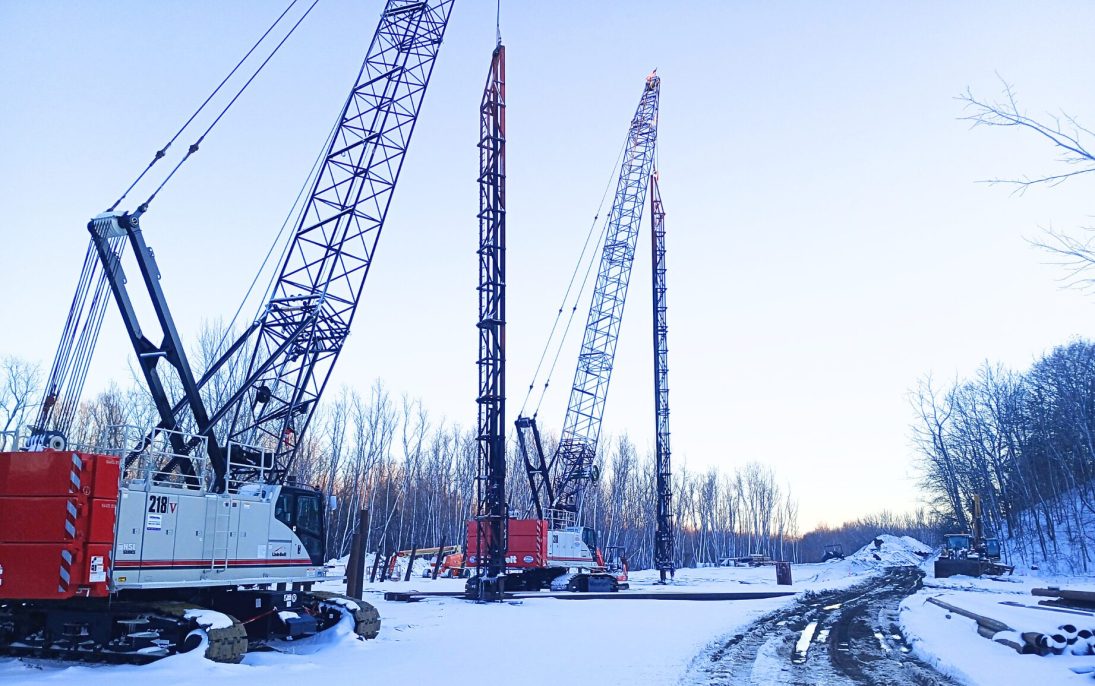
All of it depends on foundations. Hentges deployed a 150-ton Link-Belt 238 HSL alongside two 110-ton machines, a 218|V and a 218 HSL, working across both bridges. Between them the cranes drove close to 9,000ft of piling, with 24in pile weighing around 52,000lb driven into the piers.
Duty cycle and ground pressure
Pile driving is a duty-cycle application rather than a lifting one, and it is unforgiving on a machine: months of continuous hammer work, often on soft ground near a river. Shane Dobbe, a crane operator with Hentges, said the cranes coped with both the workload and the site conditions.
“They drove piling for two or three months straight under roadbed. These machines are all really good for driving pile, and they don’t add a lot of ground pressure.”
— Shane Dobbe, crane operator, S.M. Hentges & Sons
Ground bearing pressure matters on flood plain work, where the crane is frequently operating on made-up platforms over saturated ground. Working under an existing roadbed also puts a ceiling on available headroom, which constrains the leads and the boom angle the operator can use.
Setting girders, then tearing down
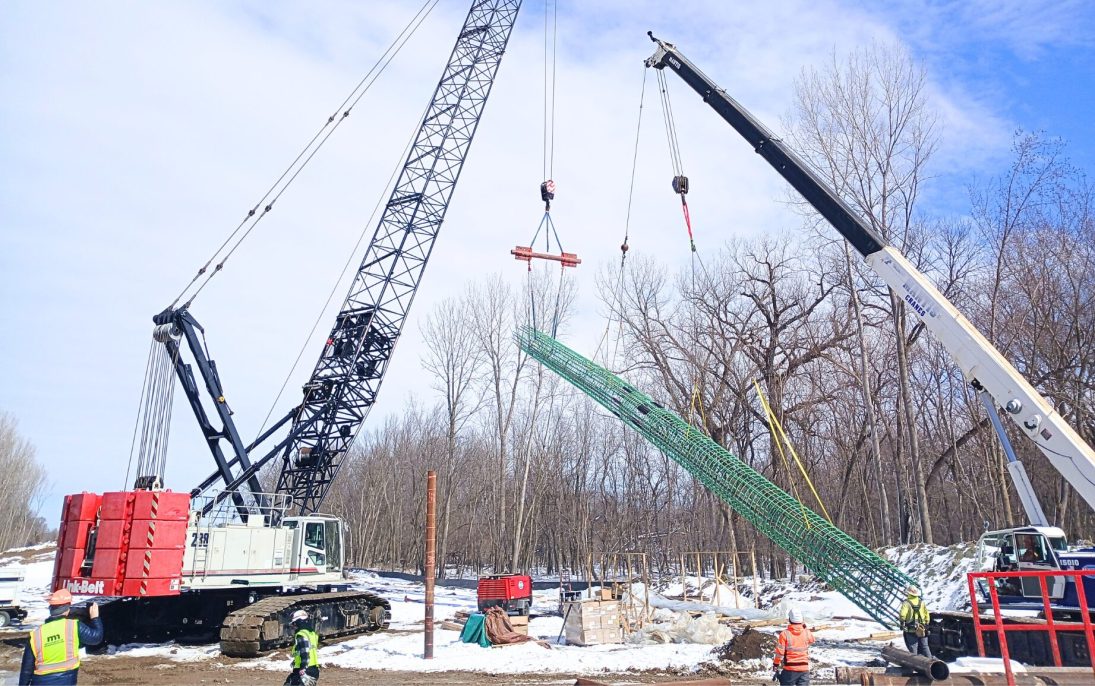
Once the foundations were in, the 238 HSL switched from piling to lifting, setting bridge girders of around 75,000lb. That change of role is the argument for a lattice crawler on this kind of contract: one machine covers both the foundation phase and the superstructure phase without a second mobilisation.
Dobbe singled out assembly and disassembly as the practical advantage of the fleet. The 238 HSL, he said, can be put together or broken down in a few hours, and he noted the 218|V’s ability to travel with the carbody and without track weights.
“I’ve been on Link-Belts for a long time. I like how they tear down. They’re fast.”
— Shane Dobbe, crane operator, S.M. Hentges & Sons
“Setting up and tearing down the 238 is really user-friendly. It’s pretty hard to get it wrong.”
— Shane Dobbe, crane operator, S.M. Hentges & Sons
Photographs of the work were provided by S.M. Hentges & Sons Inc.
Cranes
- Link-Belt 238 HSL: 150 US tons
- Link-Belt 218|V: 110 US tons
- Link-Belt 218 HSL: 110 US tons
- Crane owner: S.M. Hentges & Sons, Jordan, Minnesota
Project
- Client: Minnesota Department of Transportation
- Value: $32.5m
- Location: Near Minneapolis, Minnesota
- Scope: Rush River Bridge replacement, new overflow bridge, Highway 93 raised up to 12ft
- Piling: Close to 9,000ft driven; 24in pile at around 52,000lb
- Girders: Around 75,000lb
Related Stories
Tadano PM 18 SP loader crane rides a PistenBully at Kronplatz
Ski resort operator Funivie di Valdaora services its tower-mounted snow cannons with a Tadano PM 18 SP knuckle…
Ponticelli MK 88-4.1 repairs JR’s Pont-Neuf artwork in Paris
A Liebherr MK 88-4.1 mobile construction crane from Ponticelli repaired storm damage to artist JR's inflatable installation 'La…
Potain tower cranes build Indonesia’s new presidential palaces
A Potain MC 310 K12 and MC 205 B are erecting the Garuda Palace and State Palace in…