Crane in the yard, operator indoors: Kato tests remote control of a Roughter at its Ibaraki plant
Kato Works has run a field experiment in which a rough terrain crane standing outdoors at its Ibaraki plant was operated from a control station set up inside the building, testing whether remote working can be made to feel close enough to the cab seat.
What was tested
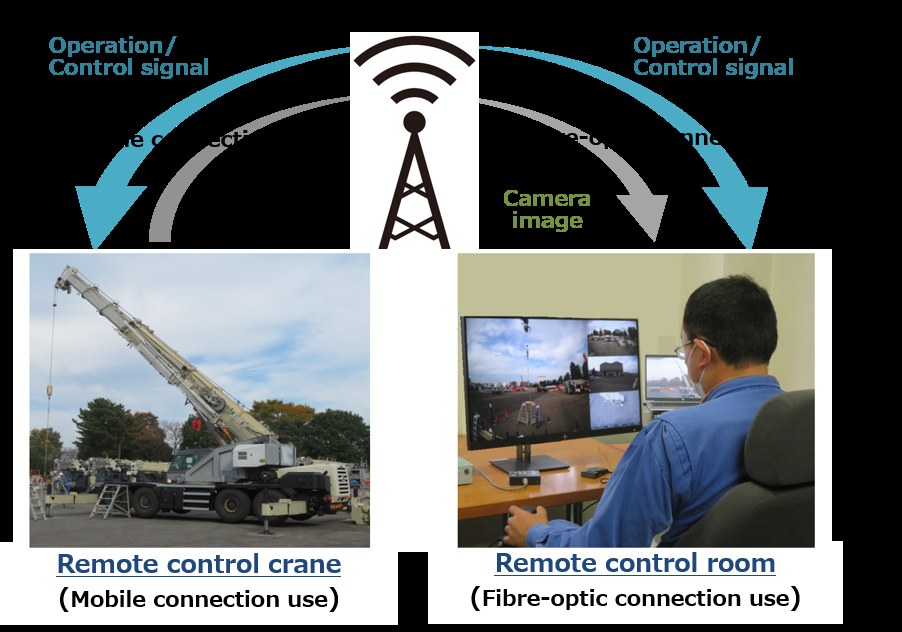
The trial took place in November 2022 and was carried out with two technology partners, Soliton Systems and KDK. Kato set up an operating station indoors at its Ibaraki factory and used it to run a rough terrain crane positioned outside, with the crane linked over a mobile connection and the control room fed by fibre. Camera images from the machine were returned to a bank of screens in front of the operator, while operating and control signals travelled in the opposite direction.
Rather than attempting a single set-piece lift, the exercise worked through a range of aspects of operation: how the controls felt in use, how manoeuvrable the crane was under remote command, and how safety could be maintained when the operator has no direct view of the machine or its surroundings.
An honest assessment
Kato’s own conclusion was measured. The company said that at this stage operating remotely still feels different from operating from the cab seat, but that meaningful progress had been made because the experiment demonstrated remote operation is achievable. It also identified areas where the technical side and other aspects of the set-up could be improved.
That is a more candid summary than manufacturers usually offer of an early autonomy or teleoperation trial, and it is the useful part for anyone following the field. The gap between a crane that can be driven remotely and a crane that can be worked remotely to production standards is largely a question of feedback — what the operator can see, hear and sense of load behaviour, boom deflection and ground conditions.
Why Kato is pursuing it
The company frames remote control as a long-term objective across both its rough terrain and all terrain crane ranges, with the aim of allowing work to be completed more efficiently and with fewer people involved. That reasoning reflects the labour position in the Japanese construction sector, where an ageing and shrinking pool of qualified crane operators has pushed contractors and manufacturers towards automation and remote working.
Kato said it would continue development of remote operation for cranes and for other machines in its range. No timetable for a commercial system has been given.
Related Stories
Hoeflon sets out four-step plan for lifting on cramped jobsites
Dutch mini crane builder Hoeflon has published practical guidance for contractors who must place steel, glass or machinery…
Jekko SPX1280 named best mini crane at PEM Awards 2026
Jekko's SPX1280 has won the Best Product of the Year title in the mini crane category at the…
Tadano names Mang Chong as mobile crane distributor for Taiwan
Tadano has appointed Taoyuan-based Mang Chong Enterprise, a partner since the 1980s, as its official distributor for mobile…