

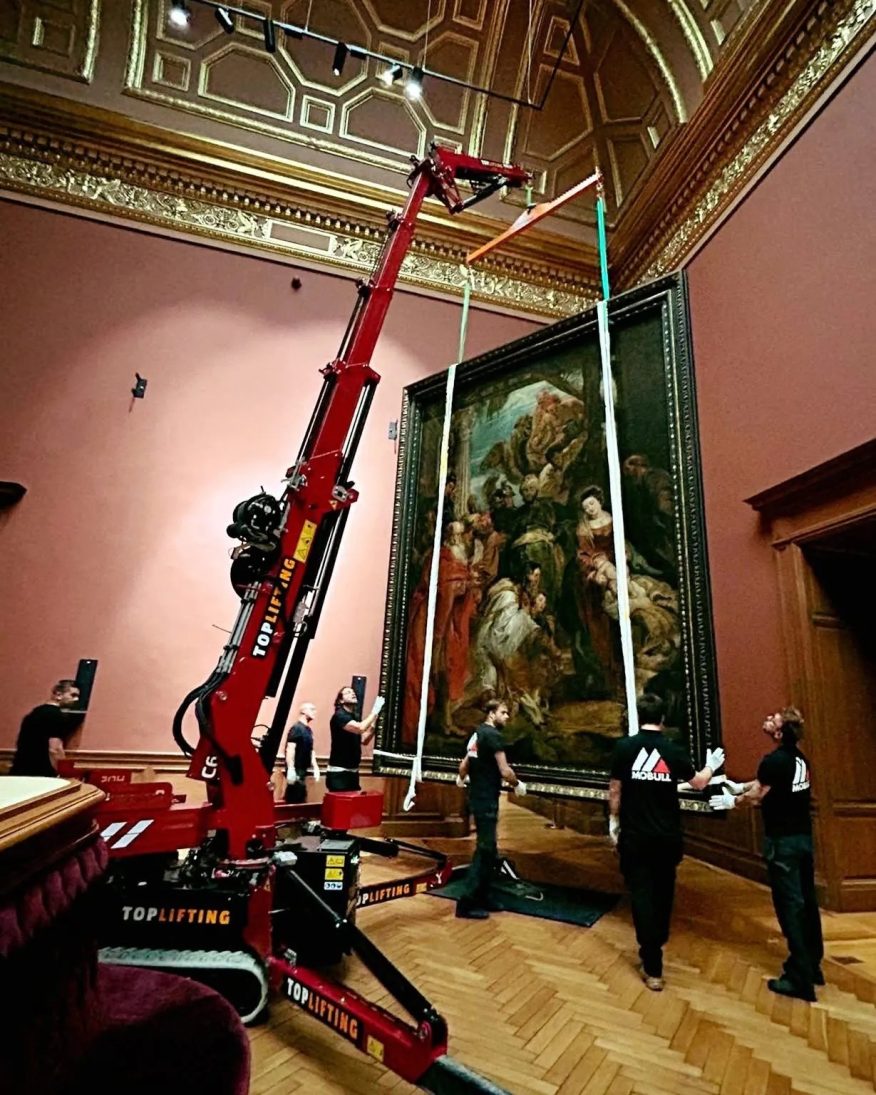
Inside the Royal Museum of Fine Arts: a C6e relocates a 690 kg Rubens canvas
A Hoeflon C6e has been used at the Royal Museum of Fine Arts in Antwerp to move a 690-kilogram painting by Peter Paul Rubens to a new position inside the building after the work returned from restoration.
A load that cannot be dropped or scuffed
The painting weighs 690 kg — not a heavy lift by crane standards, but the tolerances are unlike anything on a construction site. The canvas had just come back from an extensive restoration and had to be transferred to another location within the museum. Any contact with structure, any snatch in the movement, and the cost of the mistake is not measured in programme days.
Why a compact crane indoors
The museum brought in specialist contractor Toplifting, which selected the Hoeflon C6e. The machine is fully electric, which matters in an interior full of climate-controlled galleries and finished surfaces, and its compact footprint allowed it to be set up in the confined space available around the artwork.
The C6e lifts up to 3,000 kg, so the painting represented a small fraction of its capacity — which is normally what an operator wants for delicate work, because the crane runs well inside its chart and its movements stay smooth. Combined with proportional controls, that gave the team the fine positioning needed to move the work without risk.
Heritage work as a compact crane market
Museums, churches and historic buildings have become a steady niche for compact cranes. The access constraints are severe, the floors often cannot take heavy plant, and combustion engines are usually out of the question. An electric machine that can be walked into a gallery and set up without damaging anything answers all three problems at once.
Lift facts
- Crane: Hoeflon C6e, fully electric
- Load: Rubens painting, 690 kg
- Venue: Royal Museum of Fine Arts, Antwerp
- Contractor: Toplifting
- Task: relocating the restored artwork within the museum
Related Stories
Tadano PM 18 SP loader crane rides a PistenBully at Kronplatz
Ski resort operator Funivie di Valdaora services its tower-mounted snow cannons with a Tadano PM 18 SP knuckle…
Ponticelli MK 88-4.1 repairs JR’s Pont-Neuf artwork in Paris
A Liebherr MK 88-4.1 mobile construction crane from Ponticelli repaired storm damage to artist JR's inflatable installation 'La…
Potain tower cranes build Indonesia’s new presidential palaces
A Potain MC 310 K12 and MC 205 B are erecting the Garuda Palace and State Palace in…