

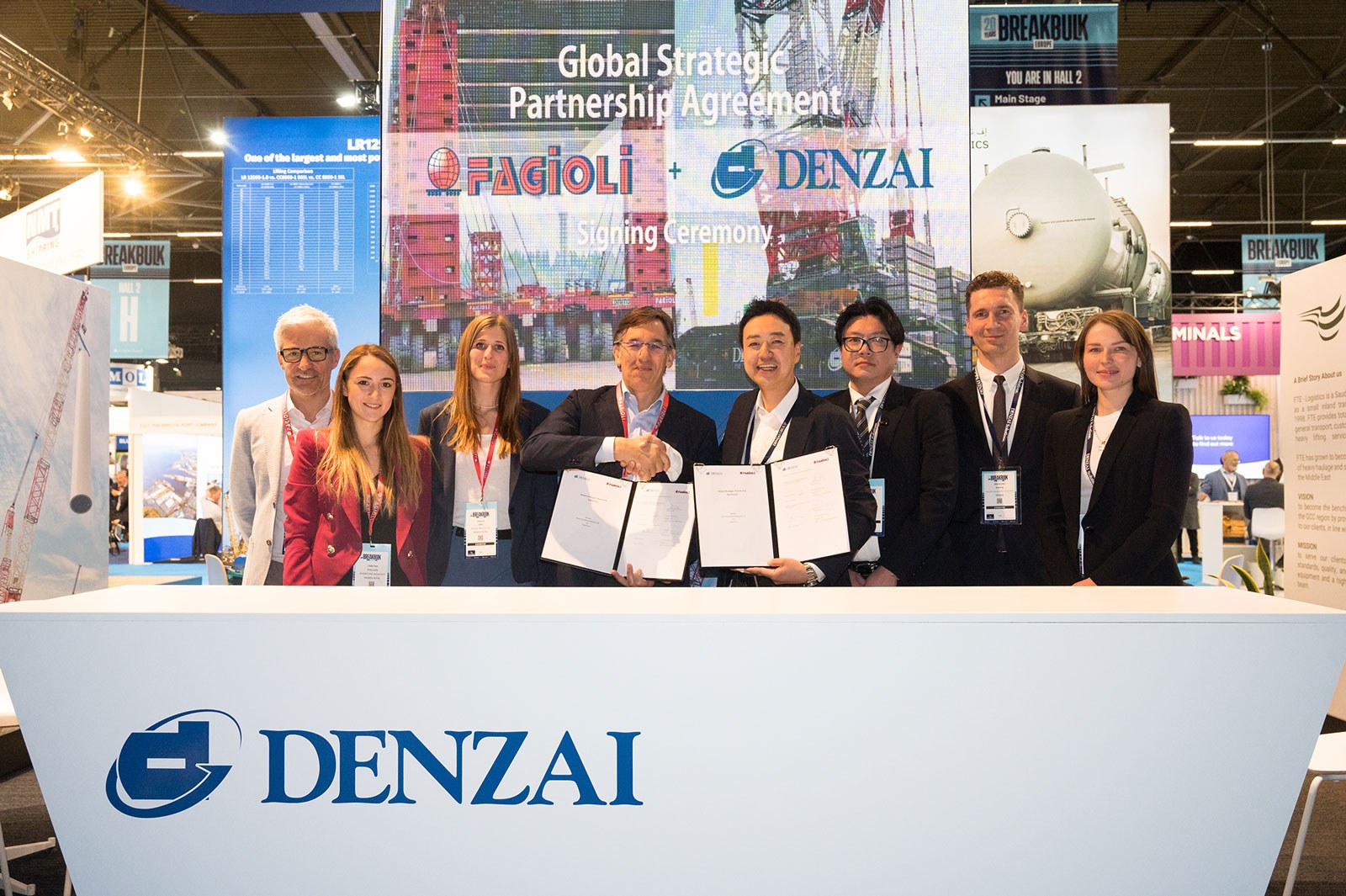
Italian and Japanese heavy lift contractors pair up across Asia, the Gulf, the US and Europe
Fagioli has entered a strategic partnership with Denzai, one of Japan’s leading heavy lifting and specialised transport contractors, giving each company a route into the other’s core markets across Asia, the Middle East, the United States, Europe and Australia.
Two fleets, two engineering departments
The alliance, announced on 13 May 2025, brings together two contractors with comparable profiles: both own and operate crawler cranes, jacking and skidding systems and modular transport equipment, and both carry their own engineering capability rather than buying it in. The stated aim is to pool expertise, technology and operational capacity so that larger and more complex scopes can be taken on jointly.
Where the geography helps
The commercial logic is largely about coverage. Fagioli expects the arrangement to strengthen its position in the Asia-Pacific region, where Denzai is long established; Denzai in turn gains visibility and operational reach in Europe and other markets where Fagioli has an existing footprint.
Both companies point to energy, infrastructure and heavy industry as the sectors where they expect the partnership to be used first. Those are the markets that generate the module load-outs, refinery and LNG component lifts and bridge installation work that neither contractor can always service alone at the far end of a long mobilisation.
Cross-border alliances of this type have become a standard answer to a structural problem in heavy lift: the equipment is expensive, the work is lumpy, and shipping a crawler crane or a full SPMT spread halfway around the world can cost more than the lift it is going to perform. Sharing fleets between partners in different regions shortens mobilisation distances and keeps utilisation up on both sides.
No merger, no shareholding
The announcement describes a partnership rather than any change of ownership, with the two businesses continuing to operate independently. Fagioli called it a significant milestone in the international growth of both organisations, built on shared values around operational excellence, innovation and safety.
What such arrangements do not resolve automatically is method and procedure. Rigging practice, lift planning documentation and operator qualification differ between Japanese and European contractors, and partnerships of this kind usually take time to converge on a common set of engineering standards before genuinely joint execution becomes routine.
For clients, the immediate practical benefit is a single point of contact able to draw on equipment and crews from either side rather than sub-contracting locally in unfamiliar territory.
Related Stories
Hoeflon sets out four-step plan for lifting on cramped jobsites
Dutch mini crane builder Hoeflon has published practical guidance for contractors who must place steel, glass or machinery…
Jekko SPX1280 named best mini crane at PEM Awards 2026
Jekko's SPX1280 has won the Best Product of the Year title in the mini crane category at the…
Tadano names Mang Chong as mobile crane distributor for Taiwan
Tadano has appointed Taoyuan-based Mang Chong Enterprise, a partner since the 1980s, as its official distributor for mobile…