

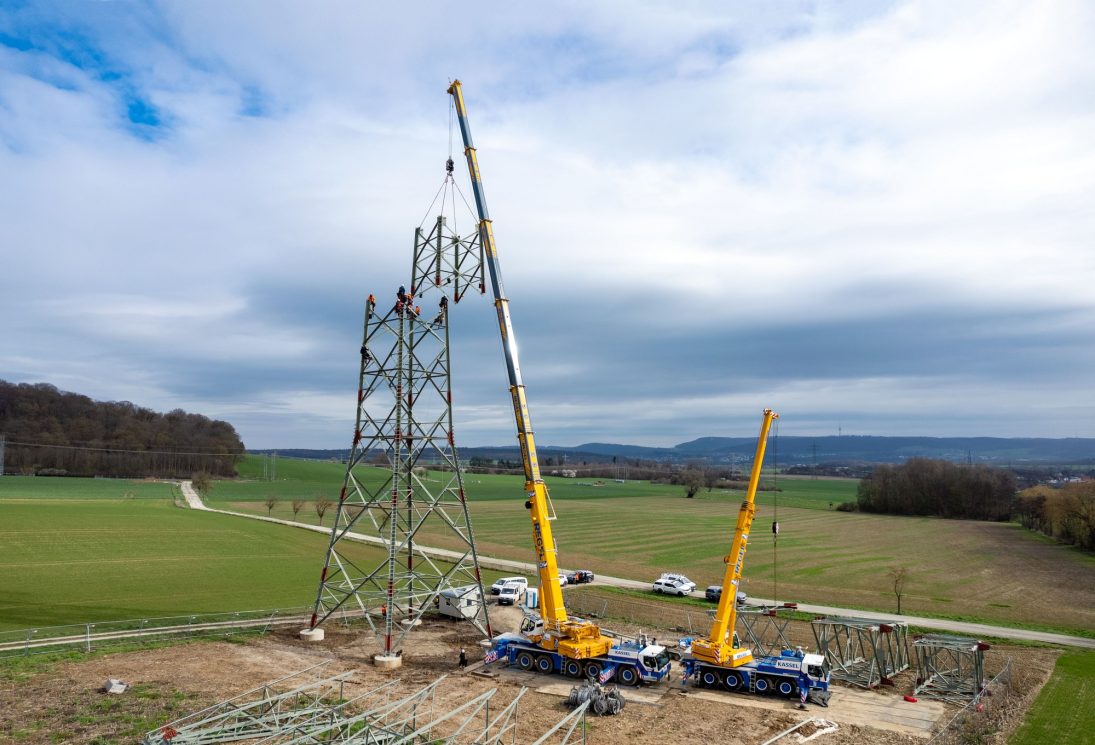
An LTM 1230-5.1 and an LTM 1070-4.2 work in daily cycles on Germany’s largest overhead line project
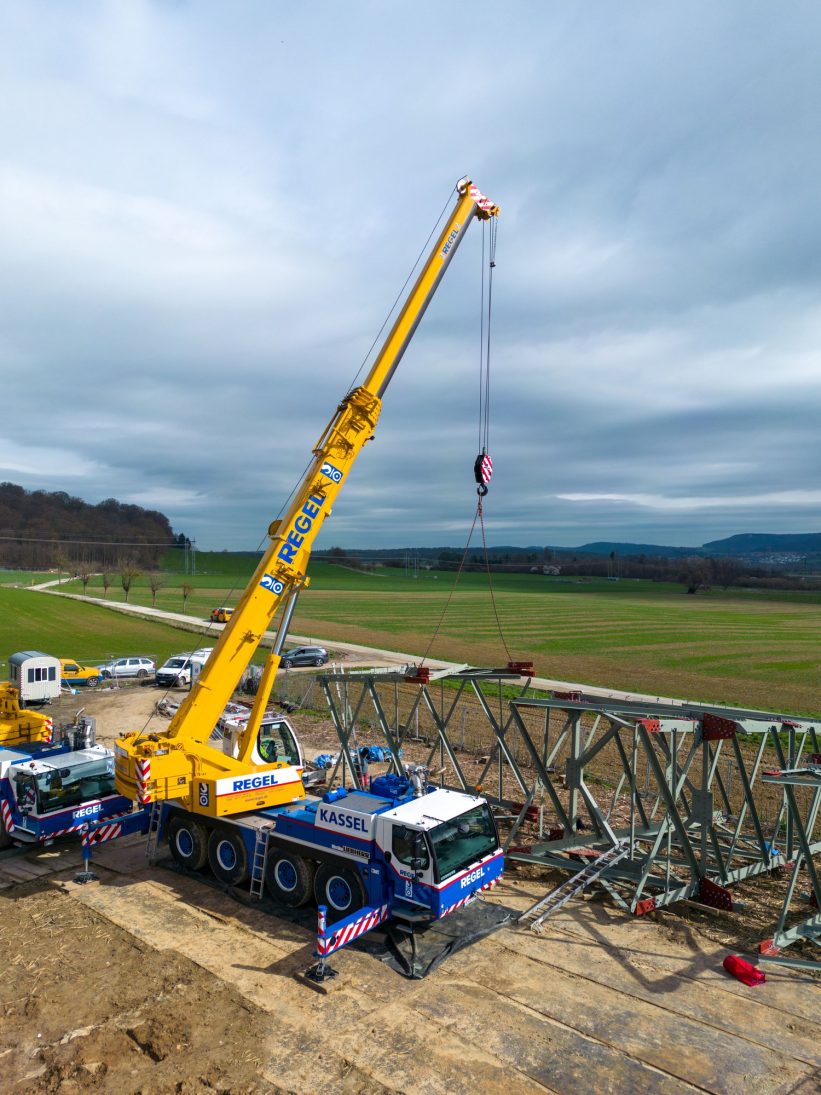
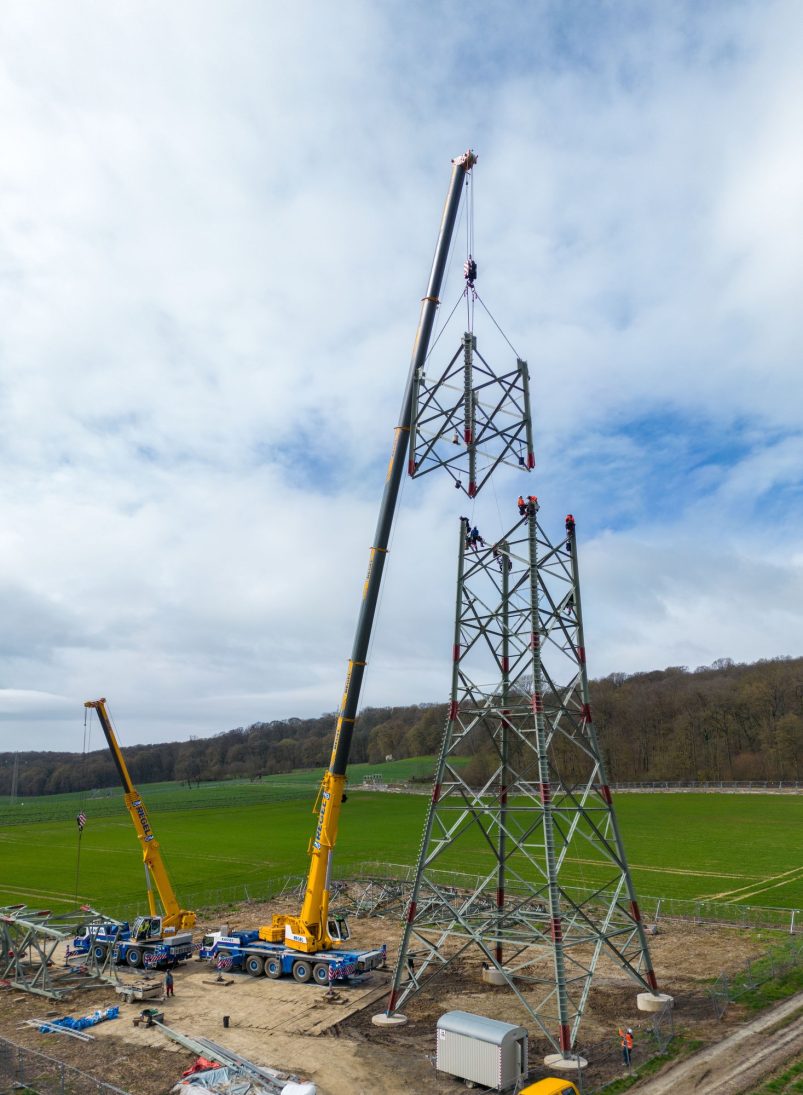
Albert Regel GmbH is erecting lattice towers up to 90 metres high on the 230-kilometre Wahle-Mecklar extra-high voltage route, pairing an LTM 1230-5.1 on the pick with an LTM 1070-4.2 handling steelwork on the ground.
555 pylons, 230 kilometres
The Wahle-Mecklar link, running through Lower Saxony and Hesse, is currently the largest overhead line project under construction in Germany. It calls for 555 lattice towers over 230 kilometres, with only a very small share of the route put underground, and is scheduled for completion in 2024 after four years of work. The line is part of the grid capacity needed to move wind power from the coast to consumers in the south.
Albert Regel GmbH, based at Baunatal near Kassel, is one of the crane contractors supplying the grid operator Tennet’s sites, and has been sending machines to the route in phases for three years.
Boom instead of jib
The workhorse is a five-axle LTM 1230-5.1.
“When it comes to mast construction, the crane of choice here is clearly our LTM 1230-5.1. With its 75-metre telescopic boom, the mobile crane can manage almost all of these jobs without the aid of a jib. We only use a 32-metre fixed jib on the crane for the largest of the up to 90-metre high overhead line pylons. A few times we have also sent out our 300-tonne LTM for this.”
— Daniel Stawizki, dispatcher, Albert Regel GmbH
Avoiding a jib on the majority of towers is the point: rigging and derigging a fixed jib on a pylon site costs a substantial part of a working day, and the whole method here is built around getting a complete tower up between morning and evening.
The second crane on the ground
Most of the time the 230-tonner is flanked by Regel’s LTM 1070-4.2. The compact 70-tonne machine handles the individual lattice elements at ground level and helps bring components upright before the larger crane takes them. It carries most of its ballast on the road and, with active speed-dependent rear-axle steering, gets across rough ground to the tower positions and is ready to work quickly — both material advantages when the crane has to move between pylon locations along an unmade route.
The company has also run an LTM 1200-5.1 together with an LTM 1090-4.2 as a pair on the same line. By its own count Regel has put up well over a hundred of the towers so far.
The fleet behind it
Regel operates around 40 mobile cranes from its Baunatal headquarters and a depot near Fulda. All but five come from the Liebherr plant at Ehingen. Alongside crane hire the company offers heavy haulage and machine and industrial relocation.
Project and cranes
- Project: Wahle-Mecklar extra-high voltage line, Lower Saxony and Hesse
- Scope: 555 pylons over 230 km, completion due 2024
- Pylon height: up to 90 m
- Main crane: Liebherr LTM 1230-5.1, 75 m telescopic boom
- Jib: 32 m fixed jib, only on the tallest towers
- Assist crane: Liebherr LTM 1070-4.2
- Contractor: Albert Regel GmbH, Baunatal — approx. 40 mobile cranes
Related Stories
Tadano PM 18 SP loader crane rides a PistenBully at Kronplatz
Ski resort operator Funivie di Valdaora services its tower-mounted snow cannons with a Tadano PM 18 SP knuckle…
Ponticelli MK 88-4.1 repairs JR’s Pont-Neuf artwork in Paris
A Liebherr MK 88-4.1 mobile construction crane from Ponticelli repaired storm damage to artist JR's inflatable installation 'La…
Potain tower cranes build Indonesia’s new presidential palaces
A Potain MC 310 K12 and MC 205 B are erecting the Garuda Palace and State Palace in…