

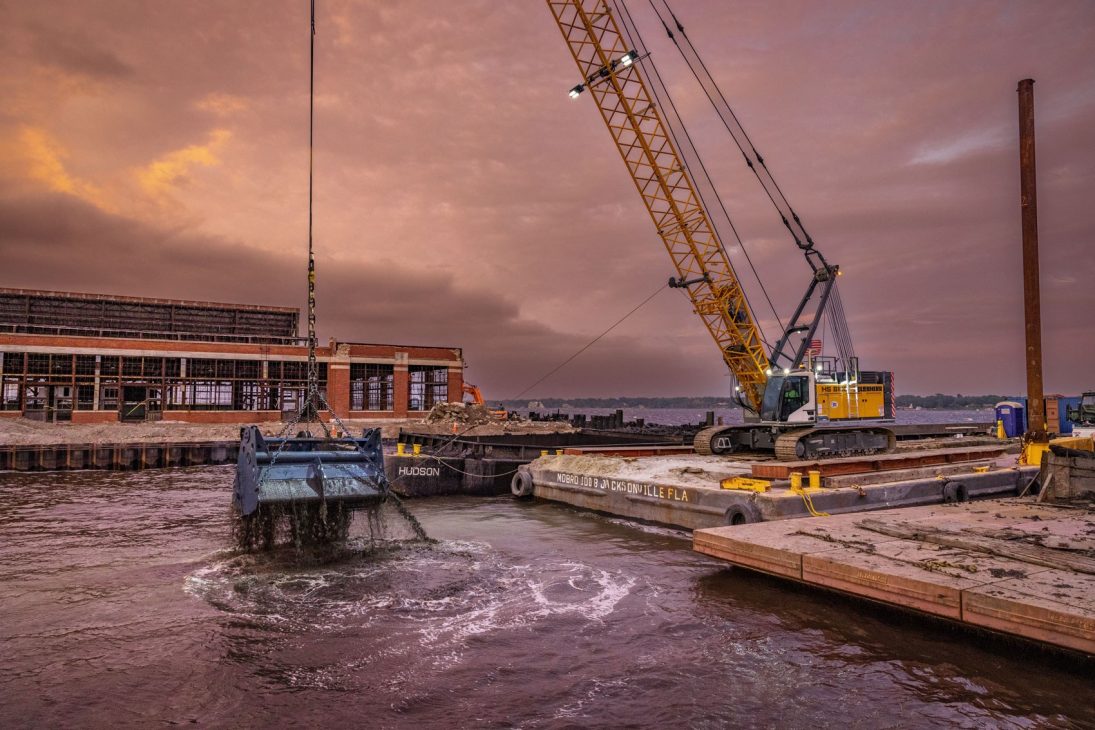
Two months on a barge off Jacksonville with a clamshell and a Liebherr duty cycle crawler crane
Brance Diversified spent roughly two months dredging some 50,000 cubic yards of sand and silt off a barge at Jacksonville, Florida, working its Liebherr HS 8100.1 duty cycle crawler crane 10 to 12 hours a day.
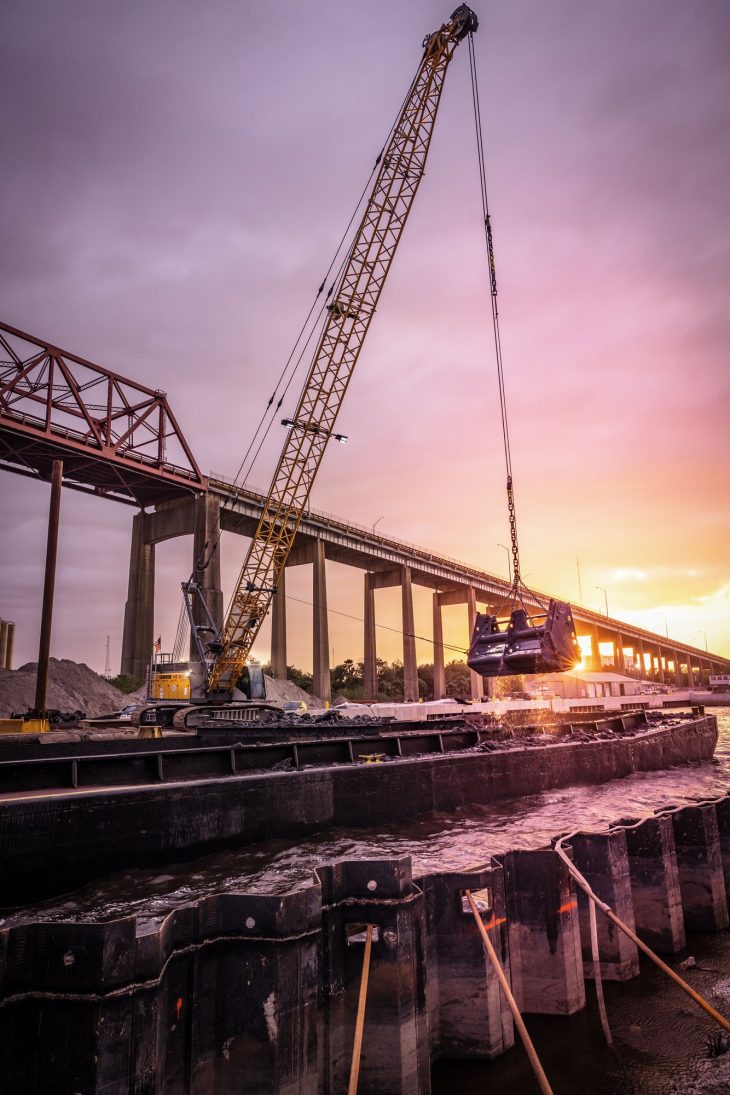
Barge-mounted clamshell work
Brance Diversified, Inc. (BDI) chose its HS 8100.1 for the Jacksonville dredging contract on the strength of its reliability, its clamshell barge charts and its production rate — the three things that decide whether a duty cycle machine earns its keep on a fixed-volume job. Around 50,000 cubic yards were moved over approximately two months.
Duty cycle crawler cranes are built for exactly this kind of repetitive, high-load-cycle work: free-fall winches, heavy rope pull and a structure designed for continuous grab operation rather than the occasional precision pick of a lifting crane.
Working from a barge changes the calculation. The crane’s permitted load chart depends on the stability of the vessel beneath it, so a manufacturer’s clamshell barge charts are the document that determines how far out the machine can dig and how heavy a grab it can swing.
“We chose the HS 8100.1 because of its powerful 523 hp engine, 61,800 lbs. line pull winches, low noise emission and low fuel consumption.”
— Lance Young, President, Brance Diversified, Inc.
The machine’s Liebherr diesel meets Tier 4 requirements, which BDI cites as consistent with its own environmental commitments.
Grab control and cycle recording
BDI’s crane is fitted with Liebherr’s GrabMatic system, which supports the operator on clamshell work by optimising grab closing, assisting with level cutting, displaying machine inclination up to 40 degrees on the operator’s monitor and logging cycles and turnover.
“These systems increase safety, minimize rope wear and significantly increase turnover/production, allowing our customers to dredge larger projects faster and more efficiently.”
— Wolfgang Herzog, VP Sales South East & Caribbean, Crawler Cranes and Deep Foundation Machines, Liebherr USA, Co.
Cycle logging matters on dredging contracts because payment and progress are measured in volume moved rather than hours worked; a recorded count of grab cycles gives both contractor and client a defensible figure.
Long shifts, changing light
The crane ran 10 to 12 hours a day across the duration of the project, handling sand and silt through varying light conditions, so BDI specified a lighting package for dusk and night work. Young’s summary of the machine after the contract was that reliability and production “definitely meet and exceed our expectations”.
Related Stories
Tadano PM 18 SP loader crane rides a PistenBully at Kronplatz
Ski resort operator Funivie di Valdaora services its tower-mounted snow cannons with a Tadano PM 18 SP knuckle…
Ponticelli MK 88-4.1 repairs JR’s Pont-Neuf artwork in Paris
A Liebherr MK 88-4.1 mobile construction crane from Ponticelli repaired storm damage to artist JR's inflatable installation 'La…
Potain tower cranes build Indonesia’s new presidential palaces
A Potain MC 310 K12 and MC 205 B are erecting the Garuda Palace and State Palace in…