

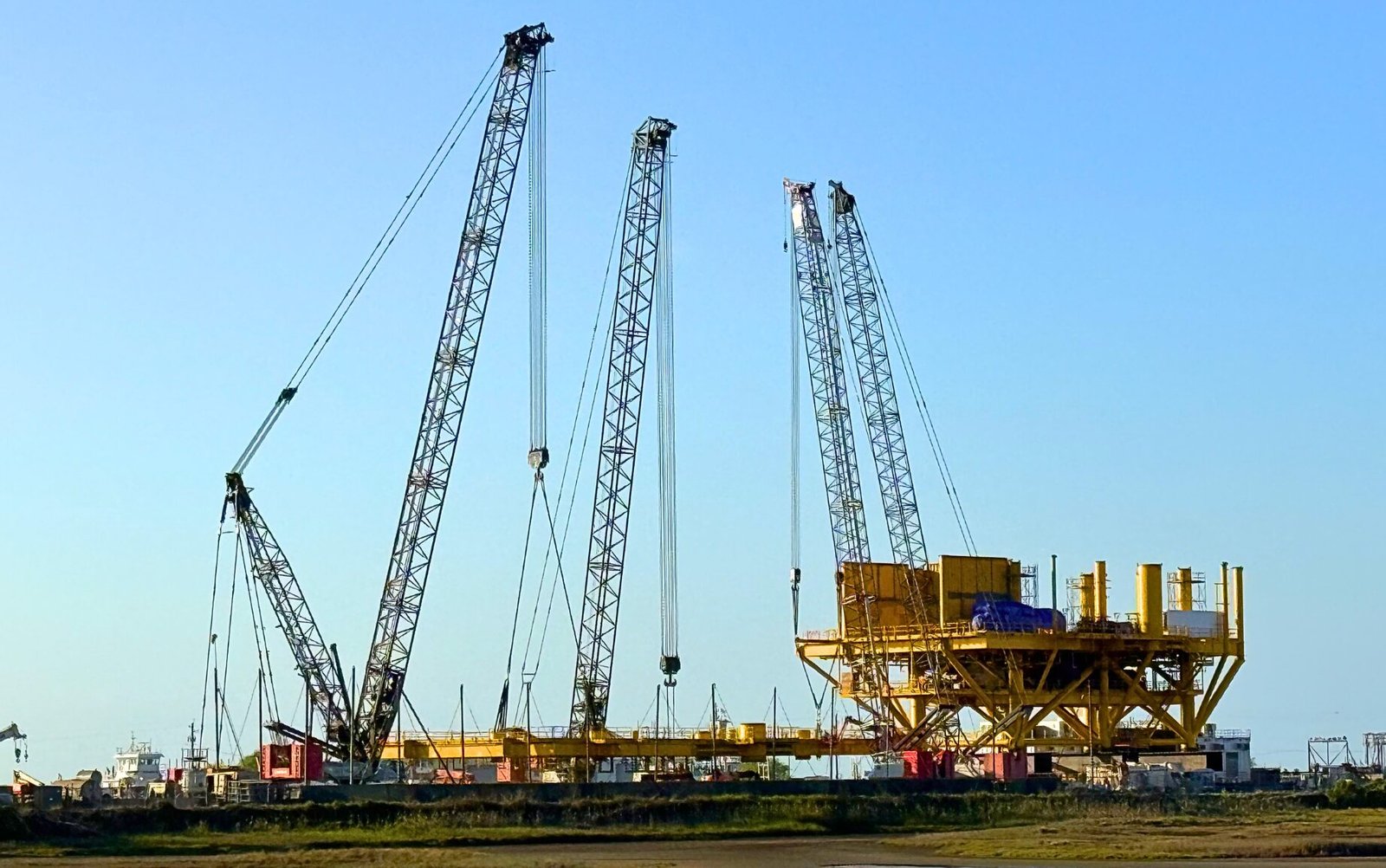
Seven Link-Belt crawlers keep State Service’s modular yard moving at Ingleside
At Ingleside on the Texas Gulf Coast, contractor State Service is running a seven-strong fleet of Link-Belt crawler cranes to assemble offshore drilling platform sections and LNG plant modules, with steel components weighing as much as 600 US tons.
The fleet spans the Link-Belt crawler range: two 300-US ton 348 Series 2 lattice crawlers, a 238 HSL, two TCC-800 telescopic crawlers and a pair of 500-US ton 548s. Working together, the cranes handle steel platform sections measuring more than 100 square feet and 10 feet high, raising them 50 feet above the lower portions of a drill rig at the offshore platform site.
Footprint over capacity
Modular construction has become a staple of oil and gas work, promising faster delivery at lower cost. For State Service, crane selection on the module yard is driven less by chart capacity than by how much room a machine takes up.
“With this work, the footprint of the crane is critical. Where the modules are closer together, you can use a 100-ton to 300-ton crane rather than something bigger. The smaller crane usually is more manoeuvrable and quicker to get into more accessible locations around the site.”
— Thomas Angleman, manager and rigging superintendent, State Service
The 348 Series 2s, the 238 HSL and the two TCC-800s build modules for a liquefied natural gas plant off-site. Finished modules are driven onto adjacent barges on self-propelled modular transporters and assembled at a permanent facility nearby. The units typically stand 60 feet tall, run 120 to 200 feet long and 24 to 40 feet wide, and sit as little as 15 feet apart in the yard.
Telecrawlers in the tight spots
Maintenance supervisor Ted Little said the TCC-800s earn their keep by telescoping into the modules where lattice boom cannot follow.
“They move really well through the yard. We do a lot of picking and carrying, and we run a lot of equipment from one end to the other over a local 10-acre site.”
— Ted Little, maintenance supervisor, State Service
Little also pointed to the touchscreen LMI, which he said is simple to configure and easy to troubleshoot, and to the camera package that lets operators confirm everything is running as it should.
Pick and carry duty
Out at the offshore platform site, operator Lance Jones rates the 348 Series 2 as the workhorse for module lifts.
“The Link-Belts are a stout crane for what they can do, especially the 348 Series 2. It can pick everything that we have out here with ease, and it can fit into pretty tight spaces.”
— Lance Jones, operator, State Service
The 238 HSL, meanwhile, is the pick-and-carry specialist. Jones credits its winch speed controls for smooth critical lifts and says it will swing, boom and hoist simultaneously without complaint. Recent duties included walking an 80-foot, 65,000-pound heavy-duty pipe joint across the site, while its heaviest pick-and-carry load to date has been around 70,000 pounds.
The cranes were delivered through B-C Equipment Sales of Corpus Christi, Texas, Link-Belt’s dealer for the region.
Facts
- Fleet: 2x Link-Belt 348 Series 2 (300 US ton), 1x 238 HSL, 2x TCC-800 telecrawler, 2x 548 (500 US ton)
- Steel components up to 600 US tons
- Platform sections lifted 50 ft above the drill rig base
- LNG modules: about 60 ft tall, 120-200 ft long, 24-40 ft wide
- Module spacing in the yard: down to 15 ft
- 238 HSL pick and carry: up to about 70,000 lb
- Dealer: B-C Equipment Sales, Corpus Christi, Texas
Related Stories
Sennebogen fleet of 13 speeds up ship handling at Yesilyurt port
Turkish steel producer Yeşilyurt Demir Çelik runs 13 Sennebogen material handlers at its Black Sea deep-sea port near…
Link-Belt 120|RT keeps zinc recycling plant lifting in North Carolina
Befesa Zinc Metal relies on a rented Link-Belt 120|RT for maintenance lifts at long radius across its Mooresboro,…
Two Liebherr NC-B 12-70 flat-tops squeeze into Sai Kung housing site
A pair of Liebherr NC-B 12-70 flat-top tower cranes is handling the lifting on a confined residential development…