

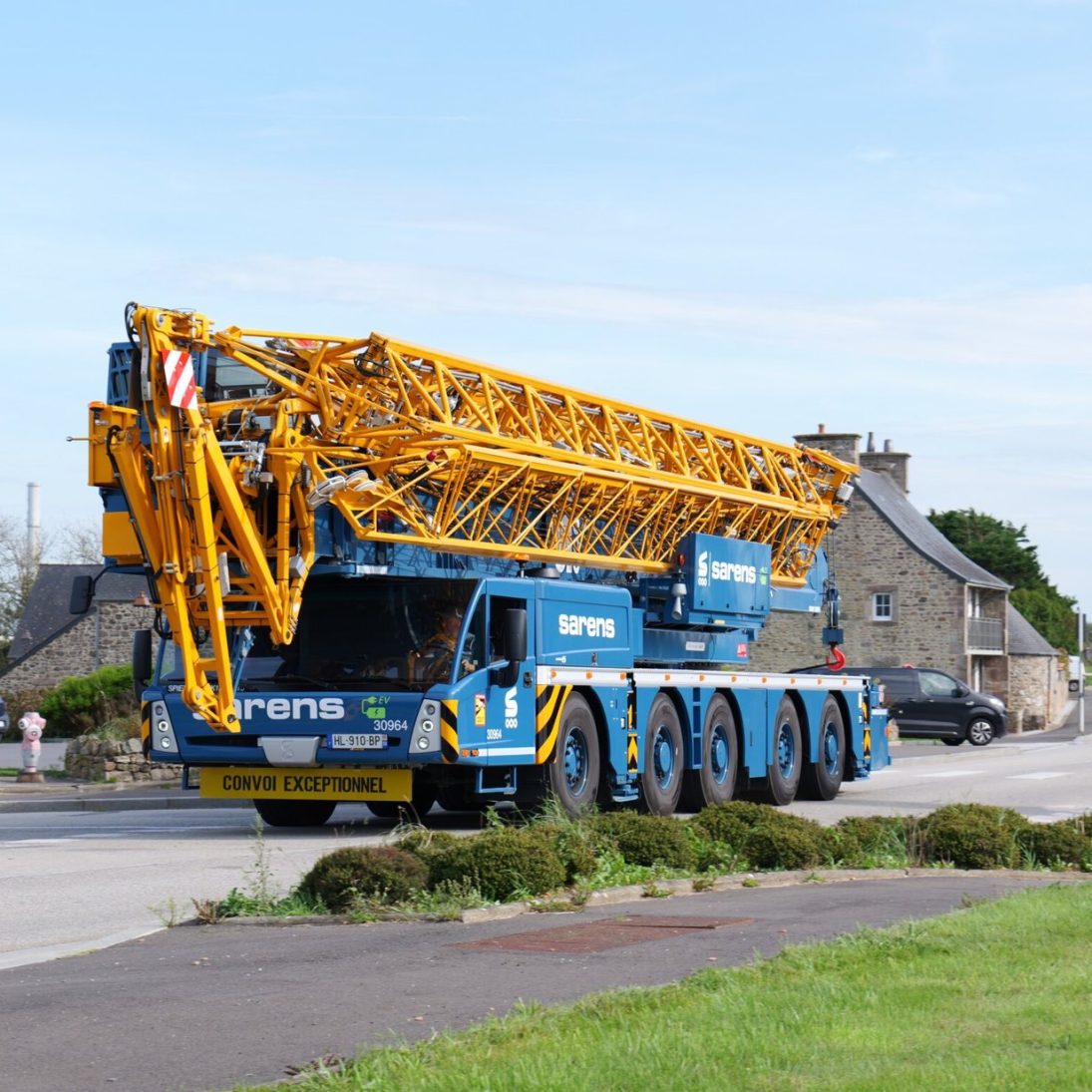
From road transport to maximum lifting capacity: the four ballast configurations of the Spierings SK1265-AT5 eLift
Spierings has set out how its five-axle SK1265-AT5 eLift mobile tower crane can be run in four ballast configurations, from a sub-60-tonne road-transport set-up to a fully ballasted machine of just under 70 tonnes.
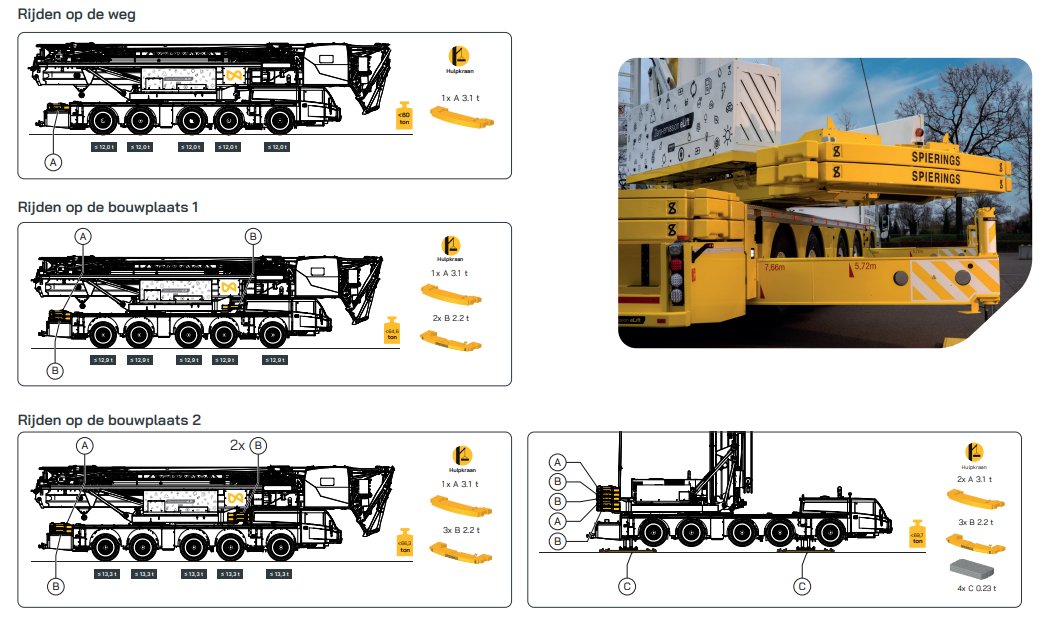
Not every lift calls for the same capacity, and the Dutch manufacturer’s answer on the SK1265-AT5 eLift is a modular ballast concept. The operator takes only the counterweight the job requires, keeping transport weight, mobility and lifting performance in balance rather than hauling the full ballast package to every site.
Four configurations, four weight classes
In its lightest form the crane is set up purely for the road: total weight stays below 60 tonnes, with the axle configuration keeping the load at roughly 12 tonnes per axle, so the machine remains within normal transport rules. A second configuration adds ballast for site work and brings the crane to under 64.6 tonnes, with lifting capacity rising while the unit stays compact.
The third step, at under 66.3 tonnes, adds further counterweight for what Spierings calls the maximum performance available within the five-axle concept. The fourth and heaviest configuration, below 69.7 tonnes, is the fully built-up machine, optimised for maximum stability and lifting capacity on site. In the ballasted configurations the crane’s integrated auxiliary crane places the counterweight itself, so no support equipment is needed.
Ballast detection removes the guesswork
Switching between set-ups means the load chart must always match the counterweight actually fitted. The SK1265-AT5 eLift therefore carries an Automatic Ballast Detection System, which recognises which ballast configuration is on the crane and applies the corresponding load chart automatically. The operator no longer selects the configuration by hand, which Spierings says reduces the chance of errors and ensures the crane always works to the chart that belongs to the ballast on board.
Matching the crane to the job
According to the manufacturer, the choice of mobile tower crane is rarely decided by capacity and reach alone: transport weight, the space available on site and the ballast a job actually needs all determine how efficiently a crane can be deployed. With the four configurations, the SK1265-AT5 eLift can travel light when the work is light and lift at full capacity when it is not, combining road mobility and lifting performance in a single five-axle package.
Facts
- Crane: Spierings SK1265-AT5 eLift, five-axle mobile tower crane
- Configuration 1: road transport, total weight under 60 t, approx. 12 t per axle
- Configuration 2: extra ballast, under 64.6 t
- Configuration 3: maximum performance within the five-axle concept, under 66.3 t
- Configuration 4: maximum stability and capacity, under 69.7 t
- Automatic Ballast Detection System applies the matching load chart
- Integrated auxiliary crane self-installs the ballast
Related Stories
Manitowoc launches upFLEX RCL upgrade for older Grove cranes
Manitowoc's new upFLEX rated capacity limiter replaces the iFLEX systems on Grove rough-terrain and truck cranes built from…
Potain launches ECS smart control system for tower cranes
Manitowoc's new Ergo Control System pairs a 13.3-inch cab touchscreen with CAN bus wiring and will be standard…
Liebherr extends Fibre rope service life for tower cranes
Liebherr has increased the overall service life of its Fibre tower crane ropes from 14 to 16 years,…