

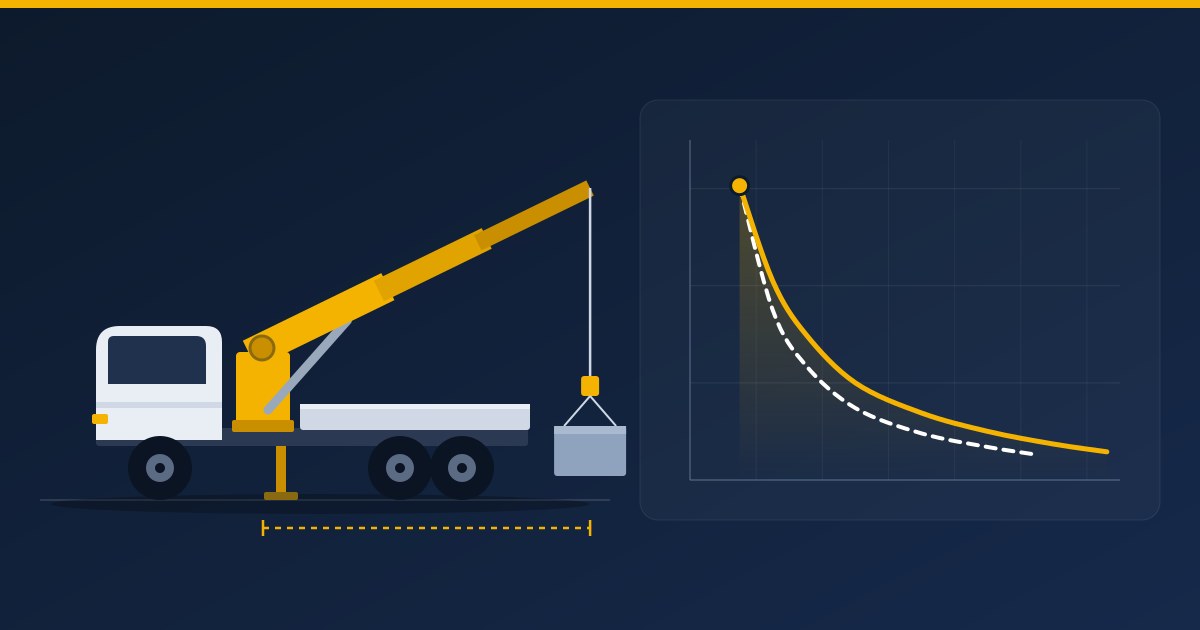
Two truck loader cranes can carry exactly the same headline rating and still behave very differently on the job. A look at how Japanese and North American manufacturers developed their truck-mounted cranes shows why the load chart, not the brochure number, decides what a crane can really do.
Two markets, two directions
Japan and North America built quite different markets for truck-mounted cranes. Japanese makers such as Furukawa UNIC and Tadano are best known for compact truck loader cranes, the kind used to unload building materials straight from a delivery truck. In North America, IMT and National Crane cover a wider field, from cranes on mechanics’ service trucks up to large boom trucks.
The Japanese approach grew out of post-war rebuilding. UNIC launched its one-tonne UNIC100 in 1961 with a simple idea: a truck that carries its own lifting gear does not have to wait for a separate crane. Tadano introduced its OC-2 hydraulic truck crane in 1955 and moved into truck loader cranes with the TM series in 1963. Later steps focused as much on safety and ease of use as on lifting more, such as UNIC’s wired remote control in 1979 and a wireless version in 1985, which let operators stand wherever they could see the load best.
Telescopic or knuckle boom
Two boom types dominate. A telescopic boom uses nested sections that slide out, giving direct reach and a compact package for the road. An articulating or knuckle boom has hydraulic joints, so it can fold and change direction to place loads around obstacles. Neither is better by default: one offers straightforward reach, the other more freedom in how the load is approached.
The boom profile matters too. UNIC adopted a hexagonal section in 1987, while Tadano’s TM-ZE290HRB series uses a seven-sided profile in high-tensile steel. Shape, material and the number of sections all affect stiffness, weight, reach and transport size.
Same rating, different crane
The UNIC URV290 series and the Tadano TM-ZE290HRB series are a close match on paper. Both have four models, both list a maximum rated capacity of 3,030 kg, and both reach roughly 6.4 to 12.6 m depending on the model, with a six-section boom on the longest version.
That 3,030 kg, however, only applies at a short radius of around 1.5 m. Further out, the permitted load drops quickly because the load moment grows with distance. A 1,000 kg load at 2 m creates a load moment of 2,000 kg·m; the same load at 6 m creates 6,000 kg·m. This is where differences in boom construction, hydraulics and outrigger layout start to show.
| Model | Type | Max. capacity | Max. reach |
|---|---|---|---|
| UNIC URV290 series | Telescopic truck loader crane | 3,030 kg | 6.43 to 12.63 m |
| Tadano TM-ZE290HRB series | Telescopic truck loader crane | 3,030 kg | 6.4 to 12.6 m |
| IMT 2820 | Telescopic service-truck crane | 2,268 kg (5,000 lb) | 6.3 m (20 ft 6 in) |
North American examples show how much the application shapes the design. The IMT 2820 is a compact telescopic crane for mechanics’ trucks, weighing about 635 kg, with a small mounting footprint that leaves payload and space for tools. At the other end, a boom truck such as the now-discontinued National Crane 400B, rated at 10 US tons with a 17.1 m main boom, belongs to a different class altogether and is no direct rival to a three-tonne loader crane.
Did you know? The best-known name in loader cranes started with skis. Swedish ski maker Eric Sundin built a hydraulic crane to move timber for his own production and founded Hydrauliska Industri AB, now Hiab, in 1944. Serial production of the HIAB 190 started in 1947. In some countries, any loader crane is still called a “hiab”, whatever badge it carries.
Stability and safety systems
Most truck-mounted cranes are powered by the truck’s engine through a power take-off driving a hydraulic pump. Pressure determines the force a cylinder can deliver, oil flow determines speed. Outriggers carry the working forces into the ground, so stability depends not only on outrigger spread but also on whether the crane stands on concrete, asphalt or soft soil.
Load indicators, overload protection, anti-two-block devices and outrigger monitoring are now common. They help the operator keep the crane within its limits, but they do not replace a correct setup or the manufacturer’s instructions.
Did you know? For US mobile cranes on fully extended outriggers, rated loads are typically kept at or below 85% of the load that would tip the crane. Many charts also mark where the limit shifts from stability to structural strength: beyond that point a crane may fail structurally without tilting first. Compact loader cranes follow other standards, so the manufacturer’s chart always comes first.
What to compare instead
A meaningful comparison between truck-mounted cranes looks beyond the maximum capacity:
- Capacity at several working radii
- Maximum horizontal reach
- Boom length and number of sections
- Outrigger configuration
- Crane weight and mounting requirements
- Hydraulic specifications
- Safety and control systems
A delivery truck needs a crane that handles typical loads without eating into payload. A service truck has to lift heavy components and still leave room for tools. A boom truck offers more reach and capacity but needs a heavier chassis and a more involved setup. The right choice starts with the actual job: the load, the working radius, the vehicle, the ground and the space available, not with the biggest number in a brochure.
About the author: Viktor Mun writes about truck-mounted cranes and lifting equipment for PickerPro.ca.
Related Stories
Spain’s first Grove GMK6450-1 joins Grúas Alhambra for wind work
Grúas Alhambra has put Spain's first Grove GMK6450-1 into service. The 450 tonne six-axle all terrain crane went…
Tadano brings AC 4.100L-1 all terrain crane back into production
Tadano will resume production of its four-axle AC 4.100L-1 all terrain crane, returning the long-serving model to its…
Wiesbauer takes Germany’s first fully electric Spierings City Boy
Spierings has handed over the first SK487-AT3 City Boy in Germany to Wiesbauer, making the Bietigheim-Bissingen firm the…