

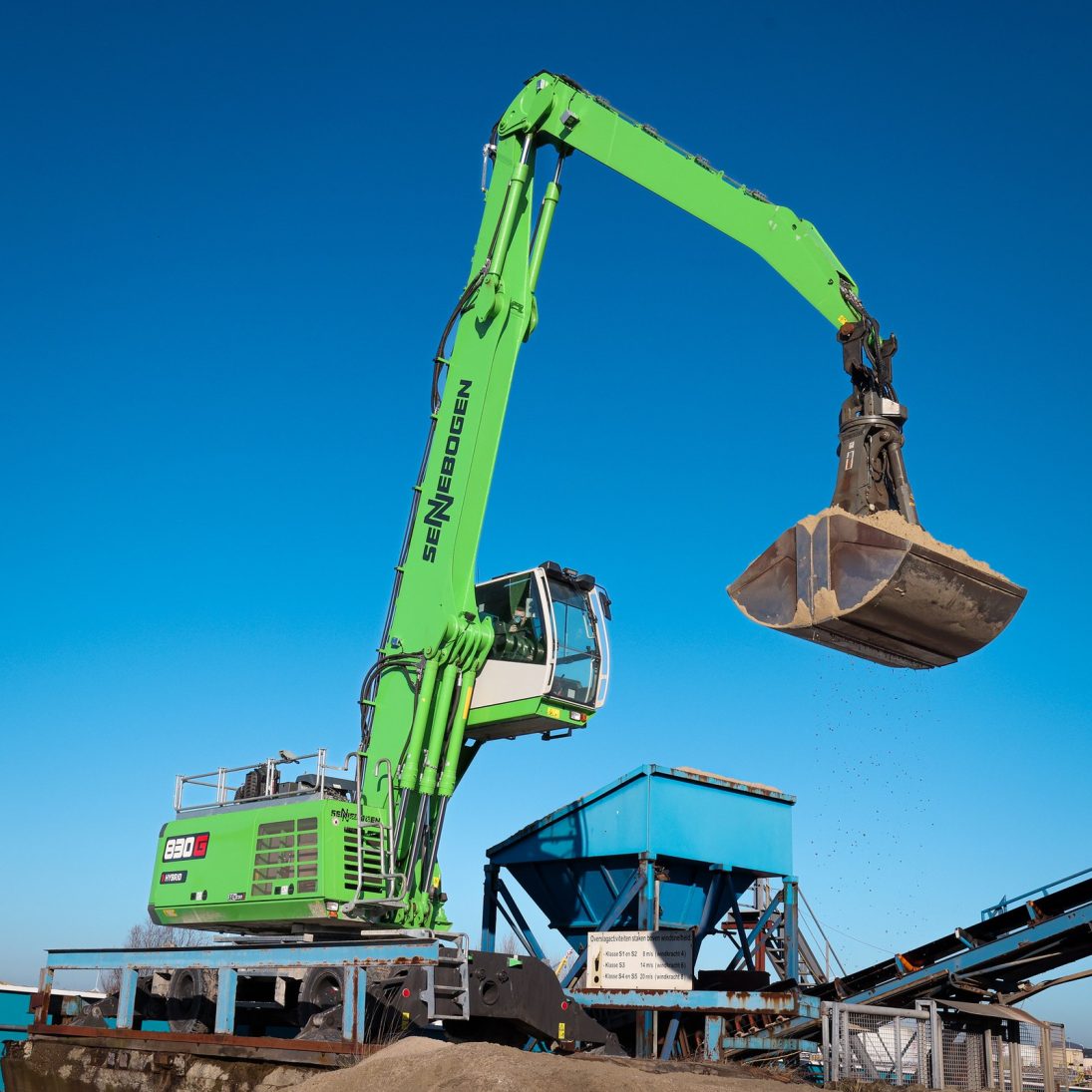
A third hybrid cylinder is what sold Verhoeks Overslag on the 830 G for barge discharge
Verhoeks Overslag discharges two or three inland vessels a week at the Port of Amsterdam. Its Sennebogen 830 G works with a 17-metre reach and a 17-second cycle, and it was the machine’s hybrid cylinder that decided the purchase.
Barge discharge on a tight clock
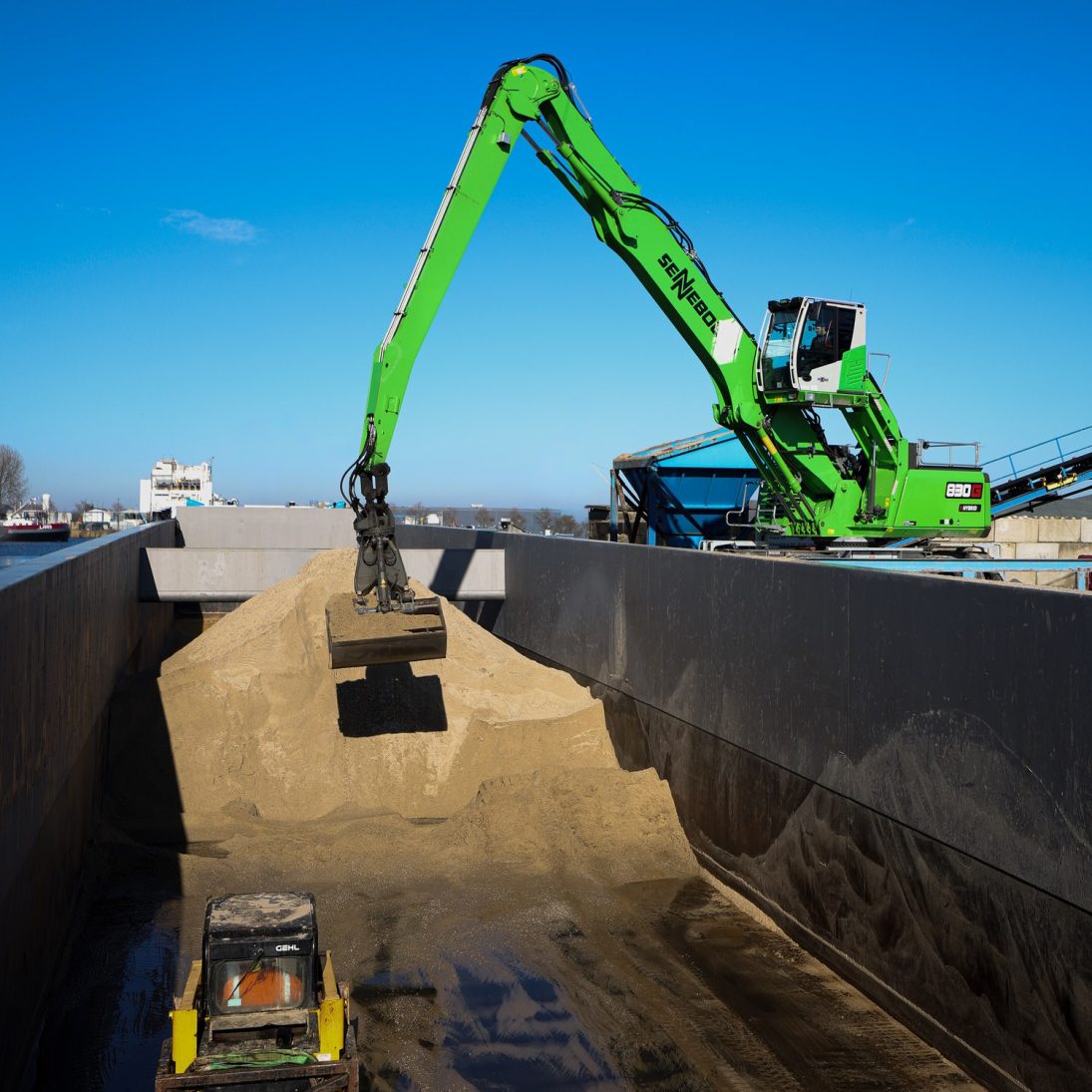
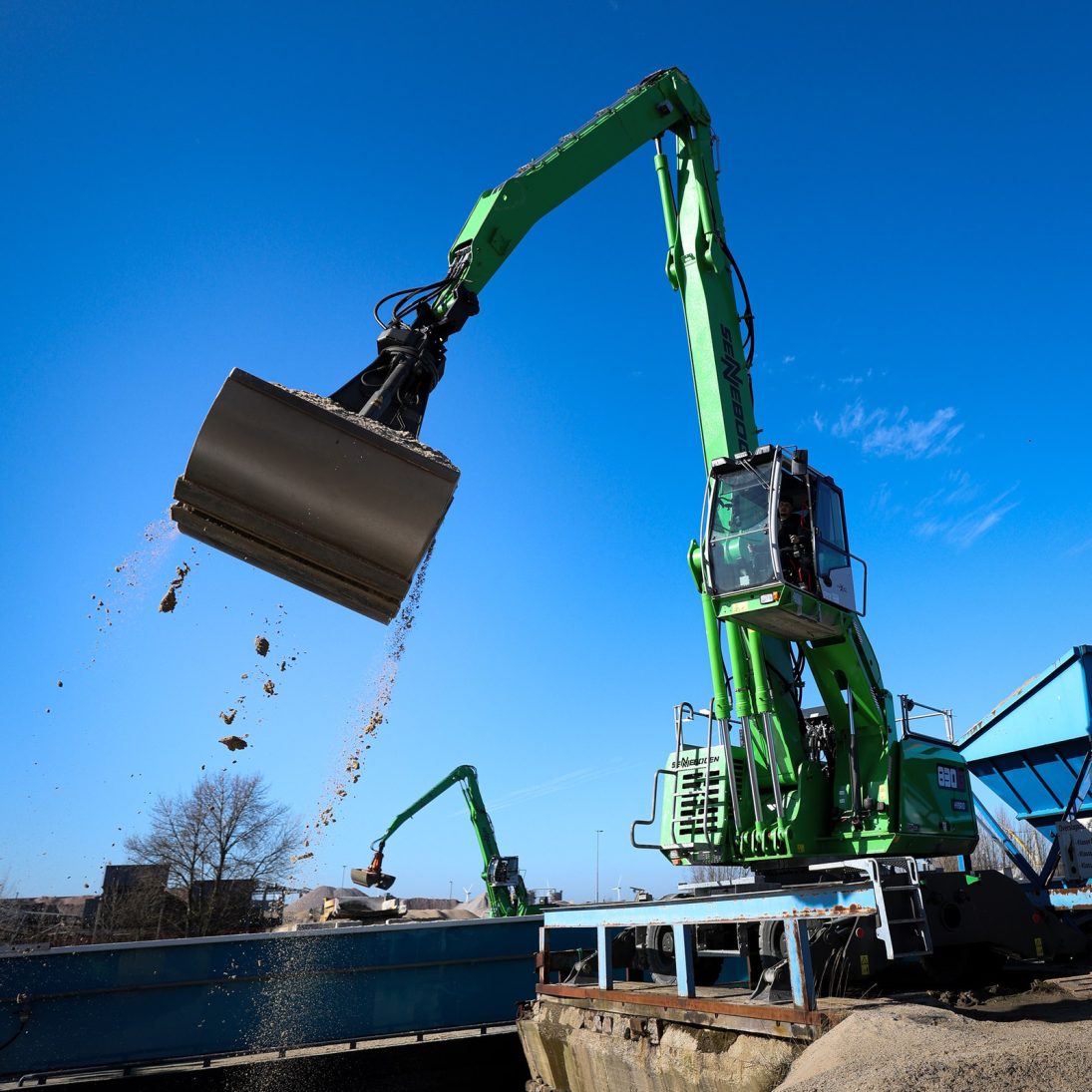
Verhoeks Overslag organises handling and transport for bulk and general cargo — sand, gravel and cellulose among them — at the Port of Amsterdam. Two or three ships have to be emptied every week, which leaves no room for a machine that slows down as the hold empties. The 830 G, a grab-equipped material handler rather than a hook-duty crane, works to a reach of 17 metres and a cycle time of about 17 seconds, which is what keeps the material flowing to lorries and stockpiles without gaps.
Discharging inland vessels is where reach and power have to work together. The boom must go deep into the hull to clean out the corners, and it has to do that with a full grab rather than trading payload for depth.
The third hybrid cylinder
The feature that settled the decision is a third hybrid cylinder. It stores energy as the boom comes down and gives it back as the boom is raised, so lifting capacity does not fall away at depth. Sennebogen’s Green Hybrid energy recovery system is new to this size class and is now offered as an option on the 830 G.
“We chose this machine because of the third hybrid cylinder. The system ensures that we can reach the ship’s floor with ease, even with a fully loaded bucket. We have additional lifting capacity when raising weights. This enables us to achieve a high handling capacity per hour.”
— André Verhoeks, owner, Verhoeks Overslag
The effect is most obvious in sand and gravel, which pack tightly in the hold and resist the grab.
Fuel and visibility
Verhoeks reports fuel consumption per tonne handled around 10 per cent below the company’s previous machines — a saving that compounds quickly on repetitive quayside work of this kind.
The cab was the other point of comparison. Steel struts have been taken out of the operator’s sightline and the front and side glazing enlarged, which matters when the grab is working out of sight below the coaming. The display can be repositioned so each operator can set his own viewing angle.
“The material handler is very comfortable. The cab is spacious and the visibility is really good. That’s important to us.”
— André Verhoeks, owner, Verhoeks Overslag
Verhoeks rates the overall package — machine, manufacturer service and dealer support — as the reason the 830 G fits into the port’s daily routine rather than any single specification figure.
Related Stories
Seven jobs that show the range of Liebherr Tower Crane Solutions
From a luffing jib crane above the Sagrada Familia to rail-mounted flat-tops at Santiago airport and more than…
Link-Belt RTC-80130 SII builds emergency-route bridge in California
A Shimmick crew used a 130 US ton Link-Belt RTC-80130 SII to build the new Mosquito Road bridge…
Four Liebherr LTC 1050-3.1s build THW’s 70-metre Danube bridge
Germany's THW used four Liebherr LTC 1050-3.1 compact cranes to pre-assemble a 70-metre temporary Danube crossing at Tuttlingen,…