

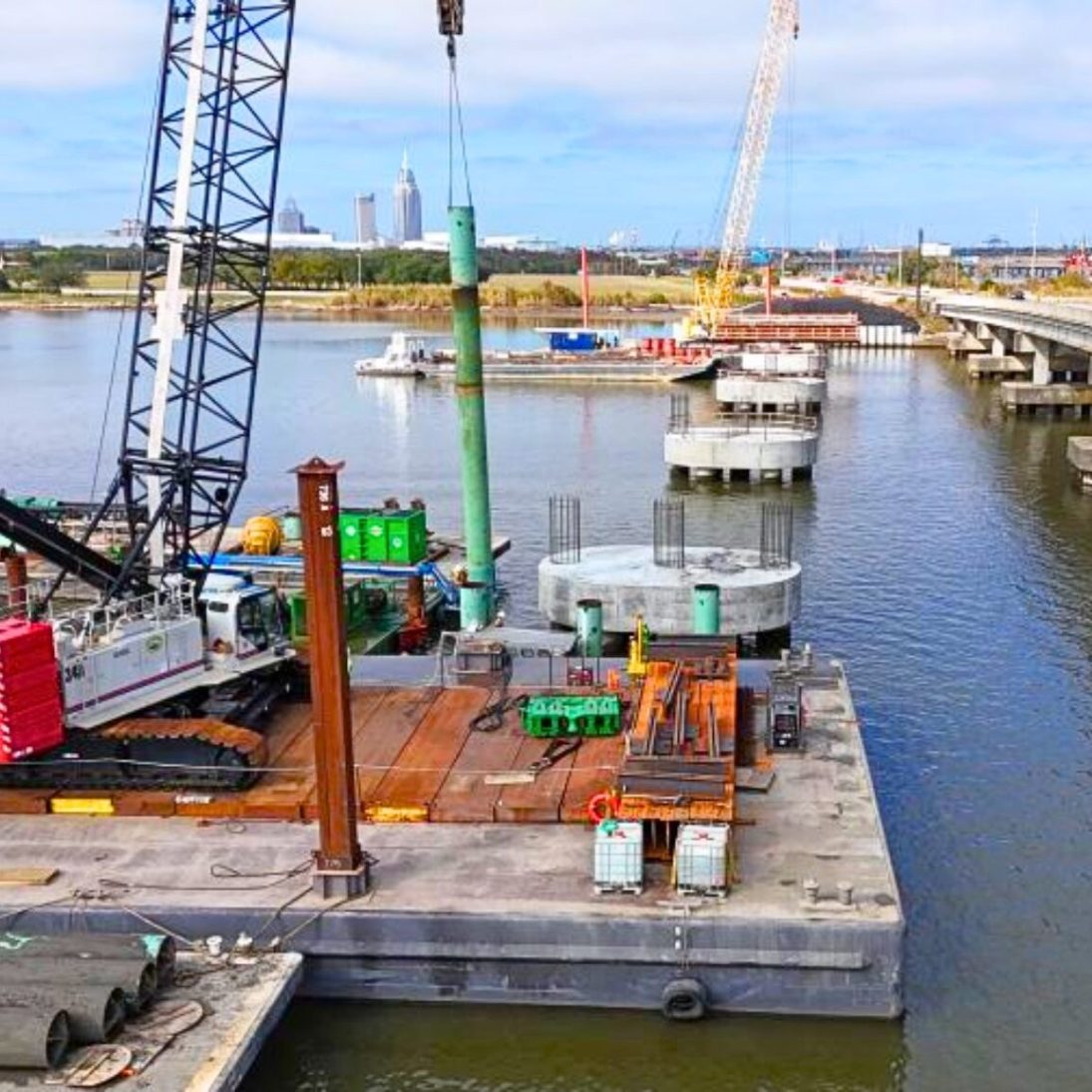
Barge-mounted crawler cranes rebuild Tensaw River Bridge in Alabama
Barge-mounted crawler cranes are at the heart of a US$79 million project to replace the westbound span of the Tensaw River Bridge near Mobile, Alabama, where contractor Scott Bridge has driven 54-inch concrete piles and completed all footings for the new crossing.
The Alabama Department of Transportation (ALDOT) is replacing the westbound span of the bridge, which has reached the end of its service life, on a key route across the U.S. 90 Causeway used by thousands of commuters, travellers and commercial vehicles every day. The new concrete structure is being built to the south of the existing eastbound bridge, allowing traffic to keep flowing throughout construction, and adds a dedicated pedestrian and cycle path serving Battleship Memorial Park.
“This bridge is a vital transportation link. Replacing it now ensures it continues serving the region safely and efficiently for decades to come.”
— Matthew Ericksen, southwest region engineer, ALDOT
Cranes on barges over the bay
General contractor Scott Bridge Co. Inc. of Opelika, Alabama, is running the job largely from the water. The project relies heavily on marine equipment, including barges and barge-mounted crawler cranes, alongside pile-driving rigs, wick drain installation machinery and utility-boring equipment. Jobsite photography released by the contractor shows a Link-Belt lattice-boom crawler crane working from a barge alongside the bridge piers.
The foundations required driving 54-inch spun-cast cylindrical concrete piles, and all bridge footings have now been completed, a milestone ALDOT says keeps the project on track. Crews are currently building the substructure and approach embankments, installing girders and progressing seawall work. Around 150,000 cubic yards of fill has been placed for the approaches, and more than one million feet of wick drains are being installed to stabilise the foundation soils.
“Working over water presents unique challenges, including marine logistics, changing weather conditions, environmental regulations, and specialized foundation construction.”
— Samuel Fountain, southwest region area construction engineer, ALDOT
Weather and environment set the pace
Fountain, speaking to trade publication Construction Equipment Guide, noted that weather, tides and tropical systems can all affect marine operations, forcing crews to adjust work activities while maintaining safety and productivity. Environmental measures run through the whole project, with specialised construction practices, training and monitoring in place to protect endangered species, aquatic habitats and submerged vegetation, coordinated with the U.S. Coast Guard, the Army Corps of Engineers, the Fish and Wildlife Service and the Federal Highway Administration.
Remaining work covers girder erection, the bridge deck, approach fills, seawalls, abutments and final paving. Construction began in December 2025 and completion is expected by mid-2028.
Project facts
- Project: Tensaw River Bridge westbound span replacement, U.S. 90 Causeway, Mobile, Alabama
- Value: US$79 million
- Client: Alabama Department of Transportation
- Contractor: Scott Bridge Co. Inc., Opelika, Alabama
- Foundations: 54-inch spun-cast cylindrical concrete piles
- Approach fill: approx. 150,000 cubic yards
- Wick drains: over 1 million feet
- Schedule: December 2025 – mid-2028
Related Stories
Seven jobs that show the range of Liebherr Tower Crane Solutions
From a luffing jib crane above the Sagrada Familia to rail-mounted flat-tops at Santiago airport and more than…
Link-Belt RTC-80130 SII builds emergency-route bridge in California
A Shimmick crew used a 130 US ton Link-Belt RTC-80130 SII to build the new Mosquito Road bridge…
Four Liebherr LTC 1050-3.1s build THW’s 70-metre Danube bridge
Germany's THW used four Liebherr LTC 1050-3.1 compact cranes to pre-assemble a 70-metre temporary Danube crossing at Tuttlingen,…