

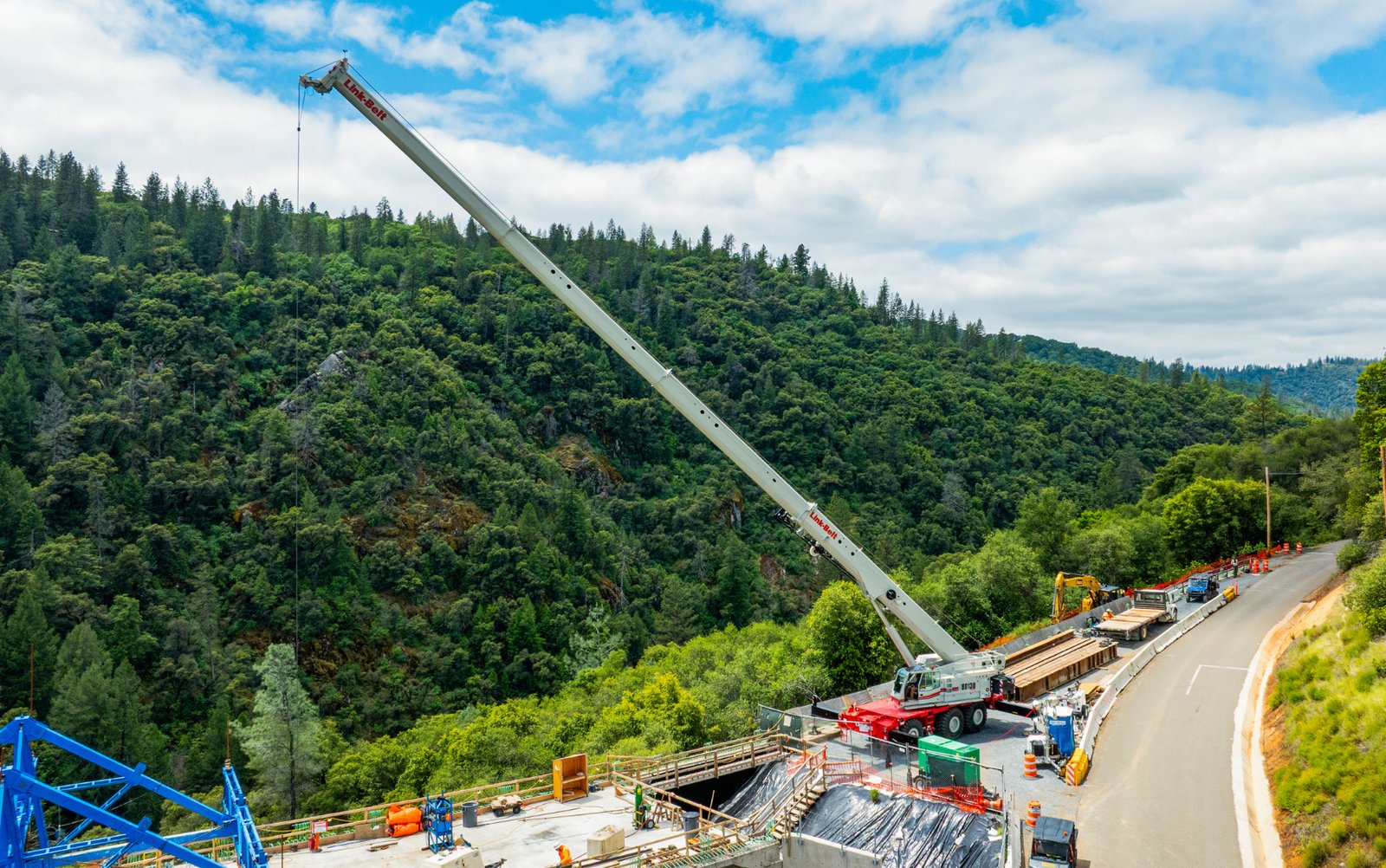
Four hours on forest tracks: Link-Belt RTC-80130 SII builds Mosquito Road bridge over the American River
Contractor Shimmick put a 130 US ton Link-Belt RTC-80130 SII rough terrain crane to work on the new Mosquito Road bridge near Placerville, California, placing 7,500 lb shoring beams at a 90 ft radius after a four-hour drive through the Eldorado National Forest.

The new crossing spans roughly 1,200 ft (365 m) over the south fork of the American River and replaces a timber bridge dating from 1939, which will be kept as a pedestrian crossing. Once open, the route will cut response times for emergency services heading into the surrounding forested areas of El Dorado County.
Reach decided the pick
Shimmick stationed the RTC-80130 SII on the structure’s north side, where the lift plan hinged on capacity at radius: the crane handled shoring beams of 7,500 lb (around 3.4 tonnes) at a 90 ft (27 m) radius.
“The reach of the RTC-80130 SII was perfect for the bridge’s north side.”
— Adam Almberg, construction manager, Shimmick
Getting there was a job in itself. The rough terrain crane travelled close to four hours through the Eldorado National Forest to reach the site, covering nearly five miles of dirt roads, switchbacks, steep grades and long descents under its own power. According to Almberg, most other cranes would have overheated on a similar approach.
“This crane handled nearly five miles of dirt roads and switchbacks on steep grades and long downhills. It did a great job traveling and handled better than most cranes.”
— Adam Almberg, construction manager, Shimmick
Batch plant tipped for removal
With the bridge deck complete, the crane’s work was not over. Shimmick roaded the RTC-80130 around 10 miles off-site to dismantle the temporary concrete batch plant that had supplied the deck surface and substructure pours. There the crane tipped the 78,000 lb (around 35 tonne) plant over for disassembly so it could be trucked away.
“There’s a lot of big pieces at the batch plant. Having the right machine for the job makes all the difference.”
— Adam Almberg, construction manager, Shimmick
Rough terrain credentials
The RTC-80130 SII sits at the top end of Link-Belt’s rough terrain range with a 130 US ton (118 tonne) rating, and the Mosquito Road job played to both halves of its name — long reach over the river gorge on one hand, and an off-road approach that would have stopped most wheeled cranes on the other.
Project facts
- Crane: Link-Belt RTC-80130 SII, 130 US ton (118 t) rough terrain
- Contractor: Shimmick
- Job: New Mosquito Road bridge, Placerville, California
- Span: approx. 1,200 ft (365 m) over the south fork of the American River
- Key lift: 7,500 lb shoring beams at 90 ft radius
- Approach: approx. five miles of forest dirt roads, four hours of travel
- Follow-up: tipping a 78,000 lb concrete batch plant for disassembly
Related Stories
Seven jobs that show the range of Liebherr Tower Crane Solutions
From a luffing jib crane above the Sagrada Familia to rail-mounted flat-tops at Santiago airport and more than…
Four Liebherr LTC 1050-3.1s build THW’s 70-metre Danube bridge
Germany's THW used four Liebherr LTC 1050-3.1 compact cranes to pre-assemble a 70-metre temporary Danube crossing at Tuttlingen,…
Three Liebherr flat-tops crown Milan’s Bovisa gasometer revamp
Liebherr 205 EC-B, 240 EC-B and 250 EC-B flat-top cranes are covering the entire Bovisa site in Milan,…