

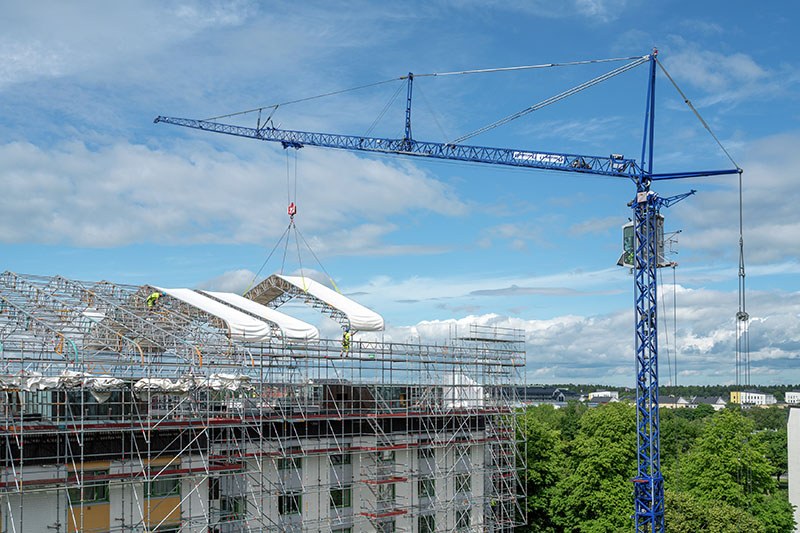
Roof-to-roof transfer: MK 88-4.1E relocates 20-metre canopy sections between Uppsala apartment blocks
Swedish contractor Pontáns Kranar used a Liebherr MK 88-4.1E mobile construction crane to move a large protective canopy from a freshly renovated six-storey building in Uppsala onto the neighbouring block — most of it lifted directly from roof to roof, with no intermediate storage.
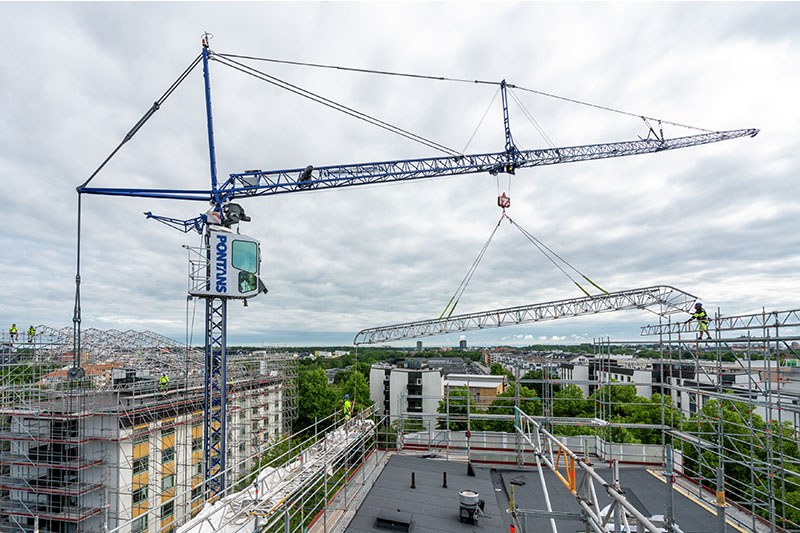
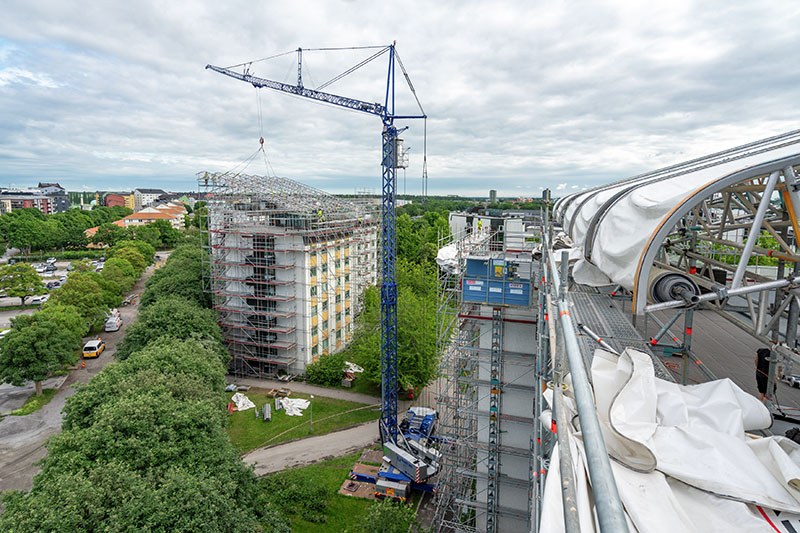
The canopy had done its job protecting the renovation work and now had to move on to the next building. That meant handling nearly 20 aluminium segments, some still covered with fabric, each up to 20 metres long and weighing around a tonne. Roughly half of them travelled straight from the old roof onto the prepared scaffolding of the target block.
“The direct transfer from one roof to the next saved us a lot of time,”
— Henri Haandrikman, crane operator, Pontáns Kranar
The remaining segments were set down briefly on the lawn, then picked up again once the crane had taken up its second position. By the evening the whole relocation was complete.
Where a conventional mobile crane could not go
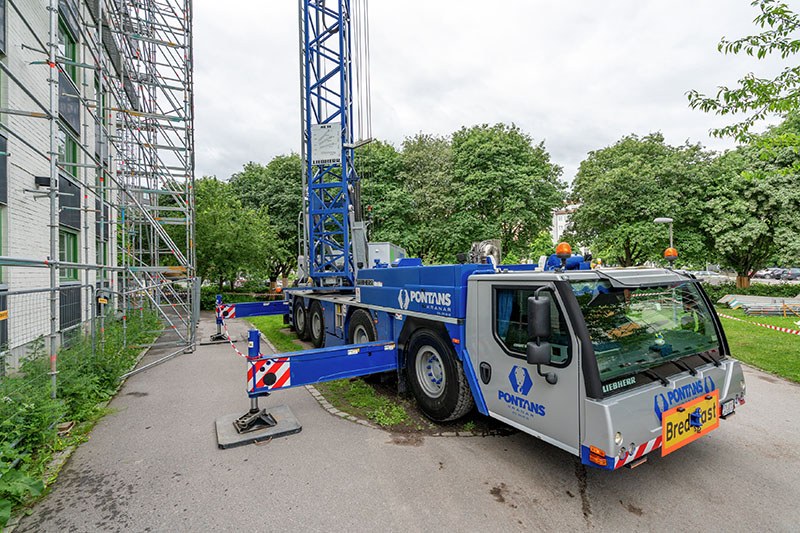
The choice of machine was settled before the first lift. Trees and other obstructions around the buildings left no realistic set-up position for a conventional mobile crane in the same load class, which would have had to stand on the road some distance away — and would have been a much larger crane as a result. The compact MK 88-4.1E instead parked directly beside the scaffolding of the renovated building and reached every segment from there.
The required hook height of around 30 metres was covered by luffing the jib to 15 degrees. “The 15-degree angle is simply perfect for this job,” said Haandrikman, who has more than 20 years’ experience on mobile and mobile construction cranes. “This jib position reduces the reach only minimally, but gives me an extra ten metres of lifting height at the end of the jib. And the continuously height-adjustable driver’s cab is particularly practical: for installation work like this, precise manoeuvring is no problem because I have a direct line of sight to the load and to the fitters on the roof.”
Electric mode and lighting for the Swedish winter
Alongside the variable ballast system, Haandrikman points to the crane’s electric mode, which keeps site operation quiet in a residential setting. The extensive lighting package earns its keep too. “We rely on it particularly during the long Swedish winter, and it allows us to significantly extend our operating hours,” he said.
The Uppsala job is typical of the machine’s working week. Haandrikman and the silver-blue MK are also regulars in Enköping and Stockholm, placing formwork, reinforcing steel and concrete buckets on concrete jobs, and working in steel construction and prefabricated timber housebuilding — anywhere long reach and fast repositioning matter more than sheer size.
Job facts
- Crane: Liebherr MK 88-4.1E mobile construction crane
- Operator: Pontáns Kranar, Sweden
- Location: Uppsala, between two six-storey residential blocks
- Load: nearly 20 aluminium canopy segments, up to 20 m long, around 1 tonne each
- Hook height: around 30 m, jib luffed to 15 degrees
Related Stories
Italy’s first Liebherr Fibre crane builds Val Trompia water plant
Facchetti Costruzioni has put a Liebherr 240 EC-B Fibre to work on the Bovegno drinking water treatment plant…
Pair of Unic URW-706 spider cranes float in to renew canal lock gates
With no road access to the lock, two Unic URW-706 mini spider cranes travelled to site by pontoon…
Zoomlion cranes lift solar and stadium projects in Africa
A ZTK45000 knuckle-boom truck crane is working on a South African solar-plus-storage site, while a Zoomlion crawler crane…