

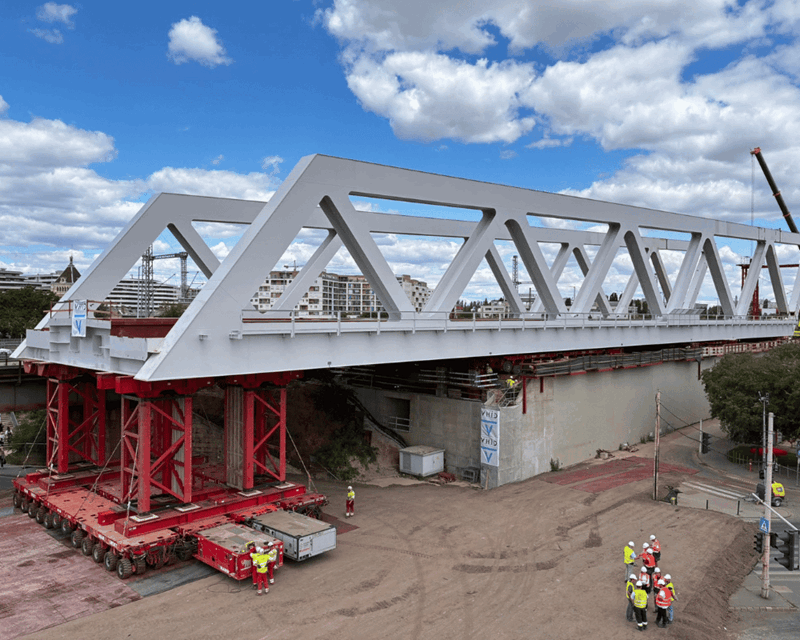
Self-propelled modular transporters fitted with purpose-built support masts let contractor V-HID launch a 2,200-tonne span across one of Budapest’s busiest streets without sinking a single pile into the road
Heavy lift and transport specialist Mammoet has helped Hungarian railway and bridge contractor V-HID install the first of two new spans that will form the Közvágóhíd railway bridge in Budapest, Hungary. Using a fleet of Self-Propelled Modular Transporters (SPMTs), the team launched the 2,200-tonne structure across Soroksári út — one of the city’s main arteries — and had the road open again before Monday’s rush hour.
A key route that couldn’t stay closed for long
The new bridge sits close to Budapest Park, in a heavily touristed part of the city, and forms part of the Ferencváros-Kelenföld railway line capacity expansion. Two identical spans are being built, each 108 metres long, 20 metres wide and weighing 2,200 tonnes; the southern span went in first, with its northern twin due roughly a year later. With Soroksári út carrying heavy traffic into central Budapest, a weeks-long closure was never going to be an option.
Support masts on SPMTs replace a piled skidding system
V-HID had previously launched bridges using skidding systems, a method that would have meant sinking 20-metre piles into the road to anchor temporary support towers, and closing the street to bring in the drilling rigs needed to install them. Having already seen Mammoet’s SPMT-based launches on other projects, V-HID asked whether a similar approach could work here; Mammoet’s answer was to mount support masts directly on SPMT units instead of building fixed towers.
The bridge sections were trucked in and assembled, coated and welded on site. Space became the main constraint: the bridge sections, the SPMT fleet and the support masts each needed their own staging area, and an old tram station on site had to be cleared to make room for the masts to be built.
Four sets of SPMTs carried out the launch, working at two different levels. Once the span had been driven forward far enough to cantilever off its abutment, the first SPMT set, each carrying four masts built from sections of Mammoet’s MSG crane system, with load spreaders beneath, moved in underneath. As the bridge inched further out, a 400-tonne mobile crane lowered additional SPMT lines from the upper level to the ground, where they picked up more masts and took their place under the span in turn. By the end of the sequence, three SPMT sets 4 x 12 axle lines each, 176 axle lines in total, carried the full length of the bridge between its two abutments.
Mammoet project manager Jordy van der Hoeven puts the result down to the team’s readiness to adapt its equipment to each job rather than the other way round: when the right tool isn’t already in the fleet, he says, Mammoet builds it.
Road reopens before Monday’s rush hour
The closure of Soroksári út ran from Friday morning and was lifted before Monday’s morning rush hour, a single weekend, instead of the weeks a piled skidding system would have needed. The second span, on the north side, is due about a year after the first, and with the new south span now in place, the team will have even less room to work with next time.
Facts
- Client: V-HID (Hungarian railway and bridge infrastructure contractor)
- Project: Ferencváros–Kelenföld railway line capacity expansion, Budapest, Hungary
- Bridge: two spans, 2,200t / 108m long / 20m wide each; south span first, north to follow about a year later
- Method: Mammoet SPMTs fitted with MSG-based support masts, replacing a piled skidding system
- Equipment: 4 SPMT sets, 176 axle lines in total; 400t mobile crane for reconfiguration
- Closure: Soroksári út, Friday morning to before Monday’s rush hour
Related Stories
Seven jobs that show the range of Liebherr Tower Crane Solutions
From a luffing jib crane above the Sagrada Familia to rail-mounted flat-tops at Santiago airport and more than…
Link-Belt RTC-80130 SII builds emergency-route bridge in California
A Shimmick crew used a 130 US ton Link-Belt RTC-80130 SII to build the new Mosquito Road bridge…
Four Liebherr LTC 1050-3.1s build THW’s 70-metre Danube bridge
Germany's THW used four Liebherr LTC 1050-3.1 compact cranes to pre-assemble a 70-metre temporary Danube crossing at Tuttlingen,…