

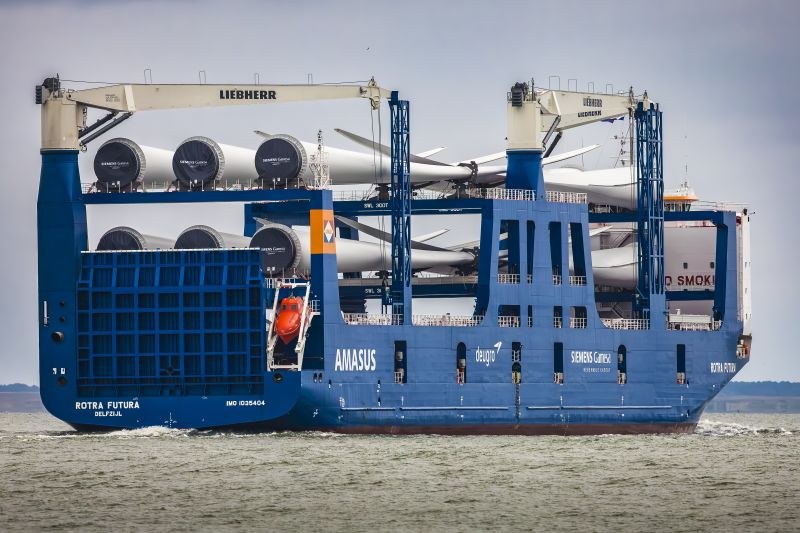
Blade logistics without a quay crane: Amasus finishes its Rotra fleet with six Liebherr LS-C 100s
With Rotra Horizon now in service alongside Rotra Futura, Dutch operator Amasus has completed a two-ship offshore wind fleet in which each vessel carries three Liebherr LS-C 100 ship cranes — enough to load and discharge turbine blades without any shore-side lifting gear.
Six cranes, no shore-side lifting
Amasus has finished commissioning the crane packages on Rotra Futura and Rotra Horizon, the two vessels it runs for offshore wind component transport. Each ship carries three Liebherr LS-C 100 ship cranes rated at up to 70 tonnes. The three-crane arrangement was chosen so that the vessels can handle triple-stacked turbine blades on their own rather than waiting for a quayside crane of the right capacity and reach to come free.
That independence is the point of the exercise. Blade sets move between a widening spread of ports in Europe and the United States, and port lifting capacity is not uniformly available. Carrying the cranes on board takes the terminal off the critical path and, Amasus argues, keeps the logistics chain running without interruption as the sector scales up.
Purpose-built hulls
The Rotra vessels were developed together with Concordia Damen and deugro Denmark, and combine roll-on/roll-off with lift-on/lift-off working. Rotra Horizon, the newer of the two, was built at Jiangsu Zhenjiang Shipyard and reached European waters in September carrying wind turbine tower sections. She measures 167.6 by 26 metres. Both ships were commissioned for Siemens Gamesa and will remain dedicated to that operation for the foreseeable future.
“Having both vessels equipped and in service means we can now offer uninterrupted blade transport across Europe and the USA.”
— Management, Amasus
Why the LS-C 100
Deck space is the scarce commodity on a blade carrier, and the LS-C 100 is built around that constraint: a small footprint, a high boom pivot point that keeps the operator’s sightlines clear over stacked cargo, and a structure laid out for maintenance access. Liebherr positions the series specifically for integration into specialised vessels of this kind, where the crane has to fit around the cargo rather than the other way round.
Liebherr’s maritime service organisation will support the cranes through the vessels’ operational life, from commissioning onwards — a practical consideration for ships that trade on both sides of the Atlantic and rarely sit still.
“Our long-standing partnership with Amasus is built on mutual trust and shared goals. Working together on this vessel concept has been a great example of how close cooperation leads to practical and forward-looking solutions.”
— Gregor Levold, General Manager Sales Offshore, Ship and Port Cranes, Liebherr Maritime Cranes
Crane and vessel facts
- Crane: Liebherr LS-C 100 ship crane
- Capacity: up to 70 t
- Installation: three cranes per vessel, two vessels
- Vessels: Rotra Futura, Rotra Horizon
- Rotra Horizon: 167.6 × 26 m, built at Jiangsu Zhenjiang Shipyard
- Design partners: Concordia Damen, deugro Denmark
- Dedicated to: Siemens Gamesa offshore wind operations
Related Stories
Gertzen retrofits Liebherr LR 1800-1.0 with X3 boom for 175 m hubs
Gertzen Kranlogistik has fitted its 800-tonne Liebherr LR 1800-1.0 crawler crane with the X3 boom system and erected…
UNIC puts the spotlight on its smallest spider crane, the URW-094
UNIC Cranes Europe has profiled the URW-094, the smallest machine in its spider crane range: a 595 mm…
Patriot Crane & Rigging takes first Tadano AC 5.250L-2
Nebraska taxi crane specialist Patriot Crane & Rigging has bought its first Tadano AC 5.250L-2 through dealer RTL…