

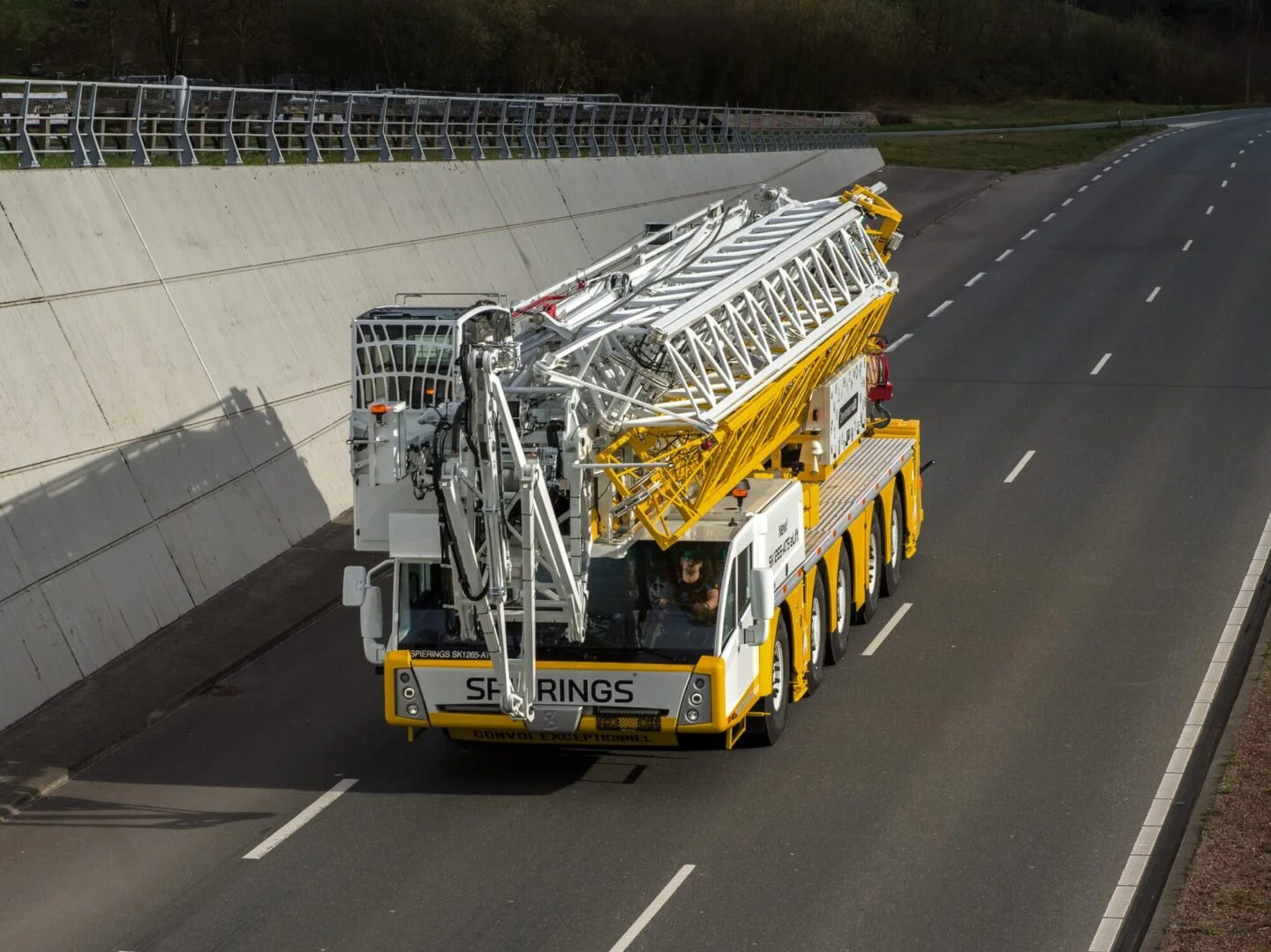
Why axle load and axle spacing increasingly decide where a mobile tower crane can be deployed
Transport regulation is quietly reshaping crane selection. Spierings argues that axle load and axle spacing, rather than gross vehicle weight alone, now determine whether a mobile tower crane travels freely or needs permits, prescribed routes and escorts.
The point where a move becomes ‘exceptional’
Almost every country sets a maximum permitted gross vehicle weight for ordinary road transport. Cross it and the move falls under special transport rules: permits, designated routes, restricted driving windows and, in many cases, escort vehicles. For a crane owner that means less freedom to redeploy and more exposure to planning risk.
Gross weight, however, is only the opening question. Regulators are at least as interested in how that weight is spread along the vehicle. A relatively light crane can still be restricted if too much load sits on a single axle, while a heavier machine may travel more easily because its mass is spread efficiently.
Axle load and axle spacing
Axle load is the weight carried by each individual axle, and limits in many countries sit somewhere around 10 to 12 tonnes. Those figures are tied directly to the load-bearing capacity of roads, bridges and other infrastructure. Exceed them and route options narrow — in some cases certain roads are ruled out altogether.
Spacing matters just as much. Regulations assess axles as groups, and where axles sit close together the permitted load per group typically falls. Spread them out and more weight can be carried within the same transport category. The consequence is that two cranes with broadly similar lifting specifications can have very different road access in practice. Spierings says the axle configuration of its five-axle SK1265-AT5 eLift was deliberately optimised on this basis, distributing total weight so the crane sits more comfortably within current transport rules.
Ballast adds to the burden
Transport planning does not end with the crane itself. On many machines the ballast has to travel separately, which means extra vehicle movements, extra permits and greater dependence on third parties within a project schedule. Combined with escort requirements and route restrictions, that turns what looks like a simple relocation into a logistical exercise.
A choice with a long tail
Regulation governing heavy transport is tightening in a number of countries, with weight, axle load and infrastructure condition all playing a larger role in assessments. Spierings frames crane buying as a long-term decision on that basis: a machine designed around efficient weight distribution today is more likely to remain deployable as rules harden.
Its own conclusion is configuration-specific. Where transport restrictions bite, the manufacturer points to a five-axle machine such as the SK1265-AT5 eLift for greater operational freedom; where those restrictions are less critical, the six-axle SK1265-AT6 eLift may be the better fit.
Transport at a glance
- Typical axle load limit: around 10–12 tonnes per axle
- Key variables: gross vehicle weight, axle load, axle spacing
- Five-axle option: Spierings SK1265-AT5 eLift
- Six-axle option: Spierings SK1265-AT6 eLift
- Exceptional transport triggers: permits, designated routes, driving-time limits, escort vehicles
- Additional factor: ballast often requires separate transport
Related Stories
Link-Belt Cranes singled out in Kentucky Manufacturing Month
The Kentucky Association of Manufacturers has highlighted Link-Belt Cranes and its Lexington factory as part of its October…
Zoomlion opens Brisbane branch with all-terrain crane orders
Zoomlion has inaugurated a Brisbane branch, with first orders signed at the opening covering 120-tonne all-terrain cranes and…
Hiab renews ProCare lifecycle services for its crane fleets
Hiab's next-generation ProCare portfolio combines service agreements with remote diagnostics and AI-driven monitoring for loader cranes, rolling out…