

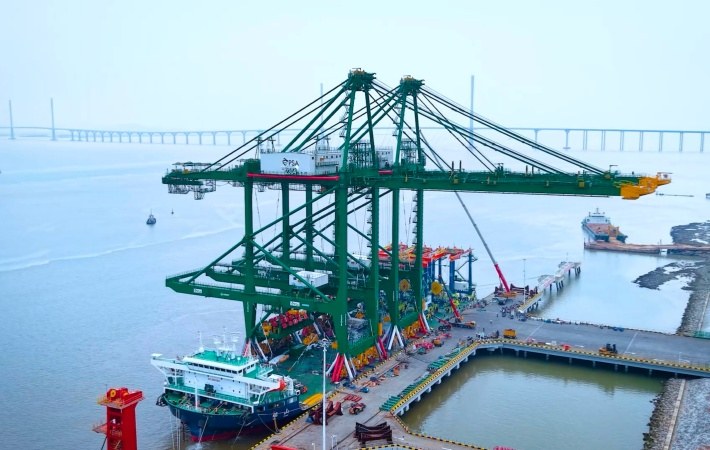
Seven automated dual-trolley ship-to-shore cranes ordered; the first two are at sea
SANY Marine has shipped the first two of seven automated dual-trolley ship-to-shore cranes ordered by PSA, machines with a 73-metre outreach and a 65-tonne spreader, alongside ten rubber-tyred gantry cranes for the same terminal.
First shipment away
The opening pair of cranes set sail on 27 May. They are the first units of a seven-crane order for automated dual-trolley ship-to-shore machines placed by PSA, and are being shipped fully assembled in the usual manner for quayside cranes of this size.
Working envelope
Each crane runs on a 35-metre rail gauge and carries a spreader rated at 65 tonnes. Front outreach is 73 metres with a 22-metre back reach, which puts the machines in the class able to serve the outer rows of the largest container vessels currently in service. Hoisting height is 55 metres above rail level, with a further 23 metres below. Trolley travel on the gantry measures 26.5 metres on the seaside and 26.7 metres on the landside.
Two trolleys and a perception network
Splitting the cycle is what makes dual-trolley machines worth their extra structural weight and cost. The main trolley works the ship side and hands containers to an intermediate platform; the gantry trolley then takes them down to the quay or to an automated stacking system. Because neither trolley has to complete the full travel, the two can overlap moves, and the operator or automation system is never waiting on a single long traverse.
The through-type structure allows the main trolley and the gantry trolley to work in coordination, splitting the ship-to-platform and platform-to-yard halves of the cycle between two machines rather than one. More than ten high-precision scanners and over 50 HD cameras build a three-dimensional perception network around the crane, which the control system uses for container positioning and handling. The same system calculates the shortest practical trolley path for each move.
Yard cranes and build capacity
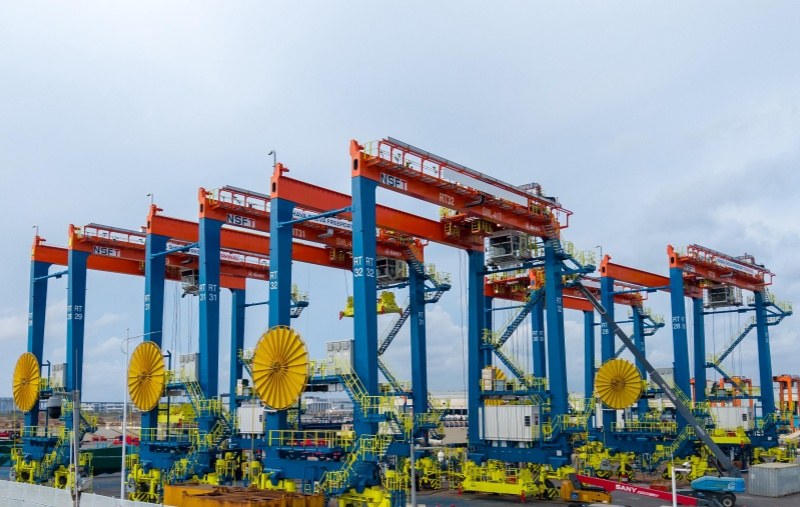
Ten rubber-tyred gantry cranes are being dispatched to the customer’s wharf at the same time. Those machines have a rated lifting capacity of 41 tonnes, a span of 23.37 metres and a lifting height of 18.2 metres.
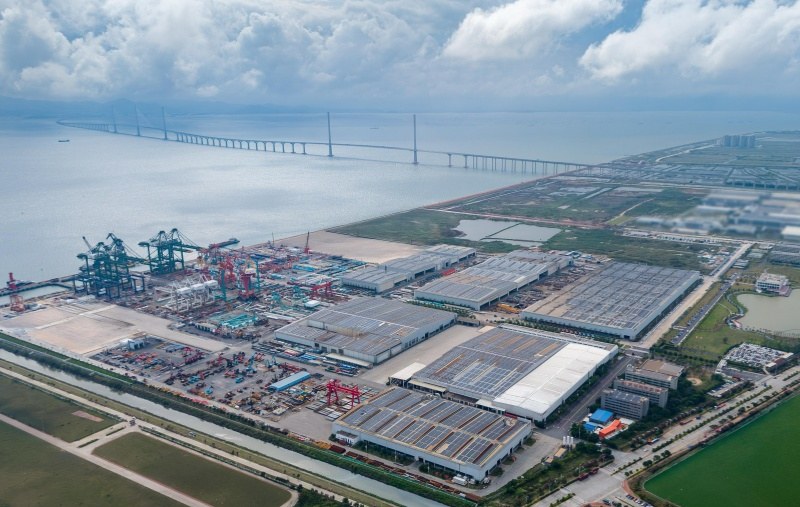
SANY Marine says its equipment assembly base now covers 500,000 square metres and can take 24 STS cranes and 40 RTGs through assembly and commissioning simultaneously — the kind of parallel capacity that determines how quickly a multi-crane terminal order can be filled.
STS crane specification
- Order: 7 dual-trolley automated STS cranes
- Spreader rating: 65 t
- Rail gauge: 35 m
- Front outreach: 73 m
- Back reach: 22 m
- Hoisting height: 55 m above rail, 23 m below
- Trolley travel: 26.5 m seaside / 26.7 m landside
- Also supplied: 10 RTGs, 41 t, 23.37 m span, 18.2 m lift height
Related Stories
Gertzen retrofits Liebherr LR 1800-1.0 with X3 boom for 175 m hubs
Gertzen Kranlogistik has fitted its 800-tonne Liebherr LR 1800-1.0 crawler crane with the X3 boom system and erected…
UNIC puts the spotlight on its smallest spider crane, the URW-094
UNIC Cranes Europe has profiled the URW-094, the smallest machine in its spider crane range: a 595 mm…
Patriot Crane & Rigging takes first Tadano AC 5.250L-2
Nebraska taxi crane specialist Patriot Crane & Rigging has bought its first Tadano AC 5.250L-2 through dealer RTL…