

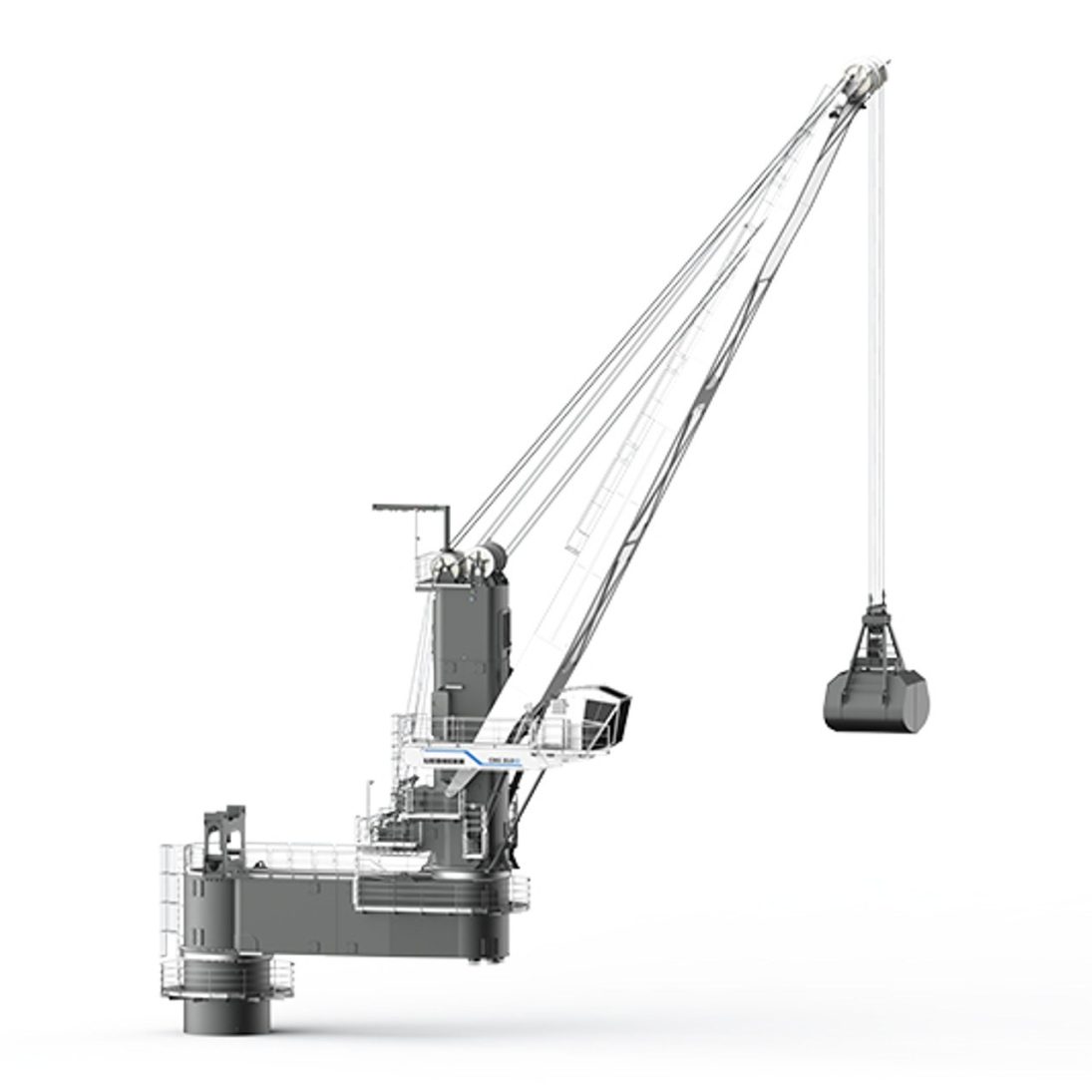
Rocktree becomes the first operator to run Liebherr’s new CBG 310 on eccentric arms
Liebherr Maritime Cranes has introduced the CBG 310 four-rope grab crane as the successor to the CBG 300, with a 44 per cent higher hoisting speed and 45 tonnes on the hook. Transshipment operator Rocktree is the launch customer.
Faster cycles for floating transshipment
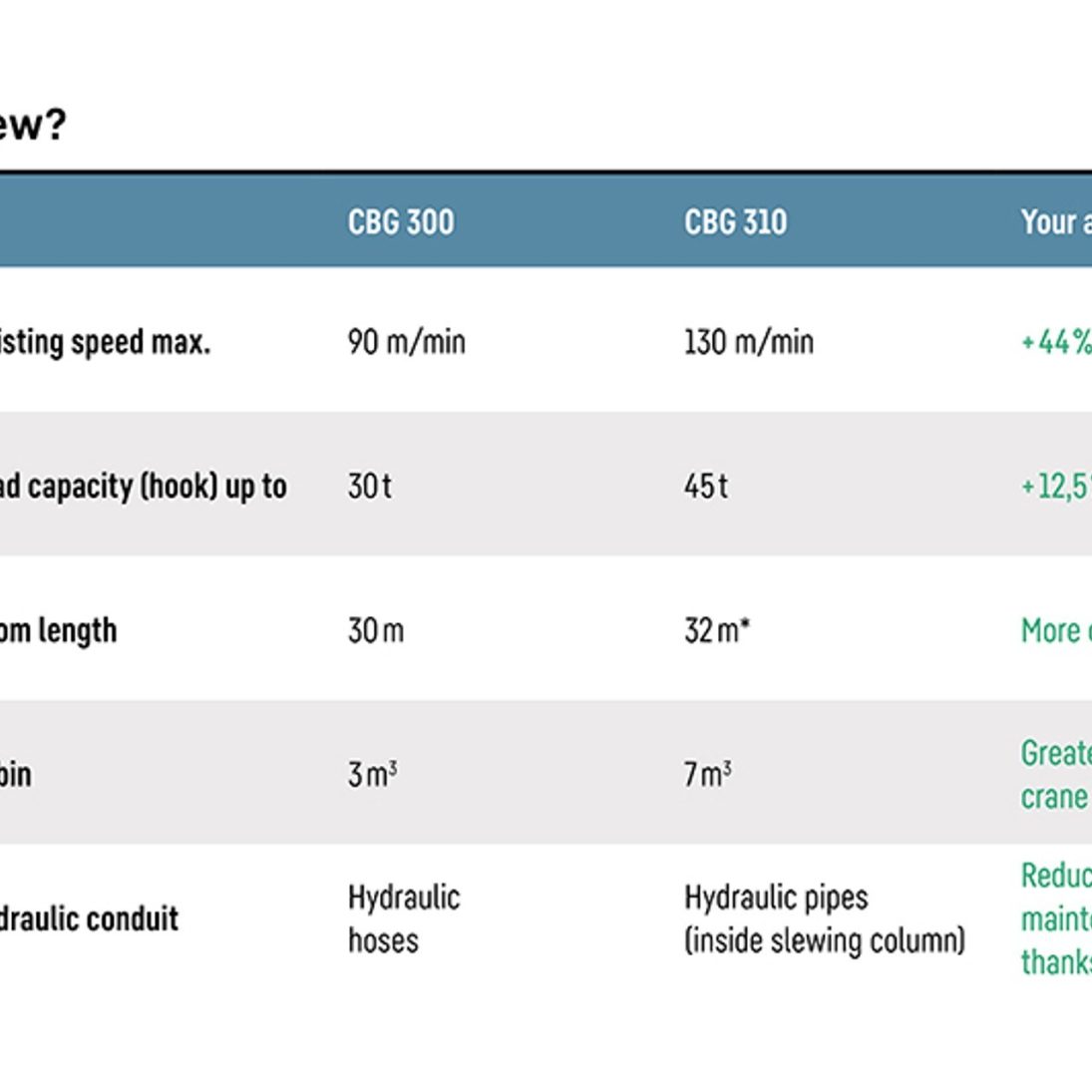
The headline change on Liebherr’s new CBG 310 is speed. Maximum hoisting speed rises to 130 metres per minute, which the manufacturer puts at 44 per cent above the outgoing CBG 300, shortening handling cycles and, with them, the time a bulk carrier spends alongside. Capacity on the hook goes up to 45 tonnes, against 30 tonnes on the earlier model.
Boom geometry has deliberately been left alone. The standard 30-metre boom is carried over so that floating installations need no re-engineering, while land-based sites can specify an outreach of up to 32 metres. In the cab, volume grows from three to seven cubic metres, which Liebherr links to better visibility and less fatigue over long shifts. On the maintenance side, the hydraulic hoses of the CBG 300 give way to piping integrated into the slewing column, reducing wear points and, Liebherr argues, lifecycle cost.
Two cranes replaced after eleven years
The first set goes to Rocktree, a floating terminal and logistics operator working in dry bulk transshipment, which decided to replace its two CBG 300 cranes after eleven years of continuous service. Because the vessel’s eccentric-arm configuration has been retained, the swap keeps a proven layout while raising throughput. Rocktree is the first operator anywhere to put CBG 310 cranes on eccentric arms.
“Moving to the CBG 310 allows us to build directly on our operational experience while achieving a clear improvement in handling speed and lifting capability.”
— Giovanni Colotto, Managing Director & Head of Fleet, Rocktree
Faster cycles combined with improved grab performance are expected to lift turnover rates and cut vessel idle time — the metric that decides whether a transshipment operation pays.
Litronic, SmartGrip and collision warning
Control sits with Liebherr’s Litronic system. SmartGrip adjusts grab behaviour automatically during the cycle to improve filling and limit spillage, while LiCAS, the Liebherr Collision Alert System, monitors distances to neighbouring Liebherr cranes and warns the operator when clearances close up — useful where several machines work the same hatch. Liebherr says the assistance runs in the background without adding to the operator’s workload.
“The CBG 310 is designed for operators who expect more from a proven concept. It delivers a clear step forward in capability while preserving the handling philosophy that crews know and trust.”
— Tim Ladendorf, Head of Sales Ship Cranes, Port and Transshipment Solutions, Liebherr-Rostock GmbH
Crane facts
- Model: Liebherr CBG 310 four-rope grab crane
- Replaces: CBG 300
- Max hoisting speed: 130 m/min (CBG 300: 90 m/min)
- Capacity on hook: up to 45 t (CBG 300: 30 t)
- Boom: 30 m standard; up to 32 m for land-based installations
- Cab volume: 7 m³ (CBG 300: 3 m³)
- Hydraulics: piping inside the slewing column instead of hoses
- Launch customer: Rocktree — two cranes, eccentric-arm mounting
- Built by: Liebherr-Rostock GmbH
Related Stories
Gertzen retrofits Liebherr LR 1800-1.0 with X3 boom for 175 m hubs
Gertzen Kranlogistik has fitted its 800-tonne Liebherr LR 1800-1.0 crawler crane with the X3 boom system and erected…
UNIC puts the spotlight on its smallest spider crane, the URW-094
UNIC Cranes Europe has profiled the URW-094, the smallest machine in its spider crane range: a 595 mm…
Patriot Crane & Rigging takes first Tadano AC 5.250L-2
Nebraska taxi crane specialist Patriot Crane & Rigging has bought its first Tadano AC 5.250L-2 through dealer RTL…