

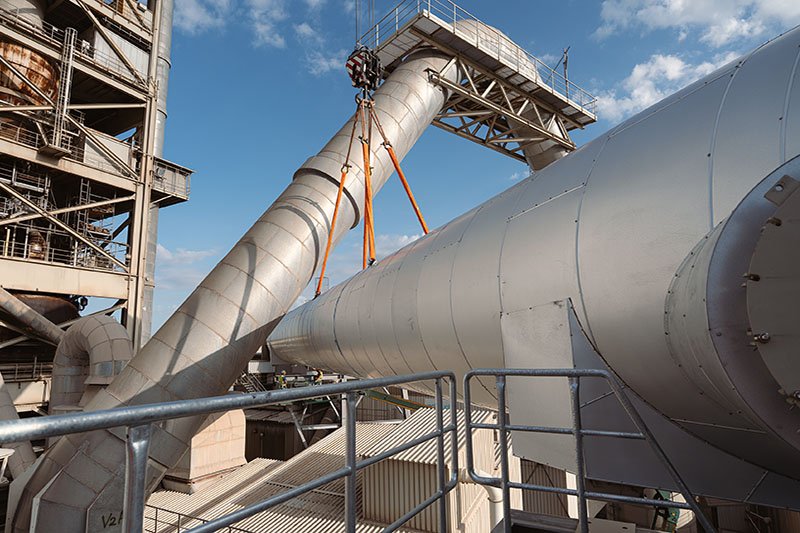
Pipe Mikado in Dotternhausen: LTM 1650-8.1 threads 33-tonne tubes between live pipework
A Liebherr LTM 1650-8.1 from heavy-lift specialist Wiesbauer has installed two 33-tonne flue gas pipes at the Holcim cement works in Dotternhausen, threading them beneath existing pipework with only centimetres to spare.
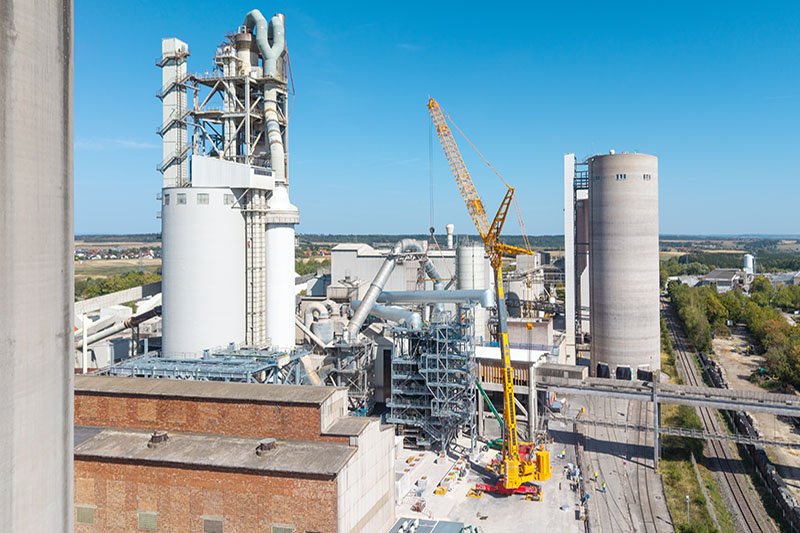
Holcim is building a new exhaust gas treatment plant at the Dotternhausen works under the name KAREm — short, in German, for ‘no exceptions for raw material-related emissions’. German law has until now allowed cement plants higher emission limits where the pollutants originate in the raw material itself; the new plant is designed so Holcim no longer needs that exemption.
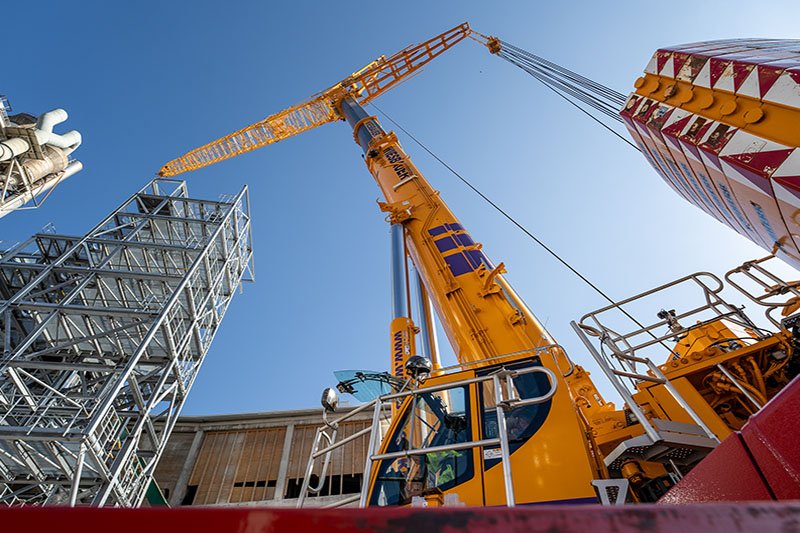
Instead of the thermal after-treatment common in the cement industry, which burns natural gas at around 850 °C, the Dotternhausen plant combines SCR (selective catalytic reduction) of nitrogen oxides with regenerative catalytic oxidation of volatile organic compounds and carbon monoxide. The catalytic route needs only around 300 °C — a temperature available on site as waste heat from the rotary kiln, so the system runs without external fuel. Around 2,000 tonnes of steel are going into the plant, with various Liebherr cranes of up to 400 tonnes capacity handling the steelwork and plant erection.
Centimetres of clearance at 30 metres
The most demanding job fell to Wiesbauer’s 700-tonne LTM 1650-8.1: two flue gas pipes, up to 38 metres long and two metres in diameter, had to be lifted into the plant structure between existing lines.
“The 700-tonne crane was configured with 155 tonnes of counterweight and a 42-metre luffing jib to lift the pipes, each weighing 33 tonnes, into the plant at a height of 30 metres with a 39-metre reach.”
— David Neher, project manager, Wiesbauer
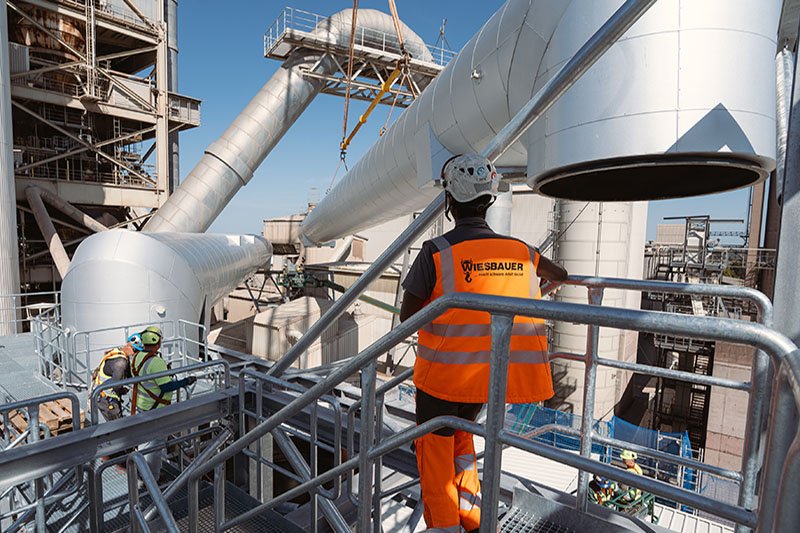
Each pipe first had to be threaded beneath an existing pipe bend, leaving only a few centimetres for the sling ropes. The second pipe then had to travel parallel to the first without touching it — all without the operator being able to see the installation point.
“Thanks to the precise LICCON control system and professional guidance from my colleague Jannik Weigle, however, it all went smoothly despite the wind.”
— Ralf Hoffmann, crane operator, Wiesbauer
Why such fat pipes?
The generous two-metre diameter is itself an efficiency measure: the thicker the pipe, the lower the flow resistance and the less power needed to pump flue gas through it, explains Holcim project manager Michael Obermailänder. The finished plant will cut cooling water demand and supply electricity and district heating to surrounding communities. “With the hoisting of the two pipes today, we have taken a major step towards our goals thanks to Liebherr’s technology and the Wiesbauer team,” Obermailänder summed up after the lift.
Wiesbauer, based in Bietigheim-Bissingen, runs around 100 mobile and crawler cranes up to the 1,000-tonne class alongside heavy haulage, industrial assembly and engineering services, with a fleet supplied predominantly by Liebherr.
Facts
- Crane: Liebherr LTM 1650-8.1 (700-tonne class)
- Configuration: 42 m luffing jib, 155 t counterweight
- Loads: two pipes, 33 t each, up to 38 m long, 2 m diameter
- Lift: 30 m height at 39 m radius
- Project: KAREm flue gas treatment plant, Holcim cement works, Dotternhausen
- Crane contractor: Wiesbauer GmbH & Co. KG, Bietigheim-Bissingen
Related Stories
Link-Belt 175|AT pair tandem-lifts 50-tonne bridge beams in Texas
Bulldog Crane and Rigging used two Link-Belt 175|AT all terrain cranes to tandem-lift sixteen 110,000 lb bridge beams…
Potain tower crane pair climbs record-setting Yangtze bridge
Two Potain MCT 560 M25 topless tower cranes are building the 253 m south tower of the Shituo…
Tadano PM 18 SP loader crane rides a PistenBully at Kronplatz
Ski resort operator Funivie di Valdaora services its tower-mounted snow cannons with a Tadano PM 18 SP knuckle…