

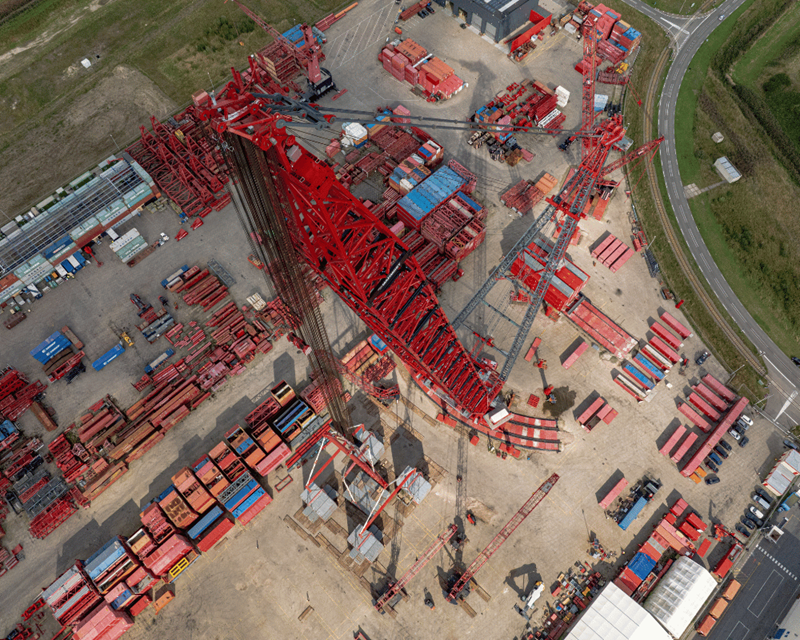
Three months of functional, structural and stability trials at Mammoet’s Westdorpe facility confirm the load charts of the 6,000 tonne class crane, clearing the way for its first project in 2025
Mammoet has finished testing its SK6000, the highest capacity land based crane in the world, with the entire process supervised by maritime classification society Lloyd’s Register. The certification confirms the crane operates safely across the full range of its specification, following three months of trials at Mammoet’s facility in Westdorpe, the Netherlands.
From functional checks to full overload
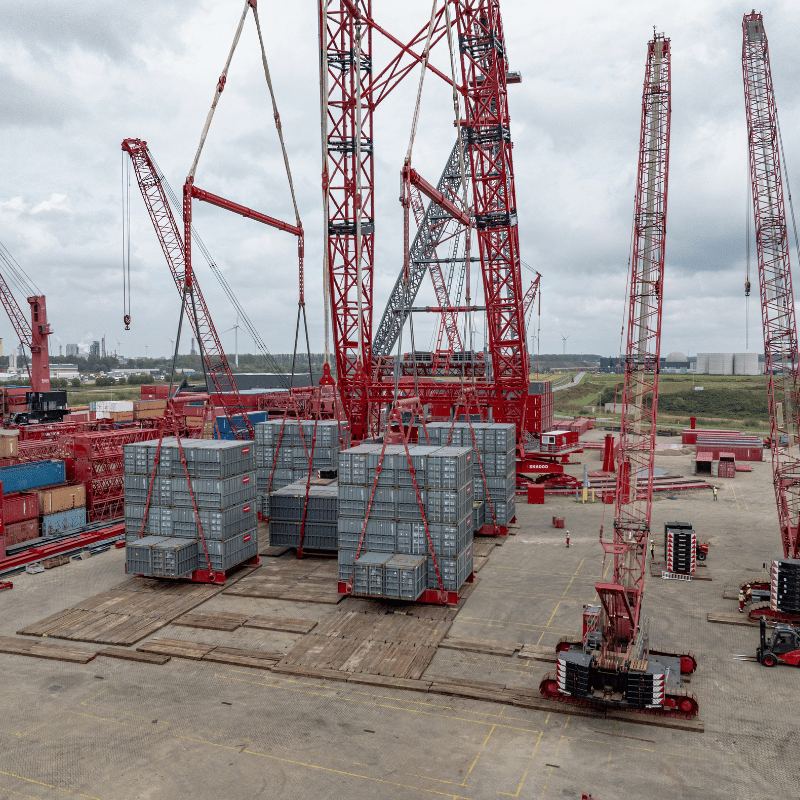
Lloyd’s Register’s involvement began earlier in the SK6000’s development, when it reviewed the crane’s engineering design and confirmed that the planned test programme would be enough to validate its capacity charts. Once underway at Westdorpe, testing opened with a full functional check, confirming the crane performed to specification and met the highest safety standards.
The programme then moved into structural and stability trials, putting the SK6000 through a series of different lift weights and configurations. Every component proved able to handle loads of up to 125% of its rated capacity, with the trials spanning the full extent of the crane’s load charts across all main mast lengths, from the shortest at 127 metres to the longest at 171 metres.
A new benchmark for land based lifting
The toughest test pushed the SK6000 to a maximum load moment of 520,000 tonne metres, more than one and a half times the rated load moment of the SK350, Mammoet’s previous record holder for the world’s strongest land based crane. Should projects eventually call for lifts beyond the SK6000’s current 171 metre reach, an optional jib can extend its capability to 3,000 tonnes at 220 metres.
Built for large scale energy projects
Mammoet designed the SK6000 to help customers across the energy sector build at a larger scale, using modularized construction methods that let assembly work run in parallel and improve overall efficiency. In offshore wind, where components keep growing to capture stronger wind flows, the crane is meant to keep today’s planned wind farms buildable as turbine sizes increase.
In the nuclear sector, its capacity allows larger components to be assembled off site in controlled conditions and installed quickly, cutting construction time on site and improving safety. For oil and gas customers, the combination of high capacity and long outreach is intended to let maintenance and upgrade projects go ahead with less disruption, while new build projects can capture economies of scale all the way from FEED (front end engineering design) through installation and beyond.
With testing complete, the SK6000 will now be boomed down and containerized ahead of shipment to its first project, due to start in early 2025.
Facts
- Crane: SK6000, Mammoet’s highest capacity land based crane
- Test oversight: Lloyd’s Register (maritime classification society)
- Test location: Mammoet’s facility in Westdorpe, the Netherlands
- Test duration: three months
- Overload margin proven: up to 125% of rated capacity
- Mast lengths tested: 127m (shortest) to 171m (longest)
- Peak load moment tested: 520,000 tonne metres, versus the SK350’s benchmark as the previous strongest land based crane
- Extended reach option: jib for 3,000t lifts to 220m
- First project: early 2025
Related Stories
Gertzen retrofits Liebherr LR 1800-1.0 with X3 boom for 175 m hubs
Gertzen Kranlogistik has fitted its 800-tonne Liebherr LR 1800-1.0 crawler crane with the X3 boom system and erected…
UNIC puts the spotlight on its smallest spider crane, the URW-094
UNIC Cranes Europe has profiled the URW-094, the smallest machine in its spider crane range: a 595 mm…
Patriot Crane & Rigging takes first Tadano AC 5.250L-2
Nebraska taxi crane specialist Patriot Crane & Rigging has bought its first Tadano AC 5.250L-2 through dealer RTL…