

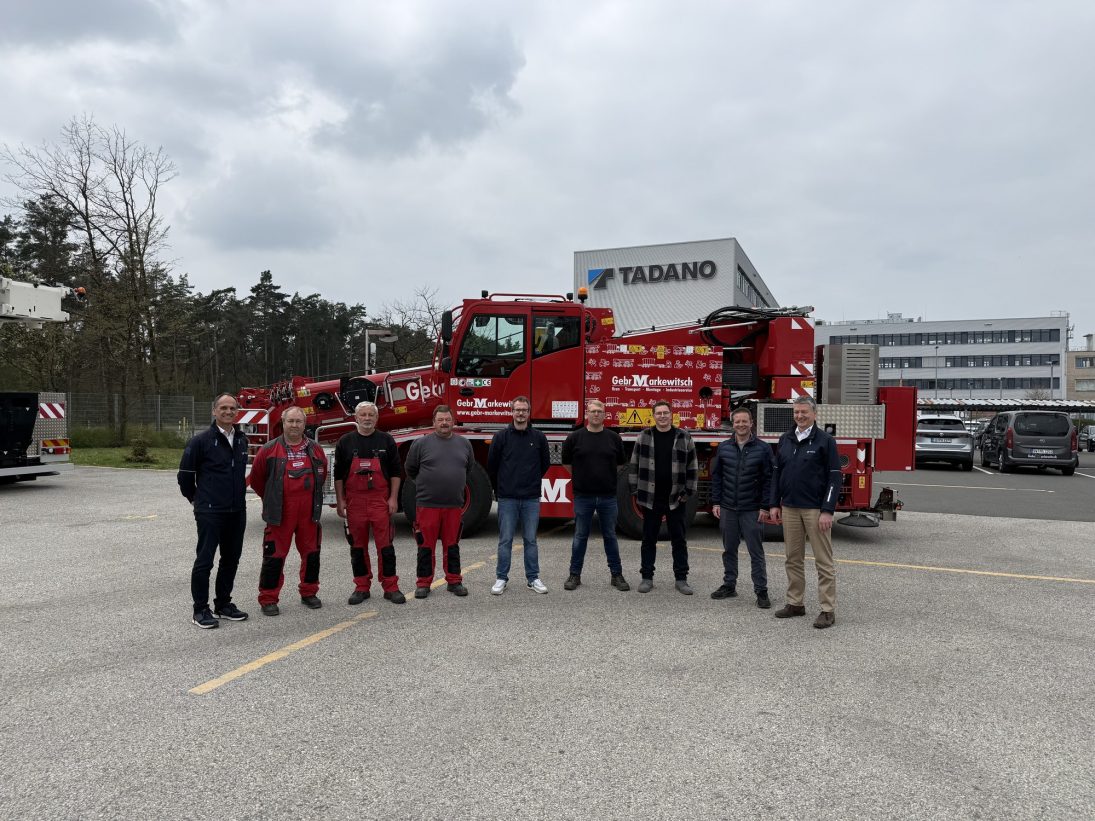
Nuremberg’s Markewitsch buys an AC 3.045-1 City — and orders it e-Pack ready
Markewitsch has taken delivery of a Tadano AC 3.045-1 City for its Schweinfurt depot, the fourth City crane in a fleet of around 20 Tadano machines and the third generation of a model the company first bought in 2002.
Two decades of City cranes
Markewitsch bought its first AC 60 City in 2002, and managing director André Markewitsch argues that a good deal of the company’s assembly work would simply not be feasible without the type. The new AC 3.045-1 City was handed over at Tadano’s Lauf plant by sales manager Hans Asam and DACH head of sales Frank Brachtendorf, and goes to the firm’s Sennfeld/Schweinfurt operation.
“With the City Cranes, we’re not only extremely flexible indoors, but also in general, especially when it comes to navigating tight entrances, maneuvering into corners, or when a compact slewing radius is crucial – in short: wherever space is limited, the City is simply unbeatable.”
— André Markewitsch, Managing Director, Markewitsch
What sold this generation
Beyond the compact envelope, Markewitsch points to the crane’s telescoping capacity under load, its capacity radar, and the Flex Base outrigger system, which extends steplessly and asymmetrically — the feature that decides whether a City crane can be set up at all in a cramped yard or plant aisle. He also rates the heavy-duty jib, which lifts up to 25 tonnes; his crews frequently work it with a spreader and no hook block. Markewitsch also notes that the term City crane has since been adopted across the industry for this class of machine, which he takes as confirmation that the original concept was sound.
e-Pack preparation for sensitive sites
The crane was ordered with e-Pack preparation, allowing electric operation on sites where a diesel engine is unwelcome — cleanroom production areas, for example, or locations with noise limits. It also removes practical obstacles: hall doors do not have to be held open and fire protection systems do not have to be switched off while the crane works.
That matters because of where the machine will earn its keep. Around half of Markewitsch’s revenue comes from assembly services, and the City cranes sit at the centre of that business: lifting machinery inside halls, erecting overhead cranes, moving plant and relocating factories.
Asam described the repeat order as a measure of a long relationship: “Markewitsch’s long-standing loyalty is anything but a given for us. It’s an expression of a trusting and collaborative partnership that we’ve built together over many years.”
Related Stories
Gertzen retrofits Liebherr LR 1800-1.0 with X3 boom for 175 m hubs
Gertzen Kranlogistik has fitted its 800-tonne Liebherr LR 1800-1.0 crawler crane with the X3 boom system and erected…
UNIC puts the spotlight on its smallest spider crane, the URW-094
UNIC Cranes Europe has profiled the URW-094, the smallest machine in its spider crane range: a 595 mm…
Patriot Crane & Rigging takes first Tadano AC 5.250L-2
Nebraska taxi crane specialist Patriot Crane & Rigging has bought its first Tadano AC 5.250L-2 through dealer RTL…