

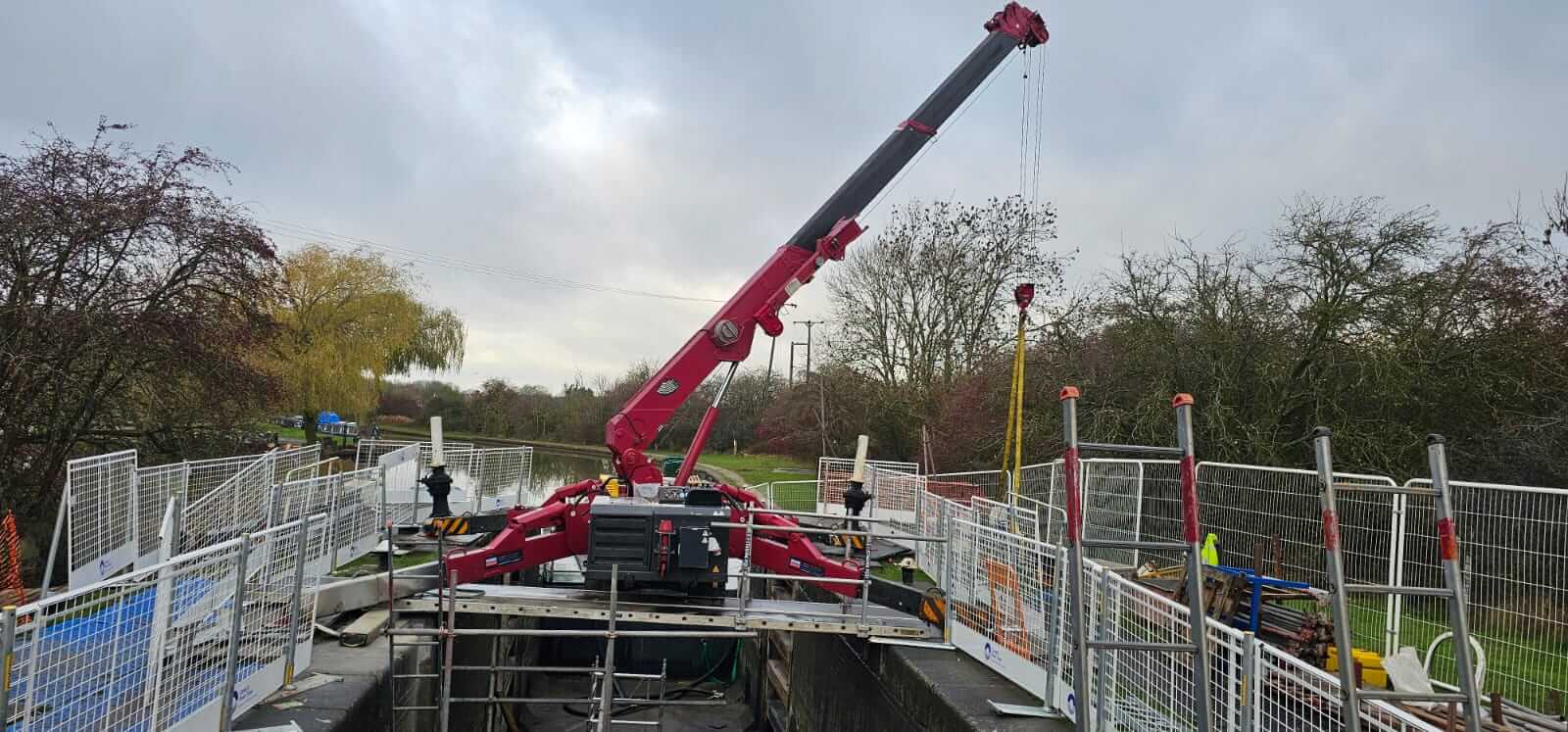
Two Unic URW-706 spider cranes arrive by water to replace lock gates on a British canal
Two Unic URW-706 mini spider cranes have replaced the gates of a canal lock for the Canal & River Trust in the United Kingdom, travelling to the site by pontoon after restricted access ruled out conventional lifting equipment.
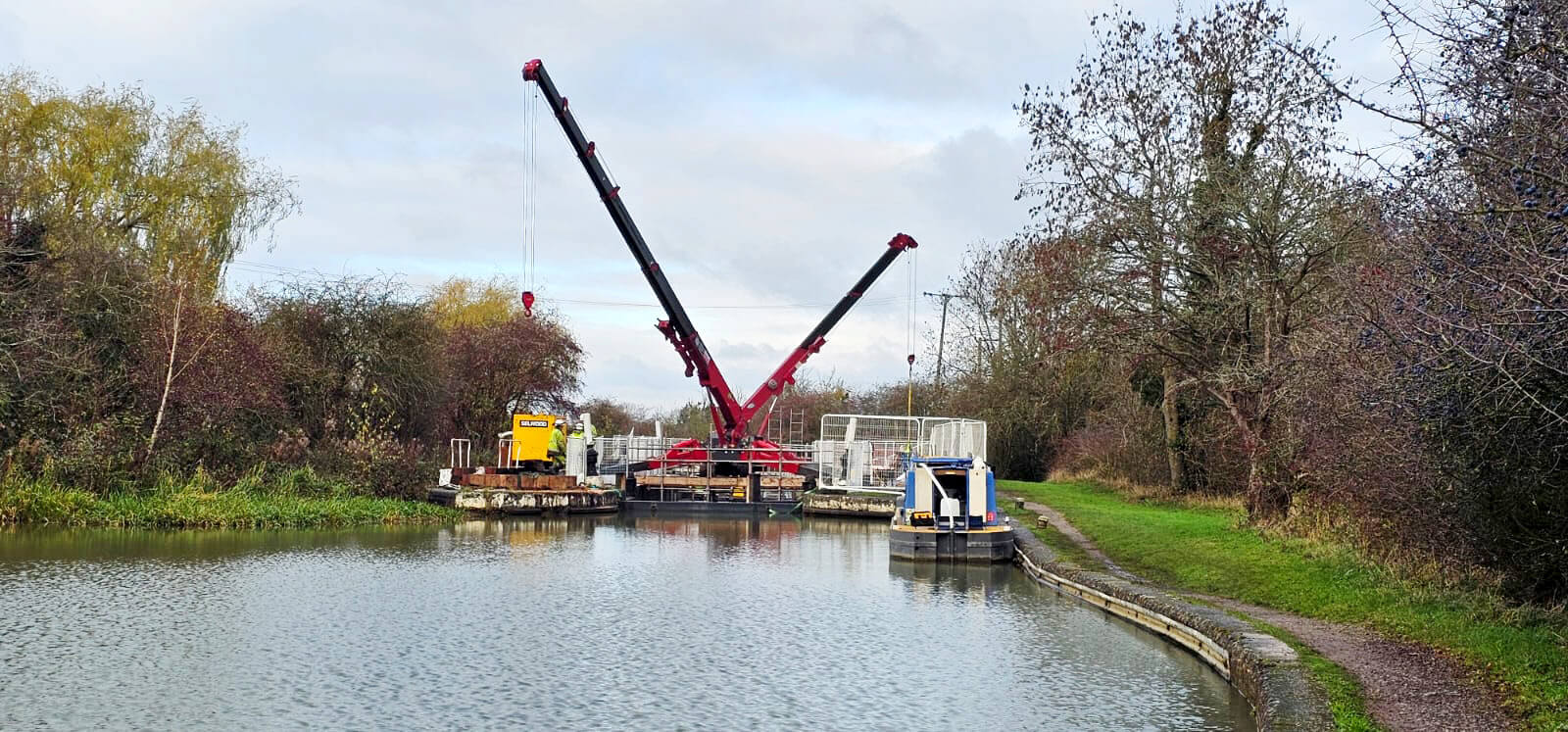
Floated in on pontoons
The lock could not be reached directly by road, so both URW-706 cranes were taken off their transport at the nearest access point, transferred onto pontoons and sailed along the canal to the work site. One crane was then set up at each end of the lock, giving the lifting team the reach and flexibility to handle components at both gate positions within the confined site.
The chamber itself measured roughly 4.7 m across and 5 m deep, which called for a carefully planned set-up. Each spider crane extended its outriggers onto the stonework on either side, straddling the chamber before it was drained. Sleepers and one-metre outrigger mats were placed under the legs to spread the load, and the URW-706’s variable outrigger geometry allowed each machine to be configured around the restricted, uneven working area.
Gates lifted out and lowered onto a pontoon
The heaviest components came out first: 800 kg balance beams, a 2,500 kg top gate and a 3,000 kg bottom gate measuring about 4.65 m in length. Slings and chains were attached while the old fixings were released, after which each gate was lifted clear of the chamber and lowered onto a pontoon waiting below. The new components were then lifted into the lock and landed accurately, ready for installation.
One crane working at a time
Lifting beside open water, from pontoons and with two cranes arranged around a narrow chamber demanded tight coordination between the lift supervisor and the operators. To keep the working area under control only one URW-706 was operated at any moment; the idle crane lowered its boom to create clearance and keep it out of the way of the live lift.
Once the replacement gates were in, both cranes were transferred back onto the pontoons, sailed back along the canal to the original access point and reloaded onto road transport. For Unic, the job shows what its larger spider cranes can do on waterside infrastructure where limited access, confined footprints or poor ground rule out conventional mobile cranes.
Related Stories
Seven jobs that show the range of Liebherr Tower Crane Solutions
From a luffing jib crane above the Sagrada Familia to rail-mounted flat-tops at Santiago airport and more than…
Link-Belt RTC-80130 SII builds emergency-route bridge in California
A Shimmick crew used a 130 US ton Link-Belt RTC-80130 SII to build the new Mosquito Road bridge…
Four Liebherr LTC 1050-3.1s build THW’s 70-metre Danube bridge
Germany's THW used four Liebherr LTC 1050-3.1 compact cranes to pre-assemble a 70-metre temporary Danube crossing at Tuttlingen,…