

Seven Liebherr tower cranes rebuild Ulm’s B10 bridge over live railway lines
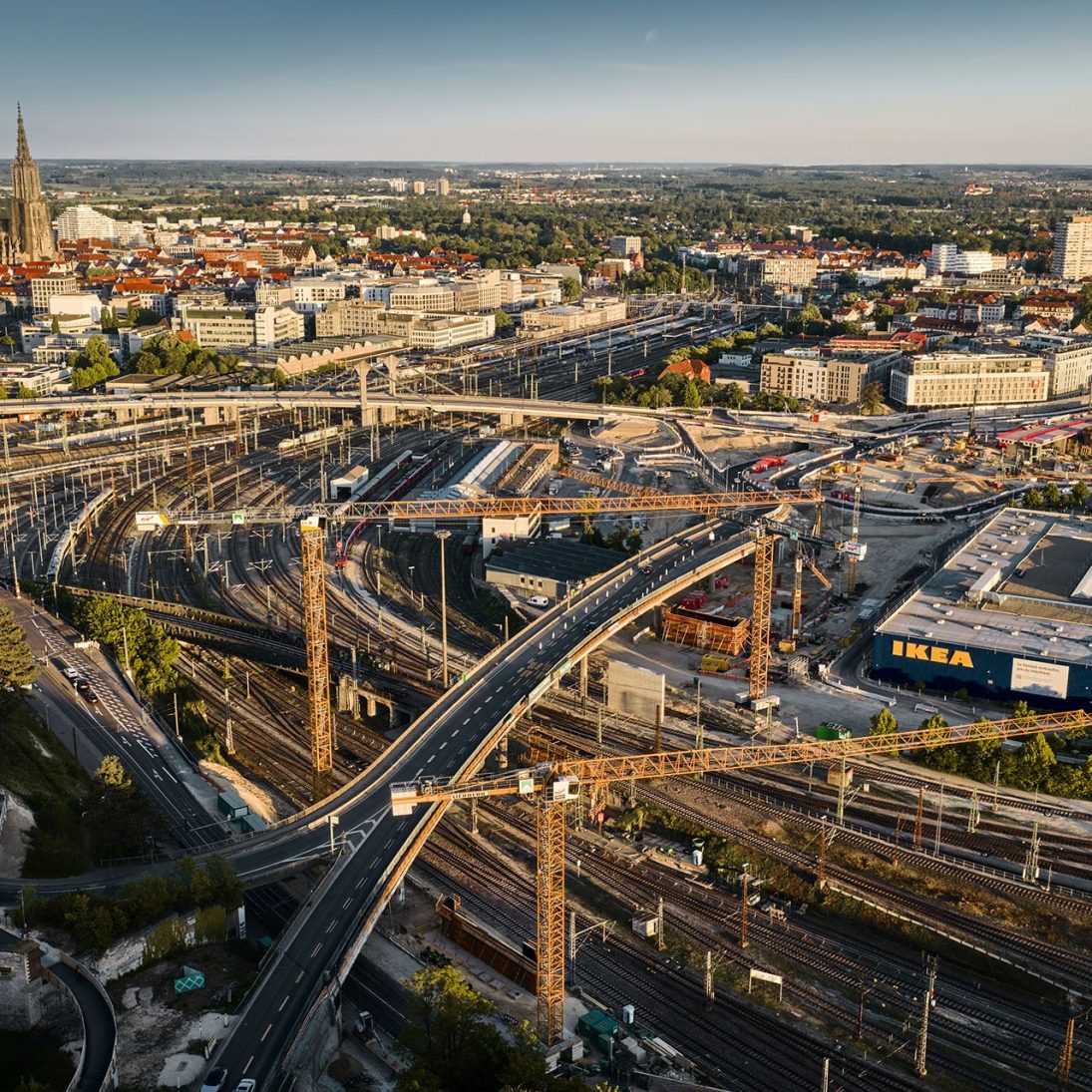
Seven Liebherr tower cranes are working between live railway tracks and one of Ulm’s busiest roads, where the ARGE B10 consortium is replacing the 1960s Wallstrassenbruecke with a new 187-metre bridge due to open fully in 2029.
A crane concept squeezed between rail and road
The Wallstrassenbruecke carries the B10 federal highway over Kienlesbergstrasse and the adjoining railway lines in Ulm, Germany. Built between 1967 and 1969, the structure has reached the end of its life and is being completely replaced. The new 187-metre bridge will go up in two halves: the western section from 2026 to 2027, the eastern section from late 2027 to early 2029, with full reopening planned for summer 2029.
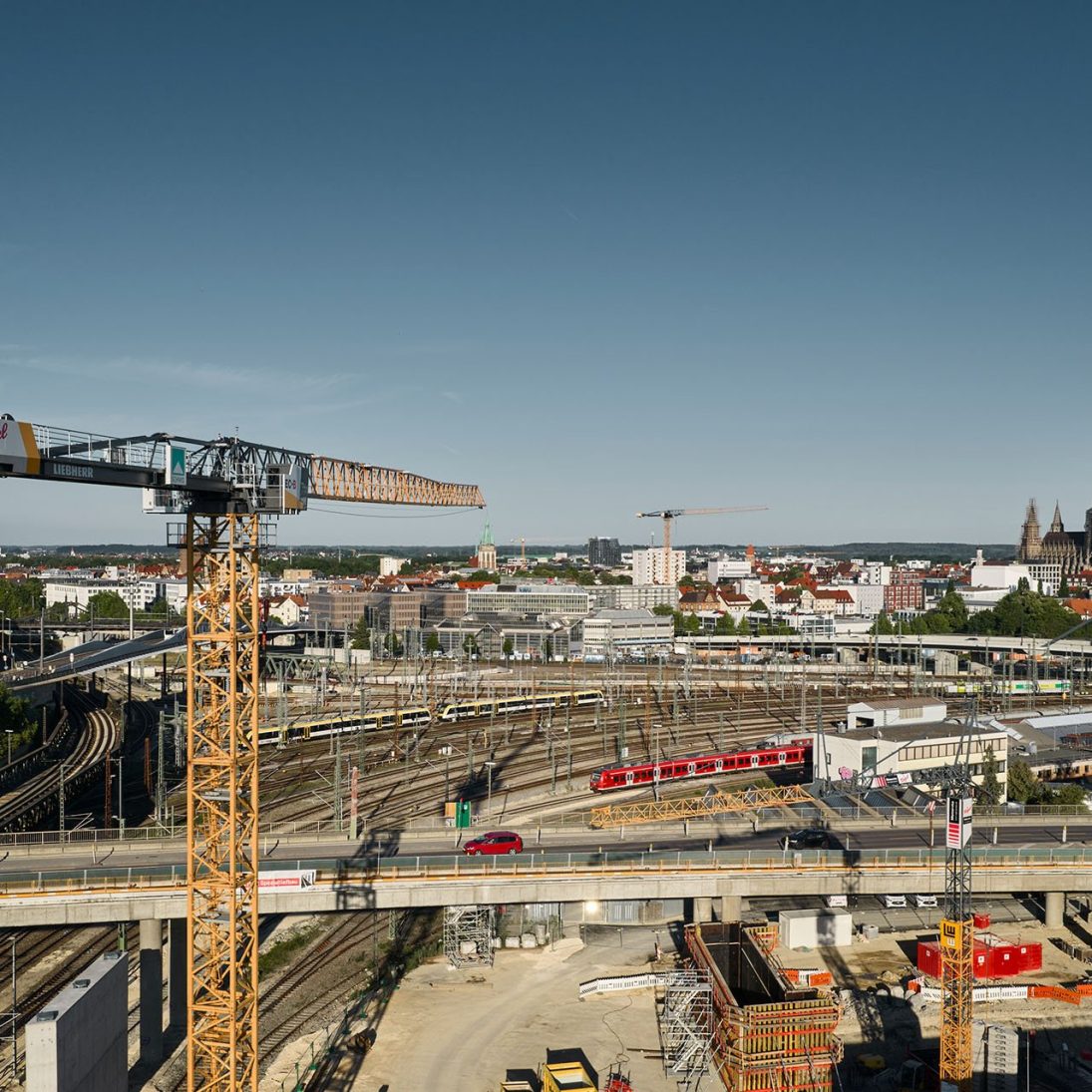
The job is being delivered by ARGE B10, a consortium of Matthaeus Schmid Bauunternehmung from Baltringen and Leonhard Weiss from Goeppingen. For the crane and logistics concept the consortium turned to long-standing partner Nagel Mietservice from Ulm, which handles project management and technical planning and supplies the crane technology for Matthaeus Schmid. The constraints are severe: up to 86,000 vehicles a day pass along the B10, the site spans fourteen railway tracks, and formwork sections and reinforcement cages have to be placed between the tracks with millimetre precision.
Two 520 EC-B 20 Fibre cranes carry the heavy lifts
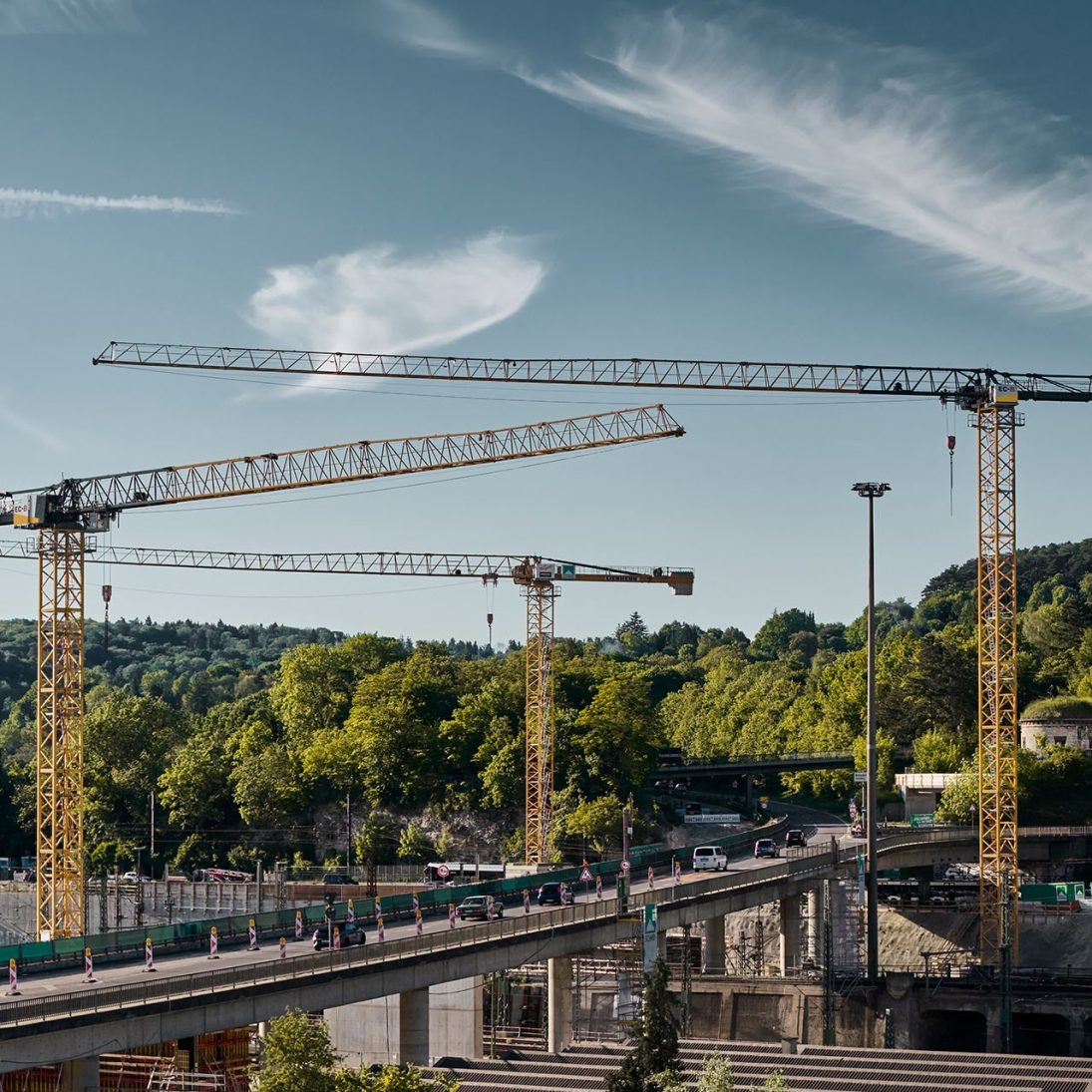
Nagel’s technicians erected the first Liebherr 520 EC-B 20 Fibre on 12 March 2026. Working at an 80-metre radius with a 52-metre hook height and a maximum capacity of 20 tonnes, the flat-top covers the entire main construction area and takes the heaviest lifts, including formwork units and reinforcement cages between the live rail tracks. A second 520 EC-B 20 Fibre followed four days later on the opposite side of the site, rigged with a 60-metre jib and 35-metre hook height for shorter cycle times in the denser working areas.
Both machines run Liebherr’s fibre rope in place of conventional steel rope. The lighter hoist rope allows a 40 per cent increase in load capacity compared with equivalent steel-rope cranes, and the rope has a 14-year service life; according to Liebherr, up to 80 per cent of rope damage can be repaired on site without a full replacement.
Self-erectors handle the fine logistics
A Liebherr 81 K self-erecting crane works at the Blaubeurer Tor on material distribution and supply of the peripheral areas, and from 17 April 2026 a 202 EC-B flat-top completed the line-up for formwork and reinforcement lifting. Consortium partner Leonhard Weiss is adding three 81.1 K self-erectors for fine logistics within the site, alongside a 34 K and an 81 K.1 that round out the seven-crane system in time for the 2026 summer construction peak. The combination of powerful top-slewers and quickly rigged self-erectors gives the site cover for both heavy single lifts and fast material cycles.
Facts
- Project: replacement of the Wallstrassenbruecke (B10), Ulm, Germany
- New bridge: 187 m long, built in two halves, full reopening summer 2029
- Cranes: 2x 520 EC-B 20 Fibre, 202 EC-B, 34 K, 81 K, 81 K.1, 3x 81.1 K
- Largest crane: 80 m radius, 52 m hook height, 20 t max capacity
- Site spans 14 railway tracks; up to 86,000 vehicles/day on the B10
- Crane supplier: Nagel Mietservice, Ulm
Related Stories
Seven jobs that show the range of Liebherr Tower Crane Solutions
From a luffing jib crane above the Sagrada Familia to rail-mounted flat-tops at Santiago airport and more than…
Link-Belt RTC-80130 SII builds emergency-route bridge in California
A Shimmick crew used a 130 US ton Link-Belt RTC-80130 SII to build the new Mosquito Road bridge…
Four Liebherr LTC 1050-3.1s build THW’s 70-metre Danube bridge
Germany's THW used four Liebherr LTC 1050-3.1 compact cranes to pre-assemble a 70-metre temporary Danube crossing at Tuttlingen,…