

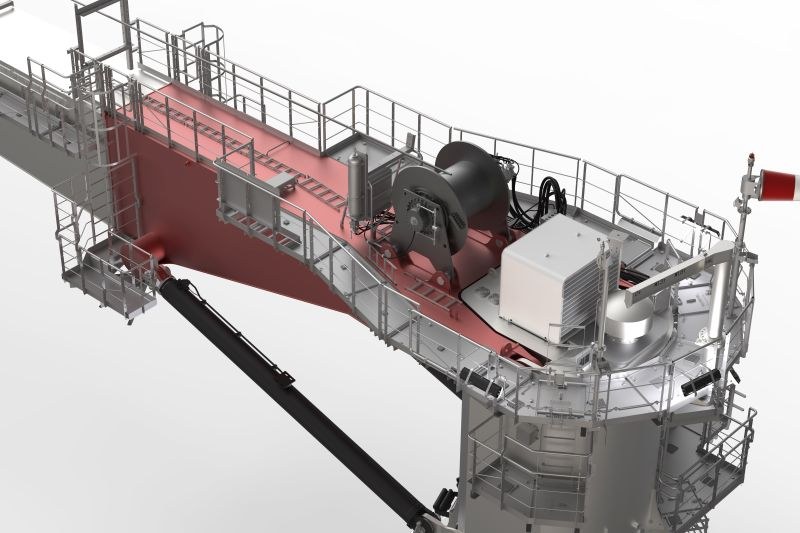
Thirty tonnes on an unmanned platform: Liebherr’s RL 900 goes to the 50Hertz Baltic grid connections
The Dutch-Belgian consortium HSI has ordered three Liebherr Ram Luffing 900 cranes for offshore substations serving 50Hertz grid connections in the German Baltic. All three will carry the LiMain semi-automated maintenance system.
Where the cranes are going
HSI — the consortium of HSM Offshore Energy, Smulders and Iv — has bought three RL 900 cranes from Liebherr’s Ram Luffing series. Two are destined for the OSS Darß and OSS Zingst platforms on the OST-6-1 grid connection; the third goes to the Jasmund platform, part of 50Hertz’s Ostwind 3 system. All three platforms were under construction at the time of the order, with delivery to the Dutch construction sites planned during 2025.
50Hertz is the transmission system operator for eastern and north-eastern Germany. OST-6-1, at around 900 MW across the two platforms, is currently the largest and most powerful offshore wind connection in the German Baltic. The Ostwind 3 wind farm sits some 42 kilometres north-east of Rügen, covers roughly 25 square kilometres and is expected to generate 300 MW — enough for around 260,000 households.
Built for a platform deck
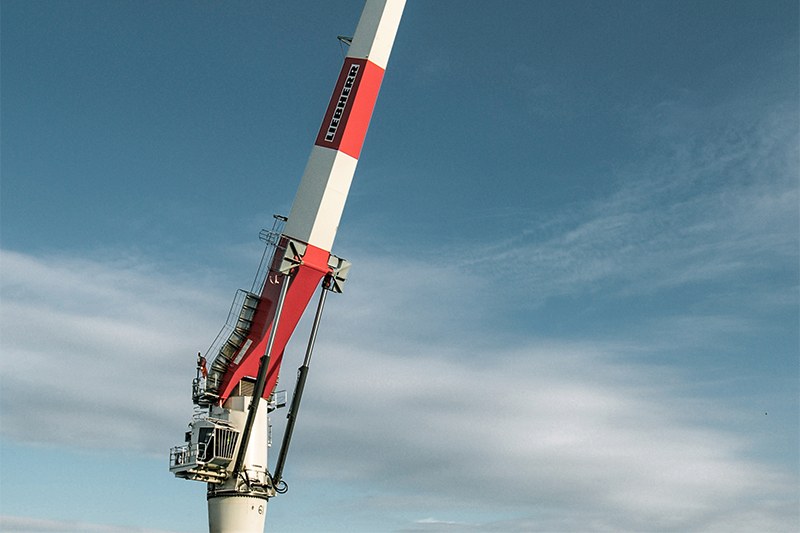
The RL series is a weight-optimised design intended for permanent installation offshore, where structural mass on a topside carries a direct cost. The RL 900 lifts up to 30 tonnes and is used mainly for maintenance and supply duties — landing spares, containers and consumables from a service vessel rather than for construction lifts.
Its low overall height and small tail radius are what make it workable in the congested space of a substation deck. The slewing column serves as the base element and houses the main drive, the electronic control system and the central hydraulic power pack, which keeps the pipework runs short and the maintainable components in one place.
LiMain and the unmanned platform problem
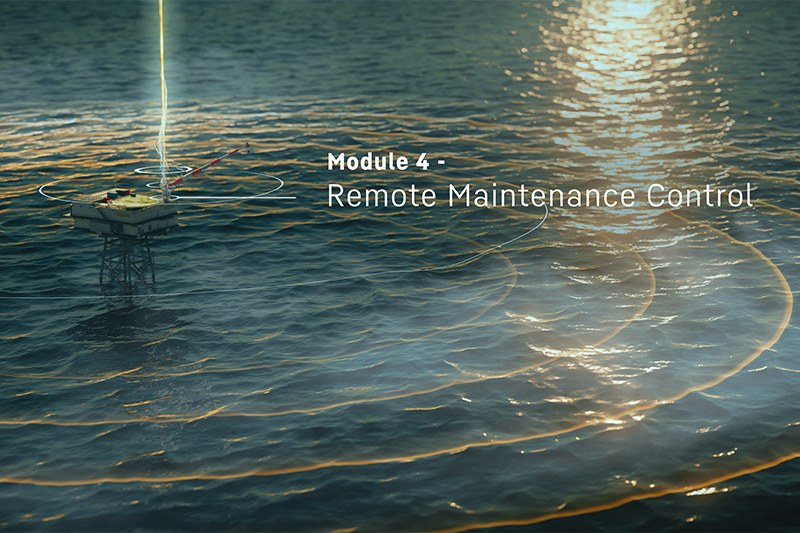
All three cranes will be delivered with LiMain, Liebherr’s digital maintenance concept for offshore cranes. It combines remote maintenance capability with real-time condition monitoring and a semi-automated maintenance routine, and is built on a modular architecture so that the operator can set how much autonomy and how wide a scope of intelligent maintenance it wants.
The commercial case is mobilisation. Getting a technician onto an unmanned platform in the Baltic is expensive and weather-dependent; Liebherr states a reduction of up to 75 per cent in mobilisations on unmanned platforms.
“We are proud to have an impact on the energy transition with our products and are aware that we are making a significant contribution to the success of our customers. We are therefore delighted that HSI has decided to realise this project together with Liebherr and that a locally produced product of the highest quality will be used off the Baltic coast of Mecklenburg-Vorpommern.”
— Stefan Schneider, Global Application Manager for General Purpose Offshore Cranes, Liebherr
Crane facts
- Model: Liebherr RL 900 (Ram Luffing series)
- Capacity: up to 30 t
- Quantity: three cranes
- Duty: platform maintenance and supply
- Maintenance system: LiMain, remote and semi-automated
- Delivery: planned during 2025
Projects
- Buyer: HSI (HSM Offshore Energy, Smulders, Iv)
- Operator: 50Hertz
- OST-6-1: OSS Darß and OSS Zingst, around 900 MW combined
- Ostwind 3: OSS Jasmund, 300 MW, 42 km north-east of Rügen
Related Stories
Gertzen retrofits Liebherr LR 1800-1.0 with X3 boom for 175 m hubs
Gertzen Kranlogistik has fitted its 800-tonne Liebherr LR 1800-1.0 crawler crane with the X3 boom system and erected…
UNIC puts the spotlight on its smallest spider crane, the URW-094
UNIC Cranes Europe has profiled the URW-094, the smallest machine in its spider crane range: a 595 mm…
Patriot Crane & Rigging takes first Tadano AC 5.250L-2
Nebraska taxi crane specialist Patriot Crane & Rigging has bought its first Tadano AC 5.250L-2 through dealer RTL…