

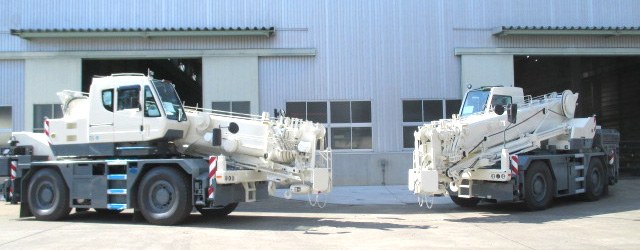
From Bauma stand to shipping crate: the first CR-250RV leaves Kato’s Gunma plant for Europe
The first Kato CR-250RV has left the company’s Gunma plant in Japan bound for Europe, six months after the 25-tonne CityRange crane made its public debut on the manufacturer’s stand at Bauma 2019 in Munich.
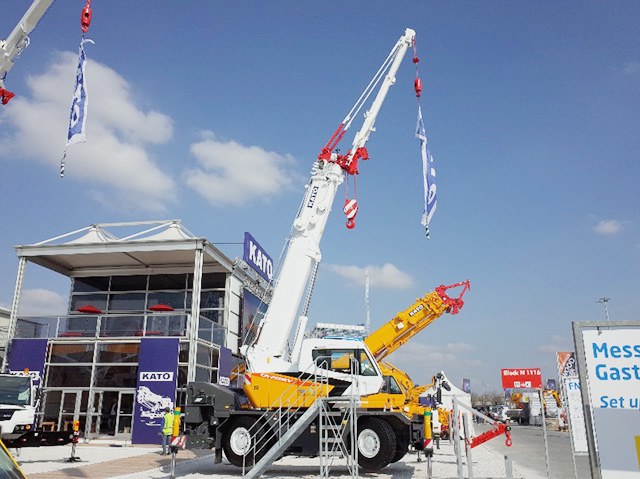
From Munich to the first delivery
Kato shipped the first CR-250RV from its Gunma plant in September 2019. The crane is the newest and largest member of the CityRange family, and it was shown to the European market for the first time at Bauma in Munich earlier the same year, where it stood on the Kato stand alongside the rest of the compact range.
The gap between show debut and first shipment is a fair reflection of how the compact city crane sector works: European buyers in this class are typically taxi-crane operators and small hire fleets who want to see and climb over a machine before committing, and the Bauma appearance was the CR-250RV’s first chance to be inspected at close quarters outside Japan.
What the customer gets
The CR-250RV lifts 25 tonnes at a 2.8 m radius. Its six-section boom telescopes from 6.7 m to 29.0 m, and the hydraulically telescoping and luffing jib extends from 5.3 m to 8.2 m. A 7.5-tonne Searcher Hook is available, the offsetting hook Kato fits across the CityRange for placing loads into height-restricted openings.
Power comes from a Cummins B6.7 meeting EU Stage V, which is what makes the crane saleable in western Europe. On the road it measures 9.195 m long, 2.395 m wide and 3.495 m high, with a gross vehicle weight of 23,795 kg divided almost exactly between the axles at 11,895 kg front and 11,900 kg rear — close enough to even that transport planning is straightforward for a machine of this size.
Safety equipment
Kato has fitted the model with a surround view system giving the operator a real-time bird’s-eye image around the crane, and a Human Detect Assist System that flags people in the machine’s blind spots. Both are aimed squarely at the environment this crane is built for, where the working area is often a closed street or a yard with pedestrians a few metres from the outriggers.
Kato directs enquiries about the crane to its local distributors. The CR-250RV has since become the largest model in the CityRange family, which extends down to the 13-tonne CR-130RV.
Related Stories
Enercon adds 1,000-tonne Liebherr LR 11000 to its erection fleet
Wind turbine manufacturer Enercon has taken delivery of a Liebherr LR 11000 crawler crane, which is already erecting…
WW Builders takes first knuckle boom with Tadano PM 38525 SP
Oklahoma contractor WW Builders Inc. has added its first loader crane, a Tadano PM 38525 SP with J813.20…
Cantiniau takes Tadano AC 4.080-1 handover at JDL Expo in Beaune
French lifting specialist Cantiniau has returned to the 80-tonne class with a new Tadano AC 4.080-1, handed over…