

From robust box to integrated workplace: three decades of Spierings cab development
Outreach, capacity and rigging time dominate mobile tower crane specifications, but Spierings argues the cab is the component that ties them together — and it has traced how its own operator workplace has changed since the 1990s.
The 1990s baseline
Early Spierings cabs were built around what mattered at the time: reliability, visibility and direct control. The crane had to perform in all conditions, and the cab was designed as a robust, functional workplace where simplicity and durability came first.
Ergonomics existed, but it was approached through control and positioning rather than comfort. The operator needed to work intuitively, with a clear relationship between input and crane movement, and seat, controls and sightlines were aligned to that. Comfort was present only insofar as it supported function. That design accumulated millions of operating hours, and Spierings makes the point that the later work is an evolution of a proven base rather than a replacement of it.
What changed on site
The job itself moved. Inner-city construction increased, space tightened, margins narrowed and precision requirements rose. Working days became longer and more intensive, which turned the cab from a functional station into an environment where sustained concentration is the limiting factor.
That produced new priorities: support for a stable working posture, proportional and precisely controllable operation, reduced physical strain, and visibility maintained across a long shift. Ergonomics became a performance question as much as a welfare one.
Safety followed a parallel path. Cab design increasingly had to be demonstrably safe in terms of operation and system integration, not simply reliable, which drove refinement of the controls and the integration of warning and monitoring systems into the operator platform. Comfort shifted too, from a secondary consideration to a prerequisite for keeping operators in the seat over a career — noise reduction, climate control and better sightlines becoming design themes in their own right.
The renewed cab
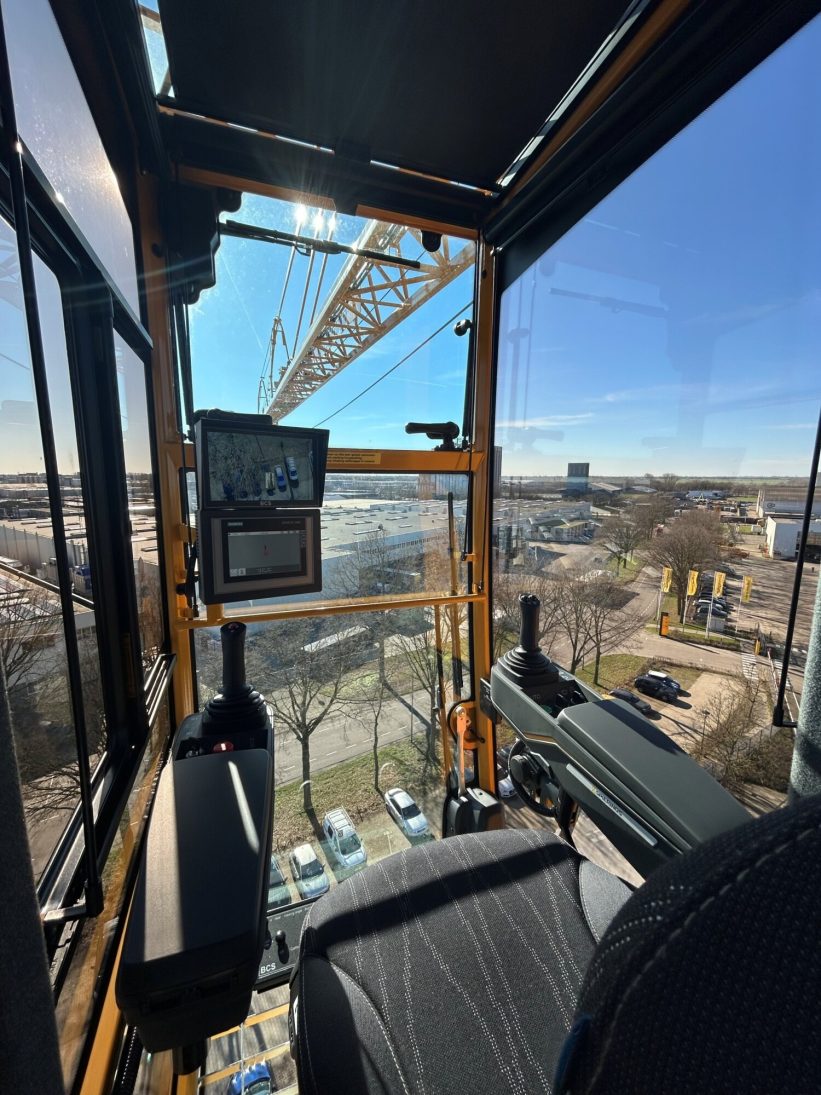
The current cab is presented as an integrated system rather than a facelift. A larger glazed area improves sightlines around the load and the working area, while a more compact screen configuration reduces visual obstruction; the seat is height-adjustable so operators can set their position to suit the view and the site.
Adjustability extends to a fully adjustable seat with forearm support, aimed at a natural posture during demanding lifting work. Safety systems are built into the controls rather than added afterwards: touch protection on the joystick prevents unintended movements, and hoist speed is reduced at a height of two metres to improve safety around the crane. Revised climate control and better insulation hold the interior climate steady, with electrically heated front windows preventing misting in cold or damp conditions.
Spierings frames the whole exercise as continuous refinement driven by operator feedback rather than periodic restyling — optimising a concept in service rather than introducing a new look.
Related Stories
Enercon adds 1,000-tonne Liebherr LR 11000 to its erection fleet
Wind turbine manufacturer Enercon has taken delivery of a Liebherr LR 11000 crawler crane, which is already erecting…
WW Builders takes first knuckle boom with Tadano PM 38525 SP
Oklahoma contractor WW Builders Inc. has added its first loader crane, a Tadano PM 38525 SP with J813.20…
Cantiniau takes Tadano AC 4.080-1 handover at JDL Expo in Beaune
French lifting specialist Cantiniau has returned to the 80-tonne class with a new Tadano AC 4.080-1, handed over…