

Sixteen-point-nine tonnes of ballast on the road: why Würzburger Kranverleih moved up to five axles
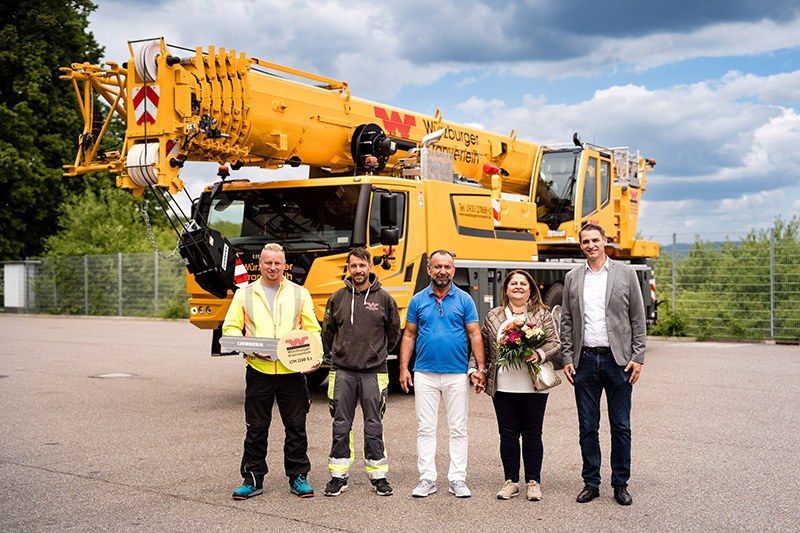
Lower Franconian family firm Würzburger Kranverleih und Bergungsdienst has replaced an eleven-year-old LTM 1090-4.1 with a new Liebherr LTM 1100-5.3, trading a four-axle carrier for a five-axle machine that can take most of its ballast to site with it.
Taxi crane arithmetic
The replacement is a straight generational step: out goes a four-axle 90-tonne crane, in comes the 100-tonne LTM 1100-5.3 with a 62-metre telescopic boom, LICCON3 control and the current Liebherr crane design. What sold it, according to owner Ibrahim Haido, was less the extra tonne-metres than what the crane can carry on public roads.
At a twelve-tonne axle load the LTM 1100-5.3 travels with up to 16.9 tonnes of ballast on board; where axle loads are tighter it can be reduced to nine tonnes per axle. For a hire company running taxi work that removes a ballast truck from a large share of jobs.
“Since the crane is able to carry along a huge amount of ballast with it on public roads, we’re able to use it with great flexibility as a taxi crane. Without any additional ballast transport, it can handle most jobs, such as the construction of steel halls or the laying of prefabricated concrete parts.”
— Ibrahim Haido, owner, Würzburger Kranverleih und Bergungsdienst GmbH
Liebherr launched the model at Bauma 2022 under the slogan “The master of all roads”, and the mobility argument is the one that has stuck with operators.
The clutch module
The crane is fitted with ZF’s TraXon gearbox with the DynamicPerform clutch module. Instead of a dry friction clutch, starting and manoeuvring torque is transferred through an oil-cooled multi-disc pack; the heat generated goes into the clutch oil and is carried away through an oil-to-water heat exchanger into the vehicle cooling system. The practical effect is close to wear-free shunting on site and in yards, with the maintenance cost that follows from it — relevant on a crane that spends a lot of its life crawling into confined access.
A fleet built on service response
Haido had already run earlier examples of the current LICCON3 generation and reports that operators are satisfied with the control system, the superstructure and the road behaviour. The company employs around 30 people across several branches and operates twelve mobile cranes, most of them Liebherr, including a mobile construction crane.
Asked what keeps him with the manufacturer, Haido points at parts availability and service response rather than at the machines themselves — the usual determinant for a small fleet where a crane standing idle is a crane not earning. He is also an advocate of the MK mobile construction crane, which he describes as an essential part of a modern mobile crane fleet, citing a strong client base for the type.
Related Stories
Enercon adds 1,000-tonne Liebherr LR 11000 to its erection fleet
Wind turbine manufacturer Enercon has taken delivery of a Liebherr LR 11000 crawler crane, which is already erecting…
WW Builders takes first knuckle boom with Tadano PM 38525 SP
Oklahoma contractor WW Builders Inc. has added its first loader crane, a Tadano PM 38525 SP with J813.20…
Cantiniau takes Tadano AC 4.080-1 handover at JDL Expo in Beaune
French lifting specialist Cantiniau has returned to the 80-tonne class with a new Tadano AC 4.080-1, handed over…