

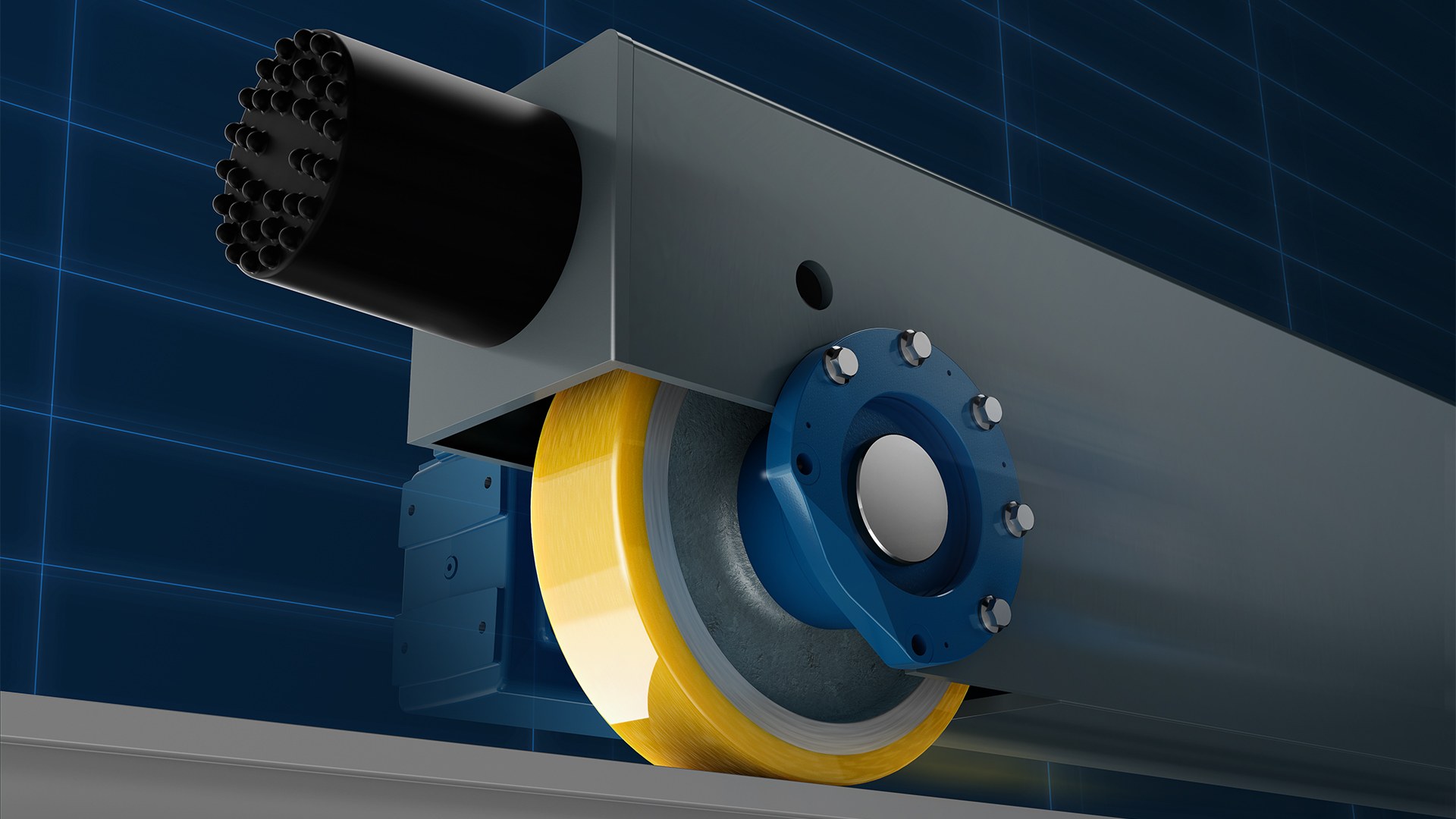
Polyurethane on a cast core: Demag’s new travel wheel holds its rating after hours standing under load
Demag has topped out its LRS travel wheel range with the LWS 450 F+, a polyurethane-tyred wheel on a cast core that the manufacturer rates for 10 per cent more load and 30 per cent more speed than the existing wheels in the family.
Where the gain comes from
The new wheel pairs a heavy cast core with a newly developed polyurethane drum. Demag attributes the higher figures to changes in both material composition and geometry, and says extended test-rig runs at its own facility confirmed the capacity and durability. On aluminium rails the wheel is described as quiet and rail-friendly, a point that matters where travel units run at speed over long distances in occupied production halls. It can also be used on steel rails and on concrete floors.
Four sizes
The range now covers four sizes in two designs. The LRS 200 (200 mm diameter) carries 1,200 kg on a minimum rail width of 70 mm; the LRS 250 carries 1,700 kg on 80 mm; the LRS 350 F carries 3,000 kg on 110 mm; and the new LRS 450 F+ carries 4,650 kg on a minimum rail width of 130 mm. The first three are rated for 200 m/min, while the 450 F+ reaches 260 m/min. Demag notes that the quoted load capacities apply at up to 100 m/min.
Mounting differs by size. The 200, 250 and 350 are offered in a nodular cast iron block housing with five machined connection faces; for the 450 a flange bearing is available as an alternative for attachment to a metal structure. Both variants can be fitted and removed without special tools, and a zinc flake coating provides the surface protection.
The standing-load argument
The most concrete claim Demag makes concerns behaviour under a stationary load. Conventional Hydropur drum wheels, it says, can lose up to half their load capacity after as little as two hours parked under load. The new PUR wheel is stated to remain fully load-bearing after longer periods under high load.
The distinction matters in installations where travel units spend long periods parked with a load on the hook — automated stores, transfer lines and any process with a buffer position. For plant designers that translates into fewer planning restrictions — no need to size around a derated wheel or to plan travel units out of a loaded parking position — and, Demag argues, better availability of the installation as a whole. The wheel system was shown at LogiMAT 2026.
Wheel range
- LRS 200: Ø200 mm · 1,200 kg · rail from 70 mm · 200 m/min
- LRS 250: Ø250 mm · 1,700 kg · rail from 80 mm · 200 m/min
- LRS 350 F: Ø350 mm · 3,000 kg · rail from 110 mm · 200 m/min
- LRS 450 F+: Ø450 mm · 4,650 kg · rail from 130 mm · 260 m/min
Design
- Construction: cast core with polyurethane drum
- Mounting: nodular cast iron block housing (200/250/350) or flange bearing (450)
- Coating: zinc flake
- Running surfaces: aluminium rail, steel rail, concrete floor
- Note: capacities quoted at up to 100 m/min
Related Stories
Maeda shows MC815 spider crane in Malaysia for first time at ONEBUILD
Maeda and distributor Sin Loy Heng Engineering exhibited at ONEBUILD 2026 in Kuala Lumpur, giving the MC815 its…
Zoomlion shows cranes and 16-strong line-up at Vertikal Days 2026
Zoomlion presented 16 machines including mobile and tower cranes at Vertikal Days 2026 at Newark Showground, and launched…
Game of Cranes returns: Liebherr seeks world’s best crane operator
Liebherr has relaunched its Game of Cranes competition, with nominations open from 1 October 2026. Five regional qualifiers…