

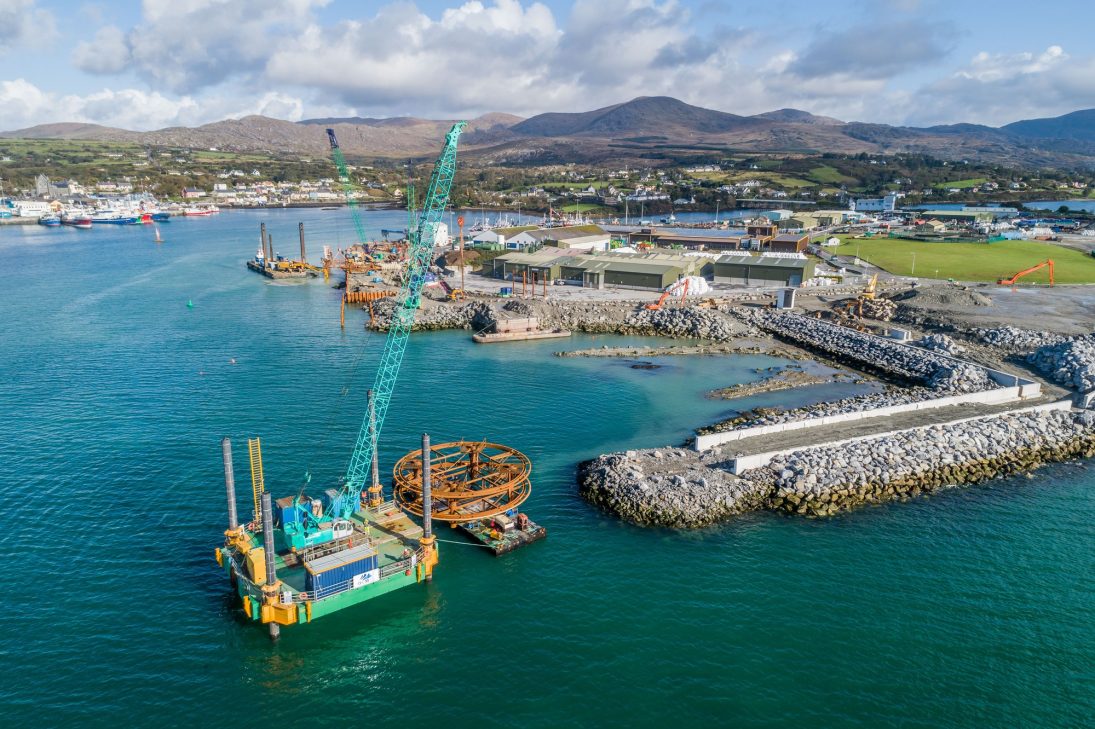
A BM700 on a jack-up barge and a CKE1100G on the quay double the working space at Castletownbere
The EUR 23 million expansion of Dinish Wharf in County Cork calls for tubular piles, sheet-pile cells and precast quay units. Two Kobelco crawler cranes of very different vintage are sharing the work.
Two cranes, one quay
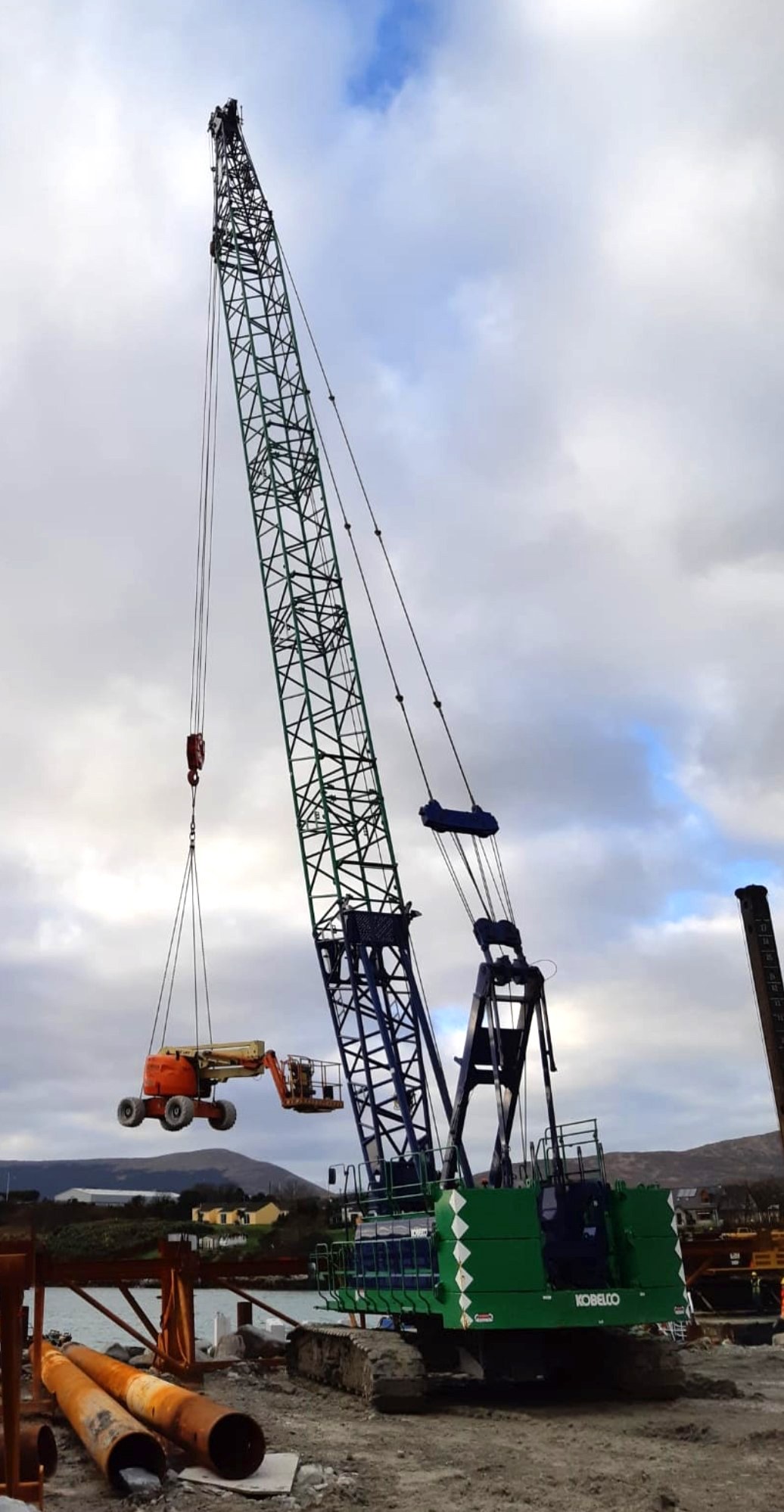
Ideal Form Crane Hire, based in Dungiven, Northern Ireland, has supplied a 65-tonne capacity Kobelco BM700 to marine and civil engineering contractor Keating Construction for the Dinish Wharf expansion at Castletownbere. The machine has more than 20,000 hours behind it.
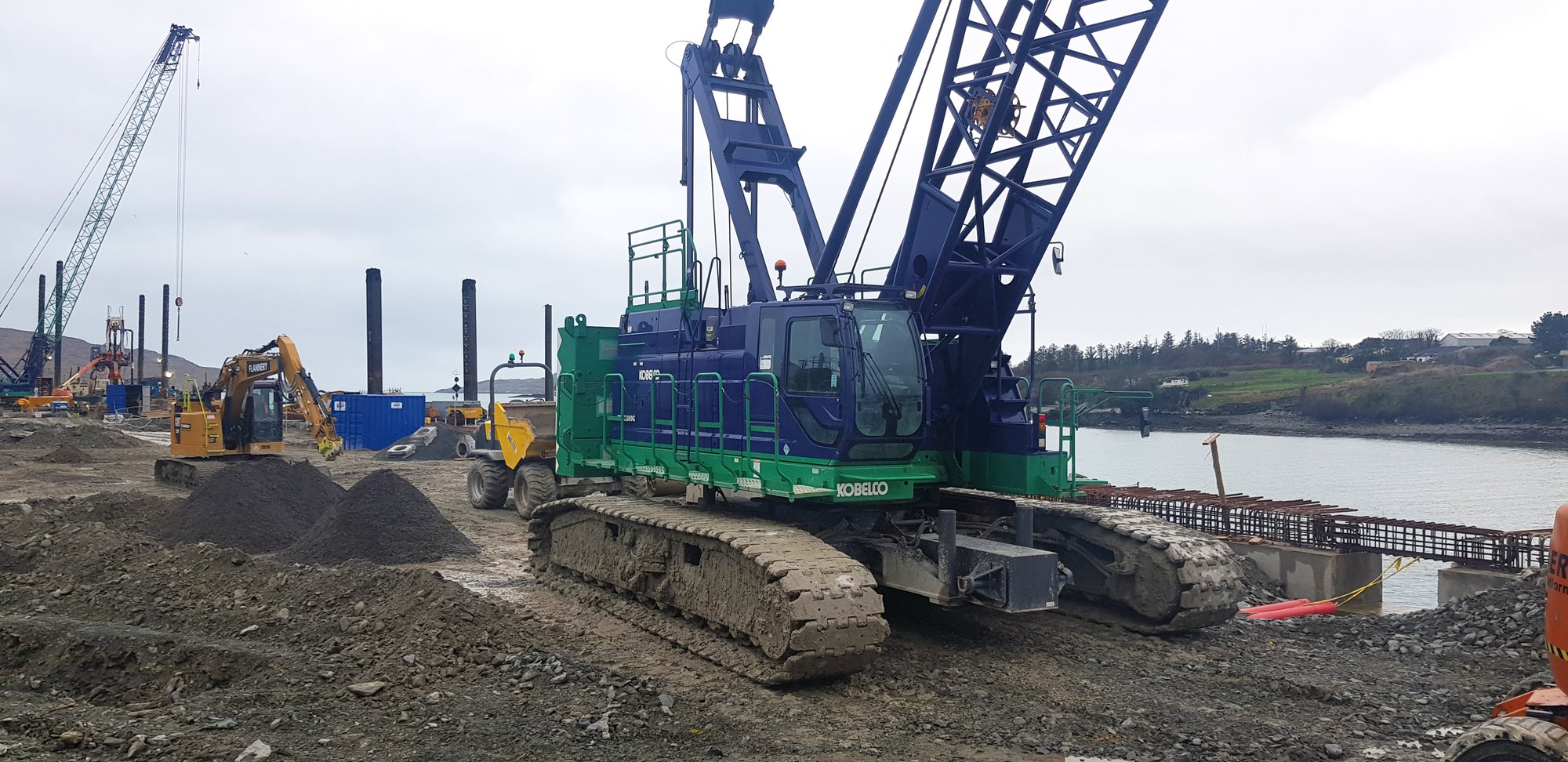
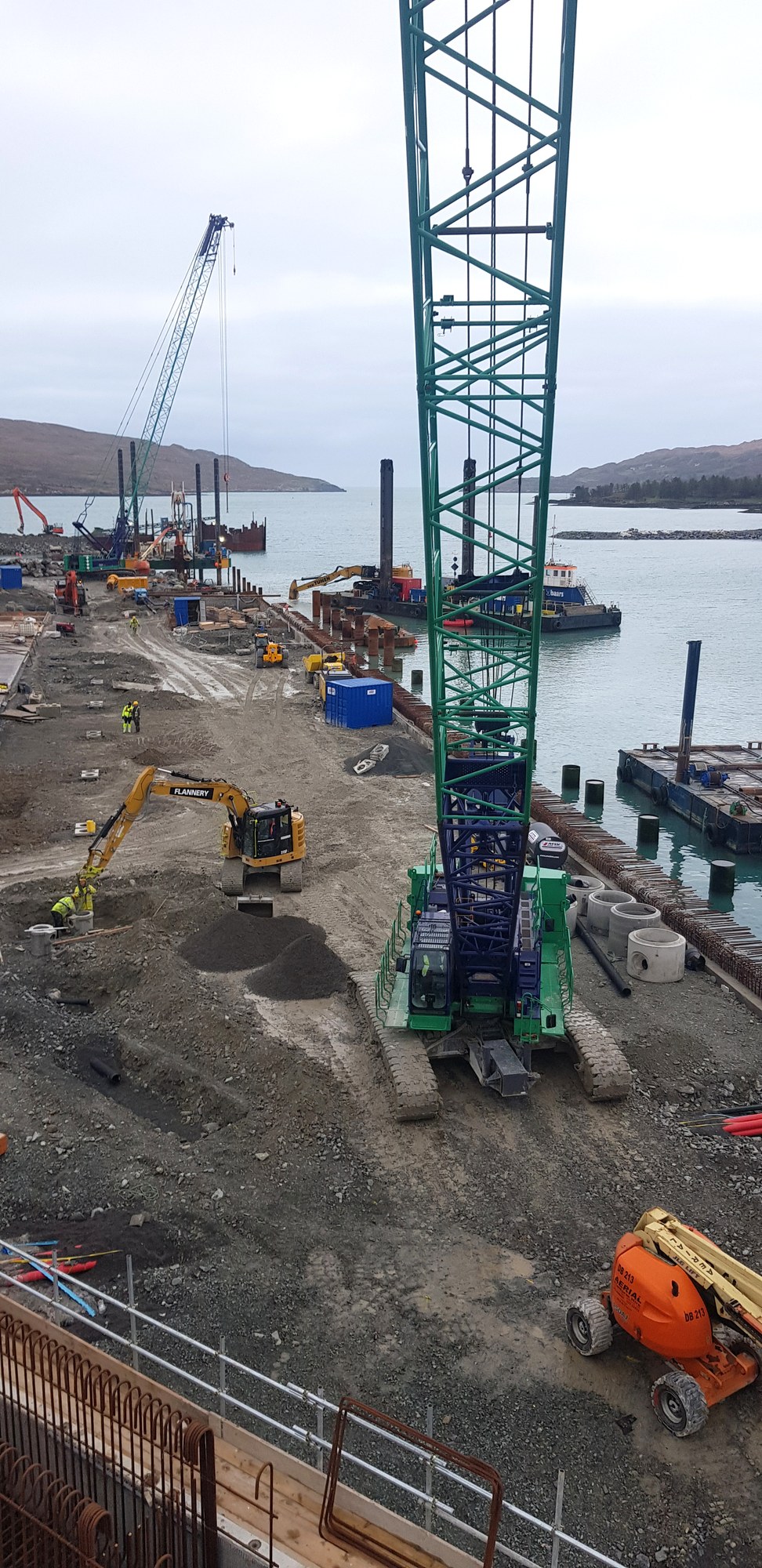
It is working alongside Keating Construction’s own 100-tonne capacity Kobelco CKE1100G. Between them the pair is installing 44 tubular piles of 900mm diameter, each weighing 10 to 12 tonnes, for Ireland’s Department of Agriculture, Food and the Marine.
Sheet piles from a jack-up barge
The BM700 operates from a jack-up barge, rigged with a 42.7m jib and 23.6 tonnes of counterweight. Its duties include lifting reinforced circular piling frames onto a floating barge and pitching 21m-long AS 500 straight-web sheet piles, which are closed into cylindrical cells to retain soil fill.
A total of 108 sheet piles make up each cell cofferdam at the end of the harbour’s breakwaters, with four cells to be built. The crane drives them into rock using an ICE 1423C vibrating hammer weighing 4.5 tonnes at the head, at a 17m radius. Once a cell is finished, the BM700 lifts out the inner cell frame in four sections of roughly nine tonnes each.
Precast and tubular work on the CKE1100G
Keating Construction’s CKE1100G carries the same 42.7m jib but a heavier 34.6 tonnes of counterweight. It handles precast concrete elements of up to 15.5 tonnes, loads and offloads 20m-long tubular and sheet piles weighing up to 11.5 tonnes, and drives the tubular piles with a 14.5-tonne BSP CX85 hammer.
Its remaining tasks are the ones that keep a piling sequence moving: servicing a pile-top drill rig that bores 4m into the rock head, and placing concrete elements, formwork and rebar.
What the port gets
The EUR 23 million (£19.95 million) scheme adds a 216m-long quay structure built from 15m-long 1016 tubular piles, a sheet-piled anchor wall and precast elements forming the quay face. It also involves dredging 55,000m3 of material, two new breakwater structures and a reclamation area for quay storage.
The result roughly doubles workable quay space at Castletownbere, opening the way for more fish landings, more on-shore processing and general marine activity — including berths for vessels up to 100m long.
Project facts
- Cranes: Kobelco BM700 (65 t) and Kobelco CKE1100G (100 t)
- Jib: 42.7m on both machines
- Counterweight: 23.6 t (BM700) / 34.6 t (CKE1100G)
- Piles: 44 tubular piles, 900mm diameter, 10–12 t each
- Sheet piles: 21m AS 500 straight web, 108 per cell, four cells
- Hammers: ICE 1423C vibro (4.5 t head) and BSP CX85 (14.5 t)
- New quay: 216m long
- Dredging: 55,000m3
- Project value: EUR 23 million (£19.95 million)
Related Stories
Helicopter lifts Liebherr derrick crane onto Paris high-rise roof
A Liebherr 200 DR 5/10 Litronic derrick crane was flown piece by piece onto the roof of the…
Tadano ATF 100G-4 lifts 2.5-tonne Bullhead at Wacken Open Air
Crane rental firm Wilhelm used its Tadano ATF 100G-4 to hoist the 2.5-tonne Bullhead skull onto the main…
Seven jobs that show the range of Liebherr Tower Crane Solutions
From a luffing jib crane above the Sagrada Familia to rail-mounted flat-tops at Santiago airport and more than…