

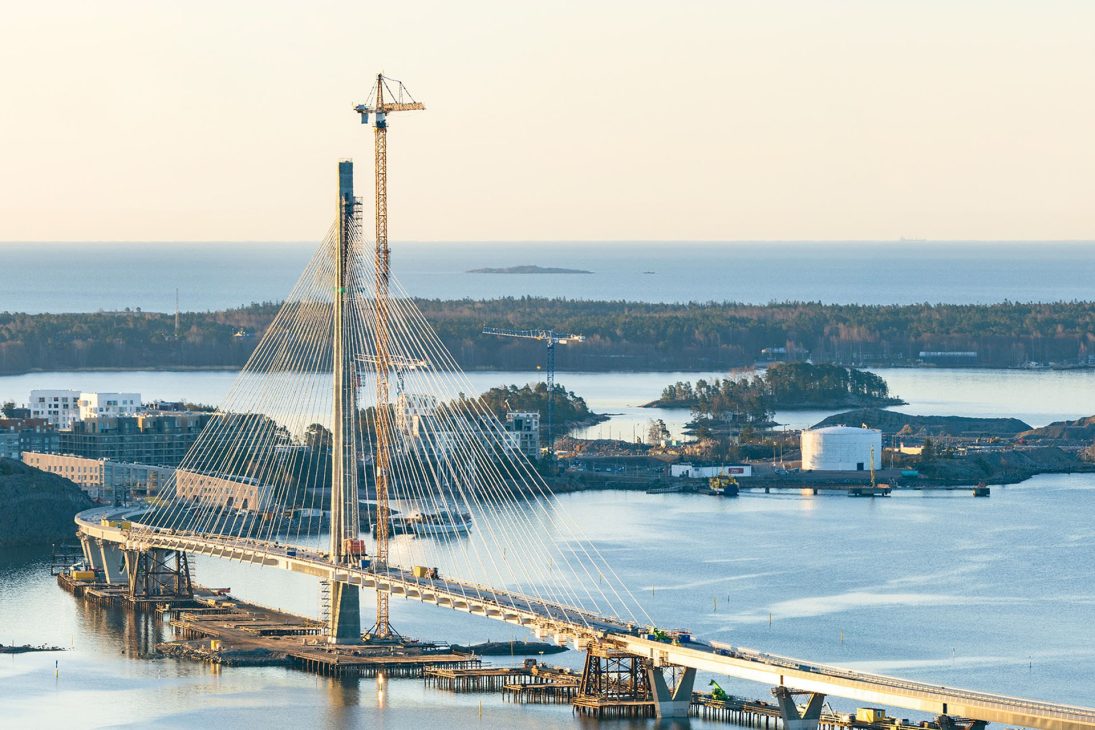
Three Nordic winters on an exposed bay: the tower crane behind the Kruunuvuori Bridge
A Liebherr 630 EC-H 40 Litronic carried out every lift on the 135-metre diamond pylon of Helsinki’s Kruunuvuori Bridge, working from winter 2022 until structural completion in 2025 on a site fully exposed to Baltic wind and sub-zero temperatures.
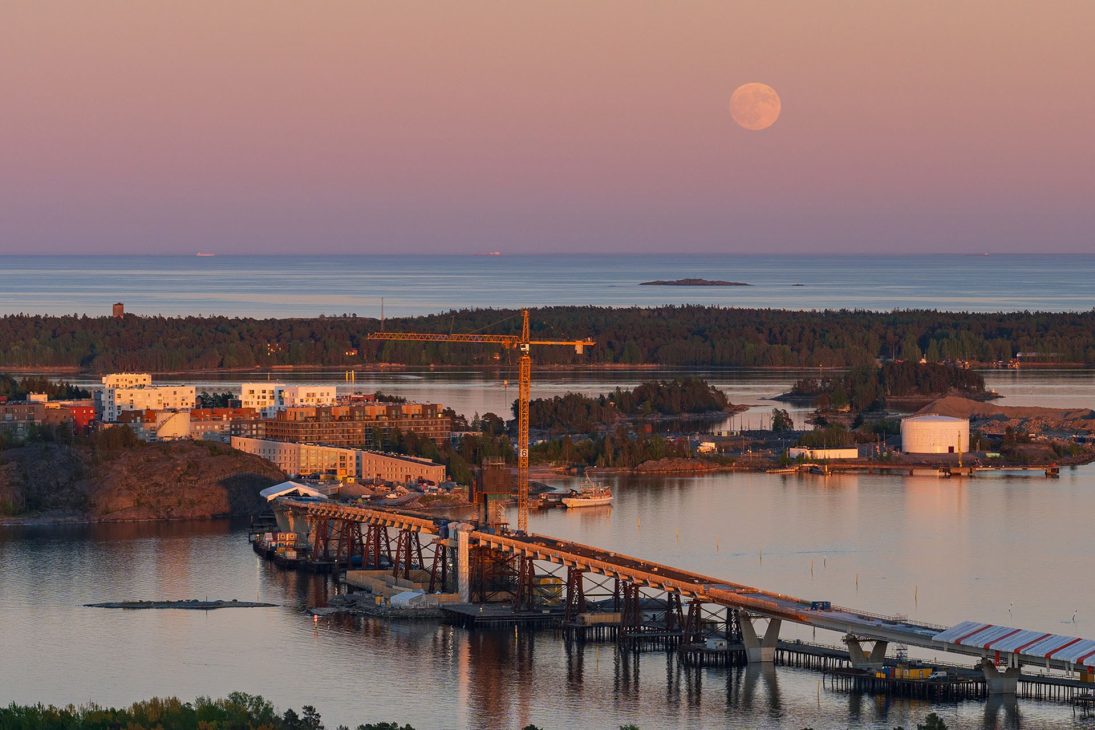

One crane, one pylon
The Kruunuvuori Bridge is the longest and tallest bridge in Finland, and its defining element is a 135-metre reinforced concrete pylon in a diamond form. Contractor TYL Kruunusillat handled the whole of the pylon construction with a single Liebherr 630 EC-H 40 Litronic high-top crane, which was already in its own fleet.
The crane positioned formwork sections, lifted reinforcement cages, moved concrete delivery equipment and handled structural components at every elevation as the pylon climbed. It offers a maximum lifting capacity of 40 tonnes; on the Helsinki site it worked at a jib radius of 48 metres, against a maximum radius of 80 metres for the model.
Guying geometry that kept changing
Configuring the crane for a structure of this height was not a standard exercise. Liebherr Tower Crane Solutions (TCS) was brought in early to calculate the tower configuration and the anchor tie-in positions, and stayed involved as the work progressed.
“Both the complex guying geometry and the regular adjustments to the guying and hook heights, driven by the progress of the construction works, required a high level of structural engineering expertise. By fully utilising the available structural capacity, we were able to apply our know-how to deliver a safe and efficient solution.”
— Member of the Liebherr Tower Crane Solutions team
Wind, ice and no shelter
The bridge crosses an open stretch of the Baltic in Helsinki’s outer harbour, with no sheltering topography and wind from every direction. Ambient temperatures fall well below zero for extended periods in winter, which puts sustained demands on the mechanical and electrical systems of a tower crane rigged close to its maximum height.
Wind loading was the critical design case. With the mast tied into a pylon rising 135 metres, both static and dynamic forces on the whole crane assembly had to be assessed carefully – which is precisely why the TCS configuration work mattered to operational continuity across three winters.
A 200-year design life
Commissioned by the City of Helsinki and designed by WSP Finland with Knight Architects, the cable-stayed bridge spans roughly 1.2 kilometres across Kruunuvuorenselkä bay, linking Laajasalo, Korkeasaari and Kalasatama with Hakaniemi in the city centre. It is specified for a service life of 200 years.
When it opens to tram traffic in late 2026 it will be Finland’s longest bridge and among the longest anywhere reserved exclusively for public transport, cyclists and pedestrians, with no provision for private cars. The surrounding development programme is expected to add more than 20,000 residents in the Laajasalo area.
Project facts
- Crane: Liebherr 630 EC-H 40 Litronic high-top
- Max lifting capacity: 40 t
- Jib radius on site: 48 m (model maximum 80 m)
- Structure: 135 m diamond-shaped concrete pylon
- Bridge: Kruunuvuori Bridge, approx. 1.2 km, cable-stayed
- Contractor: TYL Kruunusillat for the City of Helsinki
- Crane on site: winter 2022 to 2025
- Design life: 200 years; opens to trams late 2026
Related Stories
Helicopter lifts Liebherr derrick crane onto Paris high-rise roof
A Liebherr 200 DR 5/10 Litronic derrick crane was flown piece by piece onto the roof of the…
Tadano ATF 100G-4 lifts 2.5-tonne Bullhead at Wacken Open Air
Crane rental firm Wilhelm used its Tadano ATF 100G-4 to hoist the 2.5-tonne Bullhead skull onto the main…
Seven jobs that show the range of Liebherr Tower Crane Solutions
From a luffing jib crane above the Sagrada Familia to rail-mounted flat-tops at Santiago airport and more than…