

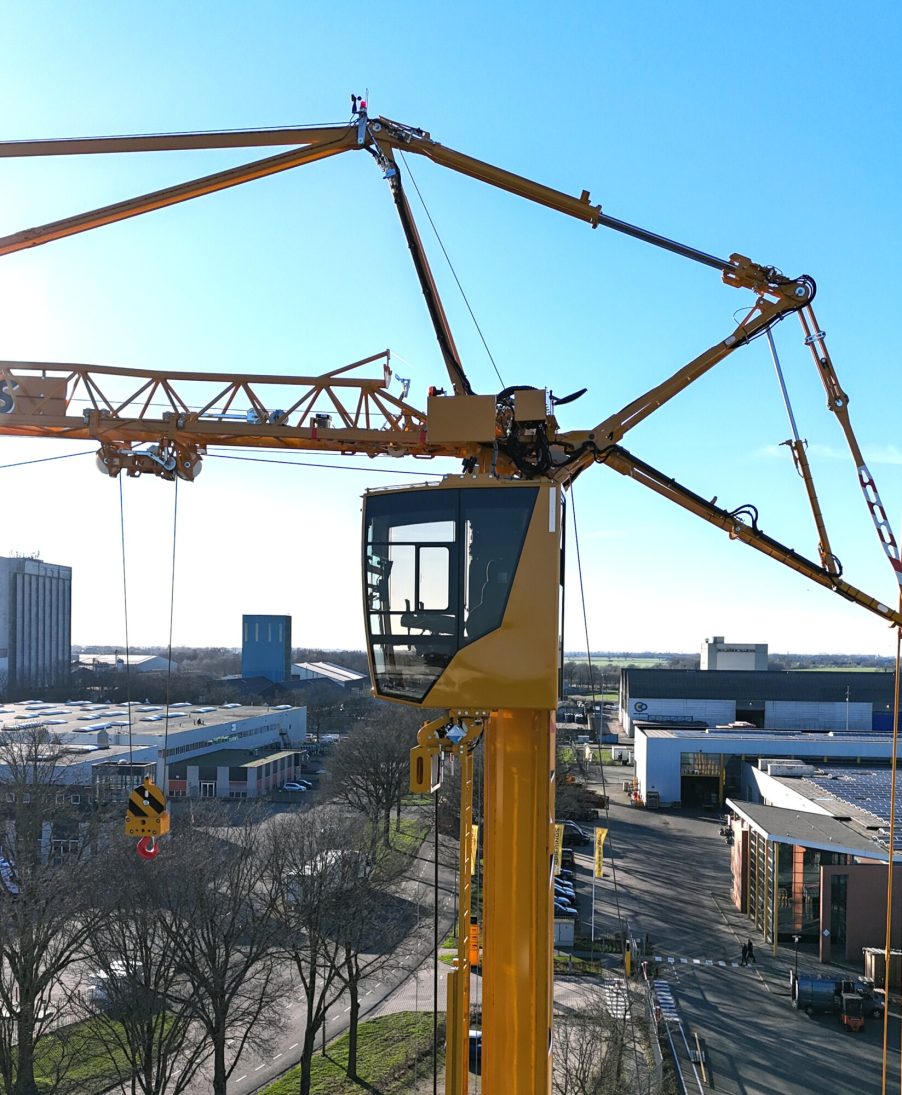
Why the layout of a mobile tower crane cab shows up in the accuracy of the lift
Spierings treats cab ergonomics as a performance question rather than a comfort one, arguing that seat support, control placement and sightlines determine how precisely an operator can work through a long shift.
What ergonomics means in a crane cab
The definition Spierings works to is narrow and practical: working posture, controls and sightlines aligned with the operator’s body and movements, with the aim of cutting physical load and supporting controlled lifting. An operator often spends hours in one position performing precise movements, and small shortcomings in support accumulate into strain.
The factors that matter are the relationship between seat and controls, support for the forearms and wrists, sightlines that do not require twisting, and a stable seating position through repetitive work.
Comfort as a performance variable
The company’s argument is that posture feeds directly into accuracy. Lifting is repetitive and control-intensive; when the working posture is wrong, strain builds and movements lose fluency. A well-laid-out cab supports steady operation, precise load placement and concentration that lasts the day — less fatigue translating into more control.
There is a mechanical version of the same point. An operator sitting in a relaxed, stable position can make small joystick inputs accurately without tension or excess force, which shows up in the stability of the crane movement and the control of the load.
The three elements that carry the load
Spierings identifies a fully adjustable seat as the foundation: seat height, depth, angle and backrest angle all adjustable to the individual operator, giving a stable base for long periods of precise work.
Full forearm support is the second. Where only the hand or wrist is supported, tension migrates to the shoulders and upper back; supporting the whole forearm reduces muscle tension and improves control over joystick movements, producing smoother operation.
Third is control placement. Joysticks and functions need to fall within natural reach, with displays that can be read without the upper body turning. Overstretching or constant corrective movement adds strain and makes operation less efficient.
Visibility, climate and noise
Visibility is treated as part of the ergonomic package rather than a separate topic. An operator forced to bend, twist or lean forward to follow the load places extra load on neck, shoulders and back, which is why glazed area and sightlines are integral to cab design.
Cab climate carries similar weight. Temperature swings, draughts and outside noise all consume energy and erode concentration, so climate control and insulation are used to hold conditions steady. Electrically heated front windows keep the glass clear of condensation and temperature-related misting so visibility is not compromised in cold or damp weather.
Spierings’ position is that these elements only work as a set — posture, visibility, controls, safety and climate balanced against one another rather than specified in isolation.
Related Stories
Manitowoc warns of hidden risks in generic crane parts
Manitowoc says counterfeit and generic spare parts invalidate crane load charts and warranties and pose serious safety risks,…
Zoomlion leads seven ISO crane standards after Frankfurt talks
At the ISO/TC96 meetings in Frankfurt, Zoomlion-led crane standards advanced, with the wind load estimation standard ISO 4302…
Spierings: cab sightlines are a safety requirement, not trim
Spierings makes the case that sightlines from the crane cab are a safety prerequisite, shaping reaction time, operator…