

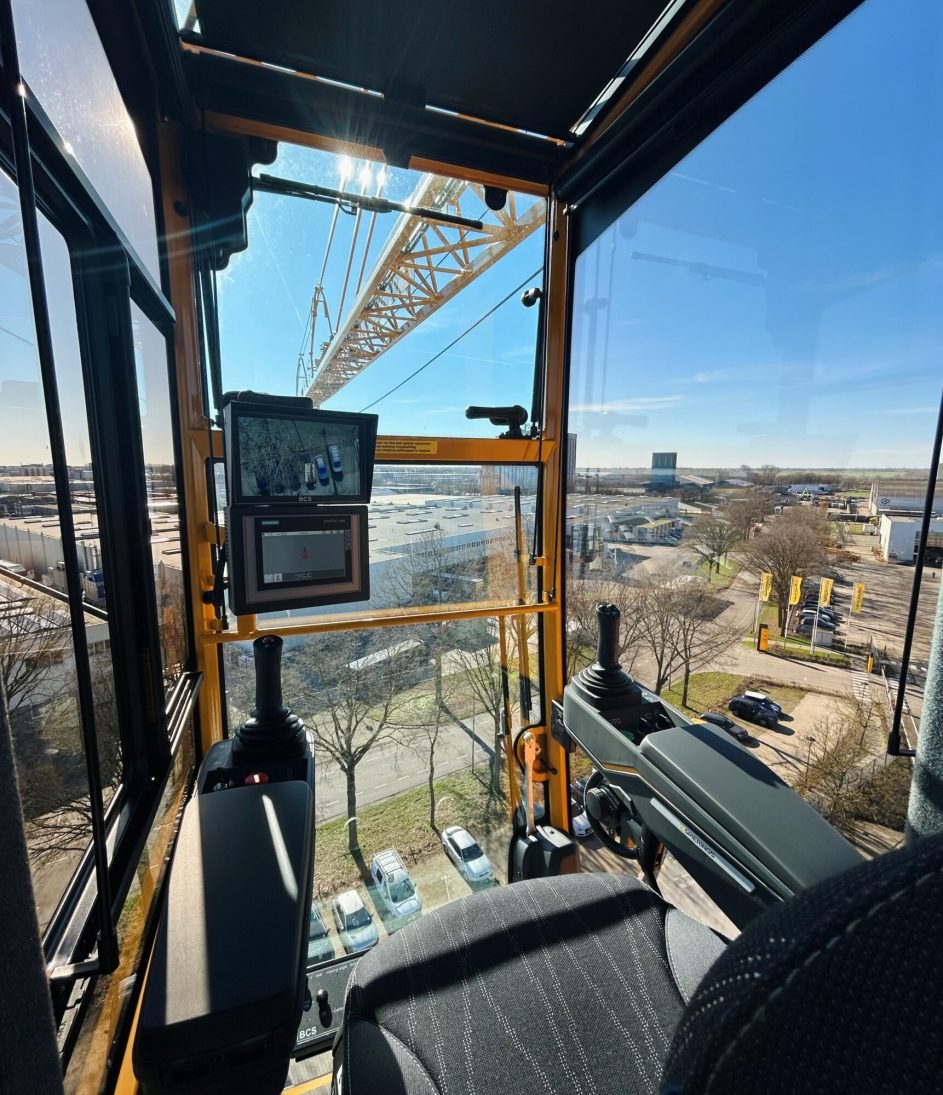
What the operator can see from the seat decides how safely the crane can work
Spierings argues that sightlines from the crane cab belong in the safety case rather than the comfort specification, because reaction time on a busy site is set by how quickly an operator sees a change around the load.
Defining the sightline
Spierings uses the term to cover everything an operator can take in from a normal seated working position: the load, the boom and the immediate working area. The glazed area, the position of the cab pillars and the placement of screens together determine how much of that is genuinely visible.
When those elements are aligned, the operator can stay seated in a natural posture and still follow the hook without twisting or leaning forward. When they are not, the driver compensates with the body — which is where both physical strain and lost time begin.
Reaction time and risk
On congested urban sites the picture around a crane changes constantly. People move beneath and around the machine, vehicles come and go, and materials are relocated. In those conditions, the manufacturer says, the interval between an operator noticing something and being able to act on it is a direct safety variable.
A restricted field of view lengthens that interval and raises the chance of an error or an unsafe situation developing. Unobstructed visibility compresses it. Spierings puts the point plainly: safety starts with being able to see what is happening.
Strain and steadiness
The physical argument runs alongside the safety one. Crane operation involves long periods in a fixed position making small, controlled movements, and it depends on sustained concentration. Where sightlines are well designed, the driver can hold a stable seated posture while keeping both the load and its surroundings in view, avoiding the repeated twisting that accumulates into back, neck and shoulder strain over a shift.
That stability shows up in the work itself. An operator who can follow the load continuously makes smoother, more predictable movements; restricted visibility produces more small corrections, which costs time and breaks the rhythm of the lift. Efficiency, on this reading, is not only a function of line speed or capacity but of how well the driver can see.
Cameras support, they do not replace
Spierings is explicit that cameras and sensors are an aid rather than a substitute. Direct vision supplies depth, context and overview in a way that a screen cannot, which is why the glazed area of the cab remains a fundamental design decision rather than a styling one.
Industry guidance for mobile tower crane cabs already addresses visibility, working posture and physical load, requiring that operators have adequate overview of both the load and the working environment from their normal position. On that basis, the company treats visibility as part of responsible cab design rather than an optional extra.
Related Stories
Manitowoc warns of hidden risks in generic crane parts
Manitowoc says counterfeit and generic spare parts invalidate crane load charts and warranties and pose serious safety risks,…
Zoomlion leads seven ISO crane standards after Frankfurt talks
At the ISO/TC96 meetings in Frankfurt, Zoomlion-led crane standards advanced, with the wind load estimation standard ISO 4302…
Seat, joysticks and glass: ergonomics in the crane cab
Spierings sets out how seat adjustment, forearm support, control placement and cab climate shape both operator health and…