

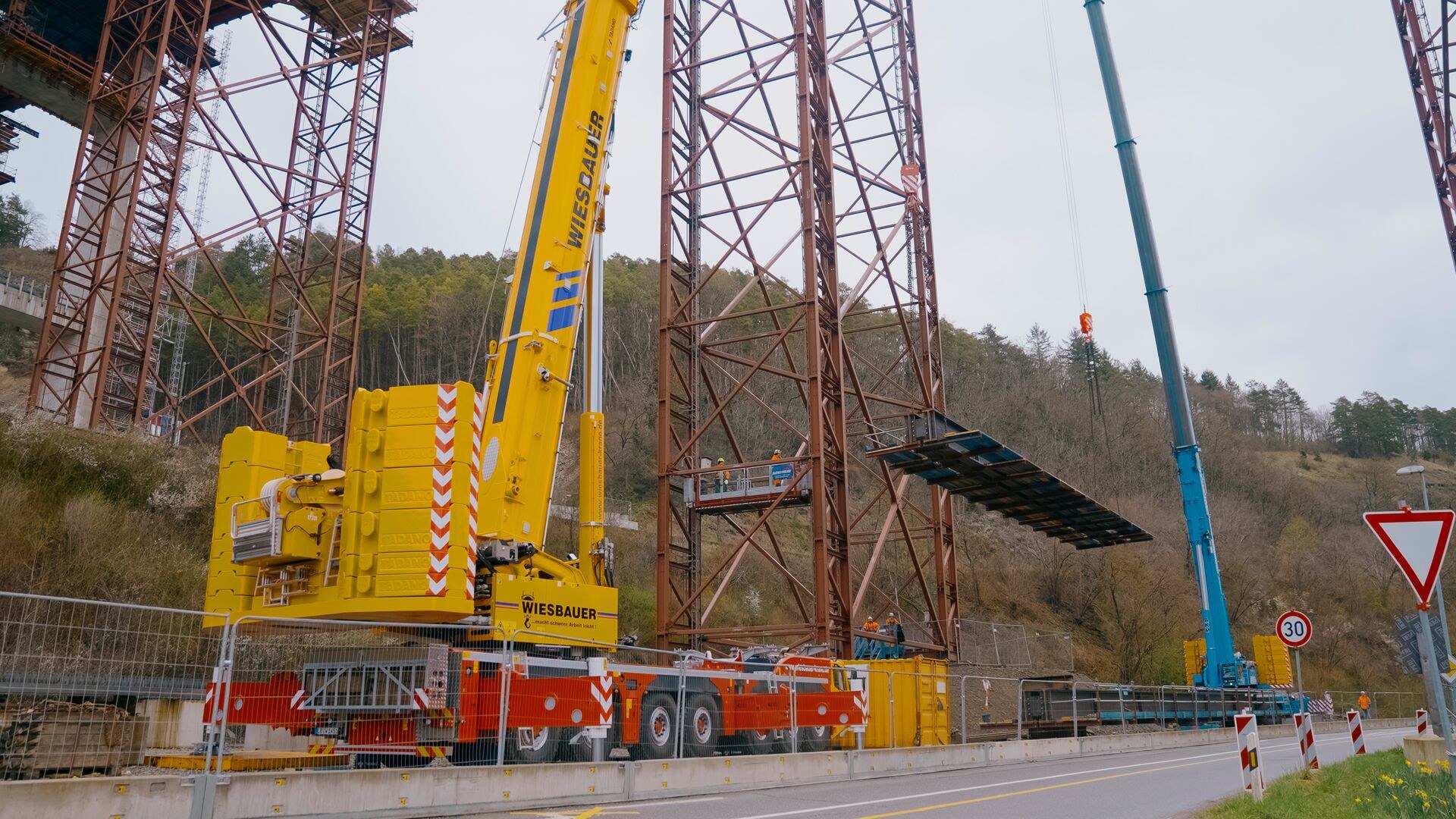
Wiesbauer’s new AC 7.450-1 goes straight from handover to a tandem lift on the Neckartal bridge
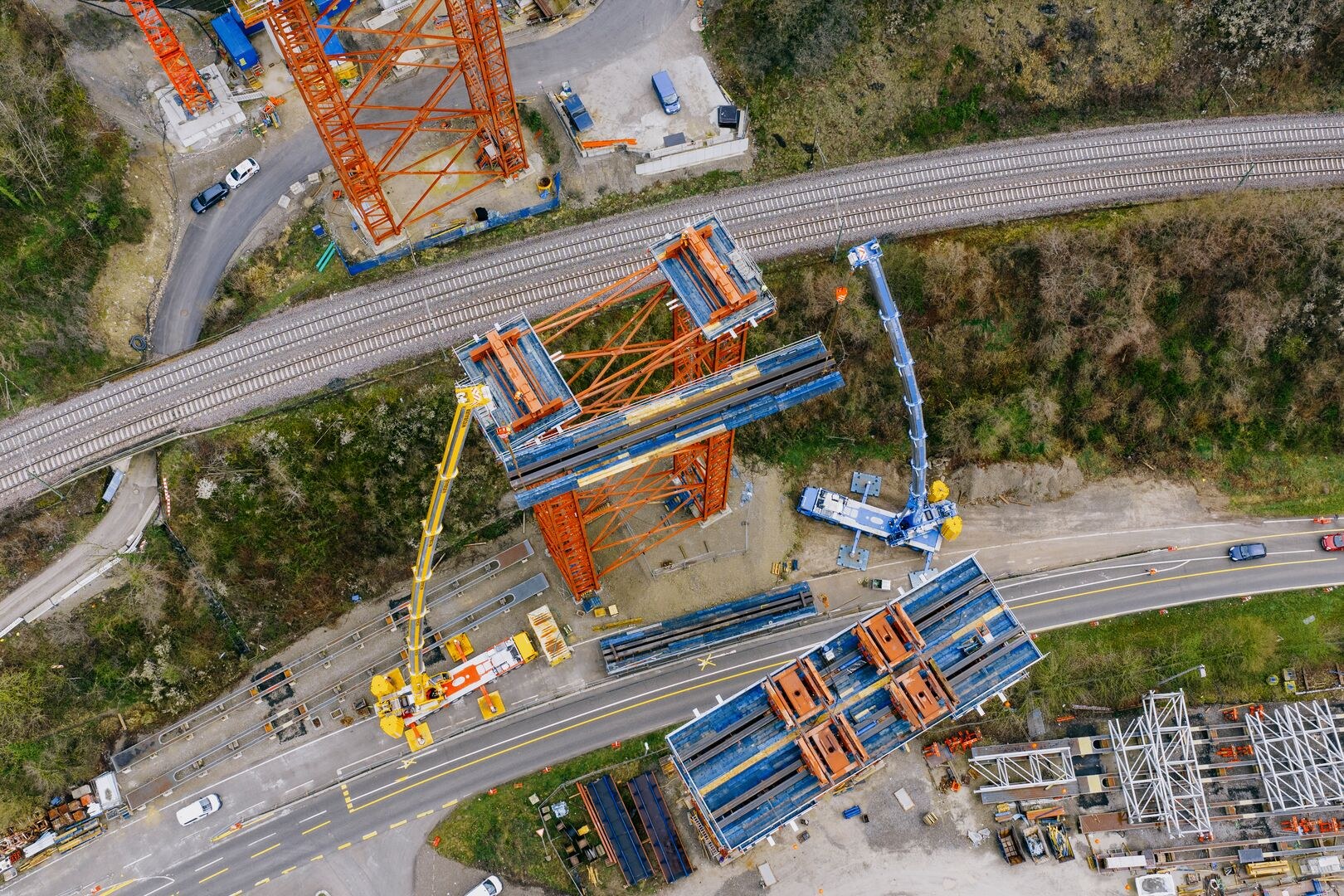
Two 32-tonne steel sections had to be placed 64 metres above the Neckar valley near Horb. Wiesbauer took the job with a tandem lift, using its newly delivered Tadano AC 7.450-1 alongside a crane from partner firm AKM.
An extradosed bridge with awkward numbers
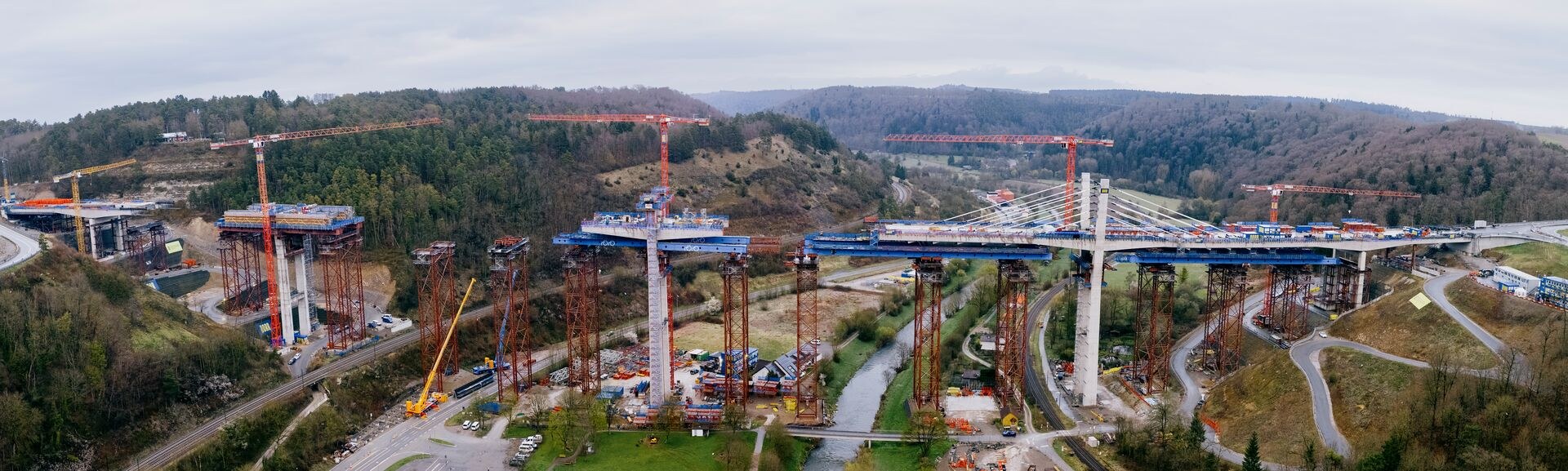
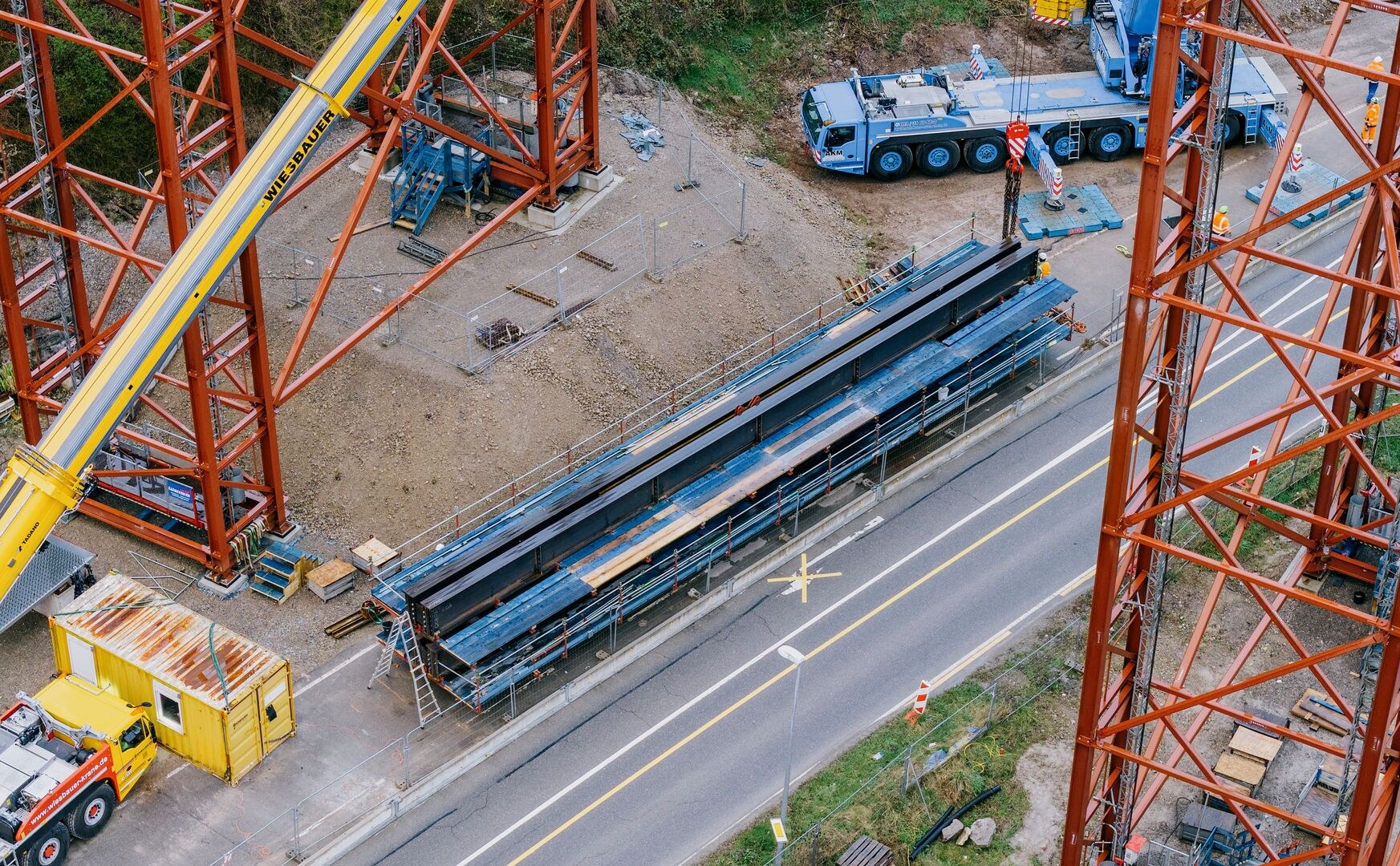
The Neckartal bridge near Horb runs 667 metres and stands 65 metres above the valley floor. As an extradosed structure — a hybrid between a girder and a cable-stayed bridge — it demands precise placement of steel elements at height, in this case two 24-metre-long sections weighing 32 tonnes each, lifted to 64 metres.
Crane service provider Wiesbauer put its newly delivered AC 7.450-1 on the job, rigged with a 76-metre main boom and 120 tonnes of counterweight. The second crane came from Munich-based partner AKM. It was the machine’s first outing: operator Jannik Weigle, who had driven it away from the handover in Zweibrücken, was also the man in the seat.
Two hooks, one load
The technical problem in any tandem lift is synchronisation — keeping the load balanced between two hooks throughout the movement. The teams worked to a lifting concept prepared in advance and ran the operation on radio, with a spotter and both operators in constant contact so that no one lost sight of the load’s attitude. On a tandem lift there is no margin for one hook running ahead of the other: an out-of-balance load transfers capacity from one crane to the next without warning, and at 64 metres there is nothing to be gained from finding out late.
“The lifting concept developed by our team beforehand proved to be extremely effective – we lifted the two 24-meter-long structural elements as planned and positioned them with centimeter precision at a height of 64 meters. Everything worked perfectly.”
— Jannik Weigle, crane operator, Wiesbauer
Why the boom length decided it
Weigle’s verdict on the crane comes down to the 80-metre telescopic boom and what it saved him. A smaller machine would have needed a jib fitted to reach the placement height; a larger crane with sufficient boom would not have fitted the standing area available on the site. The AC 7.450-1 sat in the gap between the two — a seven-axle crane that keeps a six-axle footprint while offering boom lengths normally associated with bigger machines. For a bridge site hemmed in by falsework, rail and a live road, that combination is worth more than raw capacity.
Managing director Sissy Wiesbauer framed the choice in the same terms: “We master such challenging operations with state-of-the-art crane and lifting technology, for which the AC 7.450-1 is a prime example.”
Lift at a glance
- Structure: Neckartal bridge near Horb, extradosed design
- Bridge length: 667 m · height: 65 m
- Load: 2 steel elements, 32 t each, 24 m long
- Placement height: 64 m
- Lead crane: Tadano AC 7.450-1 (Wiesbauer)
- Configuration: 76 m main boom, 120 t counterweight
- Second crane: supplied by AKM, Munich
Related Stories
Helicopter lifts Liebherr derrick crane onto Paris high-rise roof
A Liebherr 200 DR 5/10 Litronic derrick crane was flown piece by piece onto the roof of the…
Tadano ATF 100G-4 lifts 2.5-tonne Bullhead at Wacken Open Air
Crane rental firm Wilhelm used its Tadano ATF 100G-4 to hoist the 2.5-tonne Bullhead skull onto the main…
Seven jobs that show the range of Liebherr Tower Crane Solutions
From a luffing jib crane above the Sagrada Familia to rail-mounted flat-tops at Santiago airport and more than…