

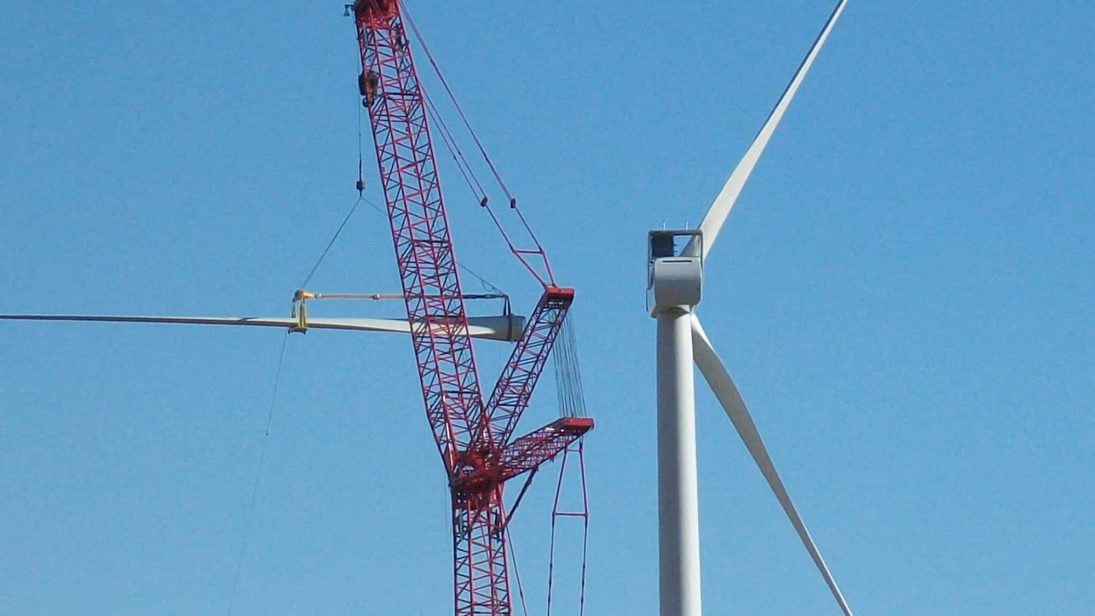
Two Manitowoc 18000s led a ten-crane spread through 111 turbine erections at Caney River
Maxim Crane Works has published a case study on the Caney River wind farm in Kansas, where a ten-crane fleet erected 111 turbines of 1.8 MW each over seven months without a major incident.
The project
Caney River, near Howard, Kansas, is a 200 MW wind farm developed by Trade Wind Energy and owned by Enel Green Power, generating enough electricity for more than 70,000 households. Balfour Wind Energy managed construction and retained Maxim Crane Works for all crane requirements. Work started in July 2011 and finished seven months later, in the first quarter of 2012, at a cost of roughly $350 million for 111 turbines rated at 1.8 MW each.
Crane spread
Maxim supplied ten machines: seven crawlers and three 100-ton rough terrain cranes. The crawler fleet was led by two 825-ton Manitowoc 18000s for the main erection work, backed by a 300-ton Manitowoc 2250, two 275-ton Manitowoc 999s and two 100-ton Link-Belt 218HSLs for component handling and assembly. All the equipment was supplied operated and maintained.
The pairing is a familiar one on US wind sites of that period — a heavy crawler on nacelle and blade lifts, with mid-size crawlers and rough terrains feeding it — but doing it 111 times inside seven months puts the emphasis on walk times, weather windows and crane availability rather than on peak capacity.
Result
More than 30,000 labour hours were worked without a major incident. Alongside the equipment, Maxim provided planning and engineering support for the duration of the contract.
Site facts
- Project: Caney River Wind Farm, Howard, Kansas
- Capacity: 200 MW — 111 turbines of 1.8 MW
- Owner / developer: Enel Green Power with Trade Wind Energy
- Construction manager: Balfour Wind Energy
- Duration: July 2011 to Q1 2012 (7 months)
- Cost: approx. $350 million
- Cranes: 10 — 7 crawlers, 3 rough terrains
- Heavy lift: 2 x Manitowoc 18000, 825 US tons
- Labour: 30,000+ hours, no major incident
Related Stories
Helicopter lifts Liebherr derrick crane onto Paris high-rise roof
A Liebherr 200 DR 5/10 Litronic derrick crane was flown piece by piece onto the roof of the…
Tadano ATF 100G-4 lifts 2.5-tonne Bullhead at Wacken Open Air
Crane rental firm Wilhelm used its Tadano ATF 100G-4 to hoist the 2.5-tonne Bullhead skull onto the main…
Seven jobs that show the range of Liebherr Tower Crane Solutions
From a luffing jib crane above the Sagrada Familia to rail-mounted flat-tops at Santiago airport and more than…