

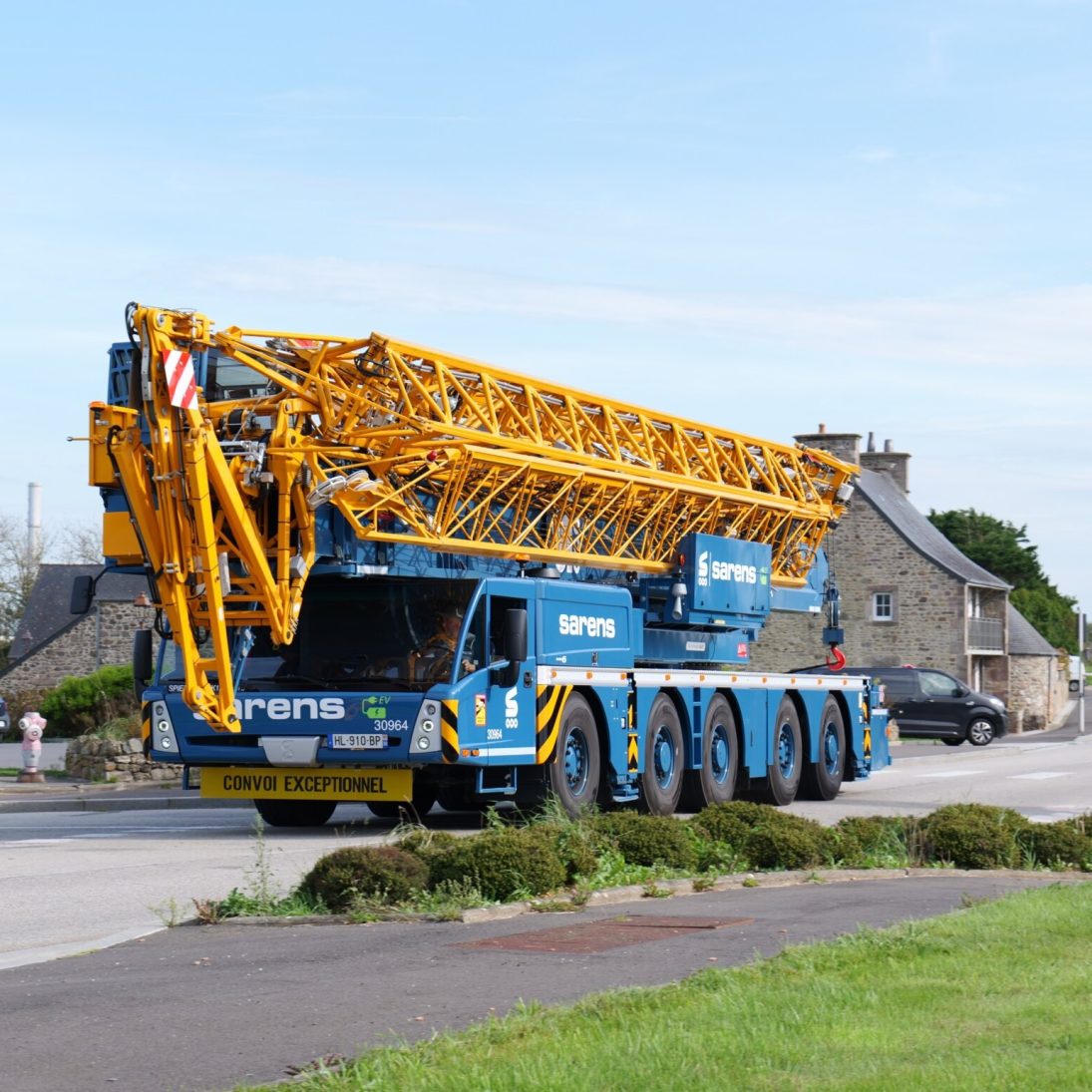
From sub-60-tonne road transport to full ballast: how the Spierings SK1265-AT5 eLift adapts to the job
Spierings has set out how its five-axle SK1265-AT5 eLift mobile tower crane moves between four crane configurations, running from a road transport weight of under 60 tonnes to a fully ballasted setup of just under 70 tonnes for maximum stability and lifting capacity.
According to the Dutch manufacturer, lifting capacity and reach are not the only factors that decide how a mobile tower crane earns its keep. Transport weight, the space available on site and the ballast a job actually requires all determine how efficiently the crane can be deployed. The SK1265-AT5 eLift answers this with a modular ballast concept: only the counterweight the lift demands goes on the crane, rather than the machine carrying its full ballast everywhere.
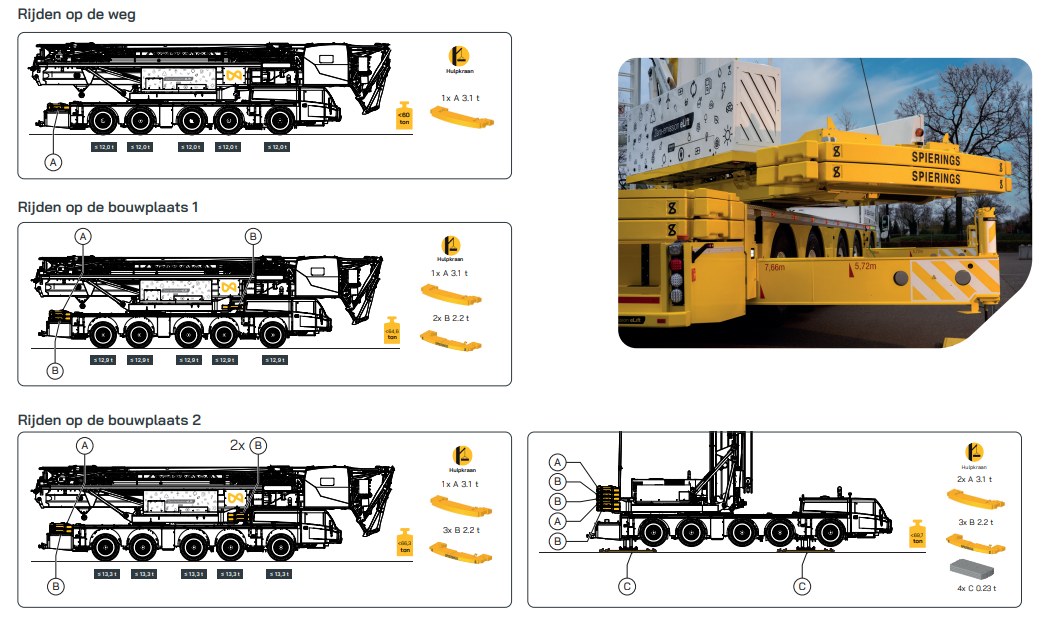
Four configurations, four weight classes
In its first configuration, for travel on public roads, the SK1265-AT5 eLift keeps its total weight below 60 tonnes, with intelligent axle load distribution limiting each of the five axles to roughly 12 tonnes. That keeps the crane within the transport regulations that apply on the road.
For work on site, additional ballast takes the crane into its second configuration at under 64.6 tonnes, raising lifting capacity while the machine stays compact. An integrated auxiliary crane lets the operator position the ballast without any support equipment.
Configuration three, at under 66.3 tonnes, is pitched as the maximum performance available within the five-axle concept, balancing reach, capacity and mobility. The fourth and heaviest configuration, at under 69.7 tonnes fully assembled, gives the crane its maximum stability and lifting performance.
Ballast detection picks the load chart
Switching between setups only works if the load chart in use matches the counterweight actually installed. The SK1265-AT5 eLift therefore carries an Automatic Ballast Detection System, which recognises the fitted ballast configuration and applies the corresponding load chart by itself, with no manual selection by the operator.
Spierings says this removes a source of error and guarantees the crane always works to the correct chart for the ballast on board. Together with the on-board auxiliary crane, it is intended to make moving between the four configurations quicker and safer.
One crane, sized to the lift
The result, in the manufacturer’s reading, is a five-axle mobile tower crane that can be sized to the lift in hand: light enough to travel efficiently between jobs, and ballasted up only when a project calls for the full lifting performance the chassis can support.
SK1265-AT5 eLift configurations
- Crane: Spierings SK1265-AT5 eLift, five-axle mobile tower crane
- Configuration 1 (road transport): under 60 t, approx. 12 t per axle
- Configuration 2: under 64.6 t, extra ballast
- Configuration 3: under 66.3 t, maximum performance in the 5-axle concept
- Configuration 4: under 69.7 t, maximum stability and capacity
- Load charts: applied automatically by the Automatic Ballast Detection System
- Ballast handling: integrated auxiliary crane, no support equipment needed
Related Stories
Unic puts its URW-095 mini spider crane under the spotlight
Unic Cranes Europe has profiled the URW-095, a 995 kg capacity mini spider crane that folds to 600…
Hoeflon makes the case for mini cranes in industrial relocations
Hoeflon has set out why compact electric mini cranes have become the tool of choice for relocation specialists…
Spierings details four ballast configurations for SK1265-AT5 eLift
Spierings' five-axle SK1265-AT5 eLift mobile tower crane runs in four ballast configurations, from a sub-60-tonne road set-up to…