

Lift planning, telemetry and a 4D simulator: what Liebherr-Werk Ehingen showed on the digital side at Bauma 2025
Liebherr-Werk Ehingen used Bauma 2025 to update the software around its mobile and crawler cranes: new filters in the Crane Finder, more machines in Crane Planner 2.0, a telemetry application, a digital service booklet and an operator training simulator.
Choosing the crane and planning the lift
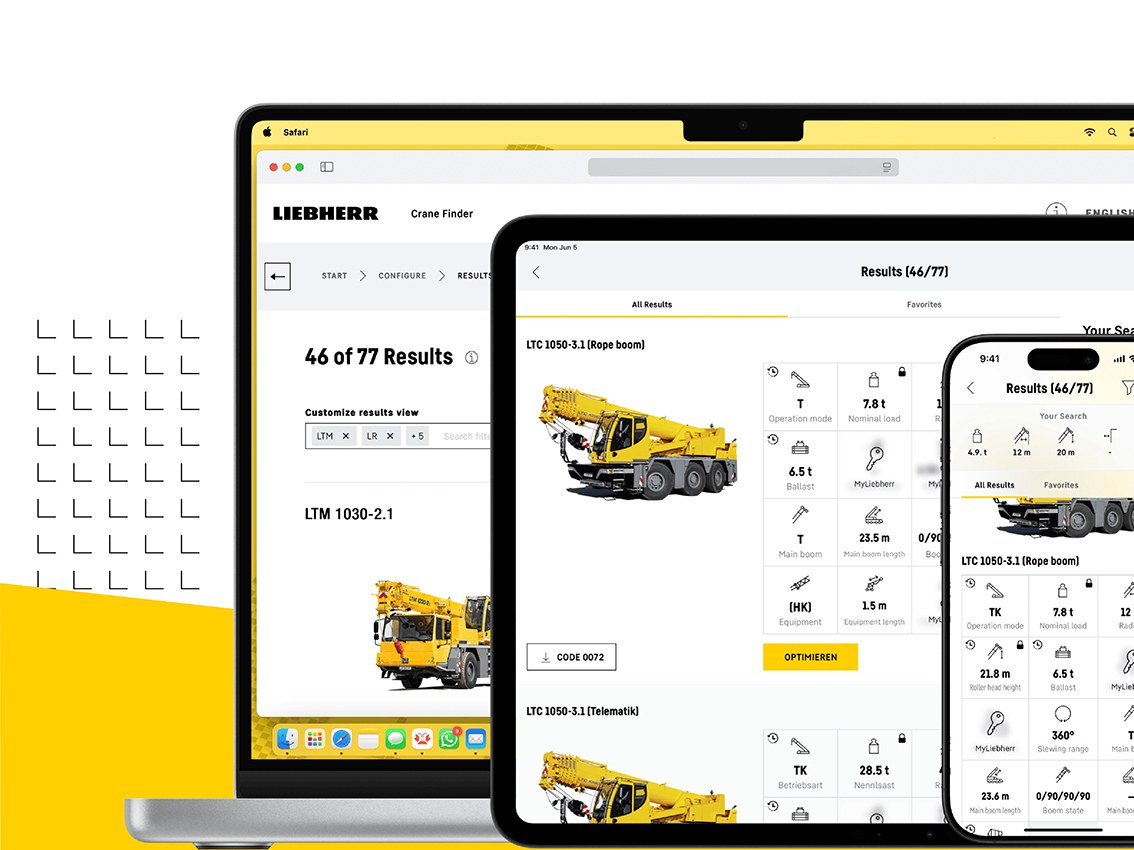
The Crane Finder takes a load, a required height and a radius and returns the cranes that will do the job, favouring the smallest machine in the lightest configuration and listing the types the customer has registered on MyLiebherr first. Two changes were introduced at Bauma. Users can now constrain the result by support configuration — selecting a small outrigger base if the site is tight — and can freeze individual entries, so that a chosen support base is retained while other parameters are varied. Mobile construction cranes (MK) have also been added to the portfolio. The tool is free and runs on desktop, tablet and phone.
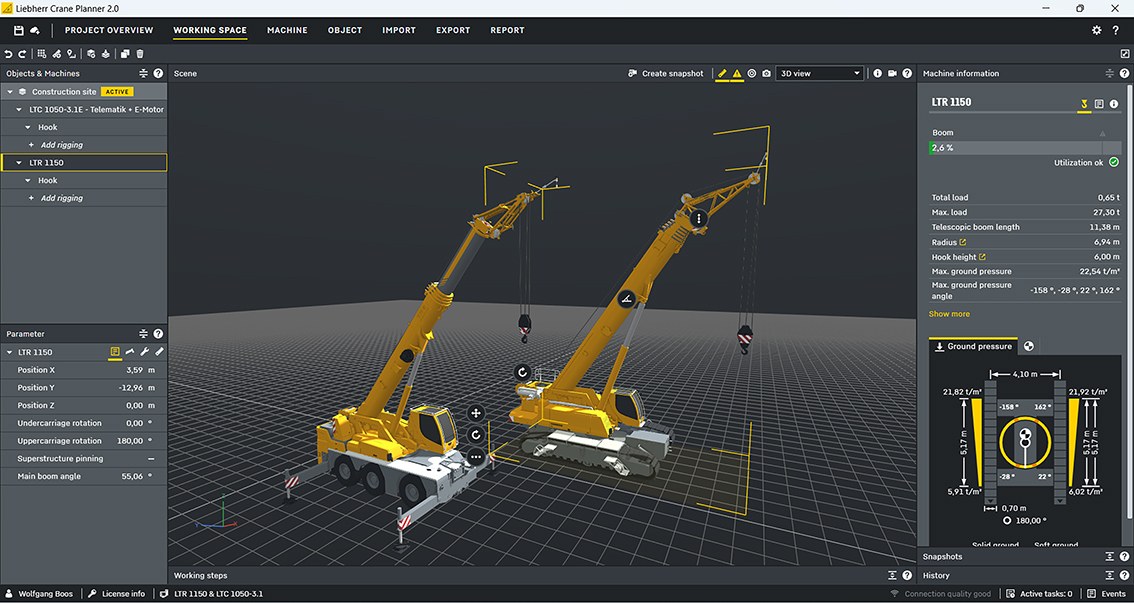
Crane Planner 2.0 is the detailed end of the same workflow: geometry, loads, utilisation and support forces simulated to scale in 3D. Site models can be imported in DWG and IFC format so the lift is planned against the real surroundings rather than an idealised one.
For Bauma the machine library was extended to 44 cranes. A telescopic crawler, the LTR 1150, can be planned in 3D for the first time, and the LTC 1050-3.1 has been added in telematics, rope and electric versions. The library now covers 15 LTM cranes, two LTC, one LTR, one LRT and 26 machines from Liebherr’s Nenzing plant.
Running and maintaining the fleet
The Performance telemetry application shows crane position, current wind speed, hook load, and fuel and AdBlue level and consumption across a fleet. Liebherr mobile cranes have shipped with Liebherr Connect — modem and SIM — as standard since 2023; cranes built from 2018 with a fleet management interface can be retrofitted. Data transmission is free worldwide. Performance currently covers LTM cranes and is accessed through MyLiebherr under a free licence, with further crane types to follow.
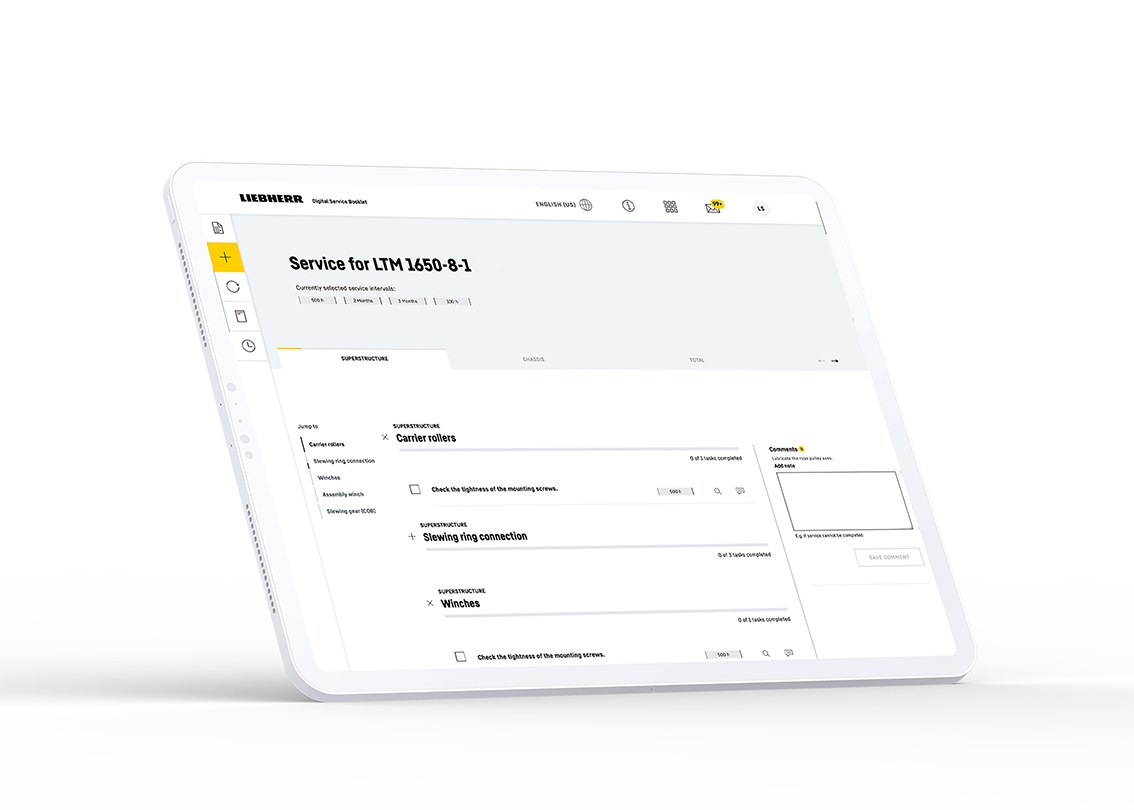
Alongside it Liebherr presented the concept of a Digital Service Booklet, collecting a mobile crane’s whole service and maintenance history in one online record accessible to both technicians and operators. It will be rolled out crane type by crane type.
The engine side is covered by LiDIA, a diagnostic tool for cranes with Liebherr engines from emission stage 4 upwards. It shows engine status, active and passive fault codes and current restrictions, and in its extended version opens up the combustion engine’s specific diagnostic functions. Service technicians can connect remotely; operators can run system tests and minor repairs themselves.
Training without tying up a crane
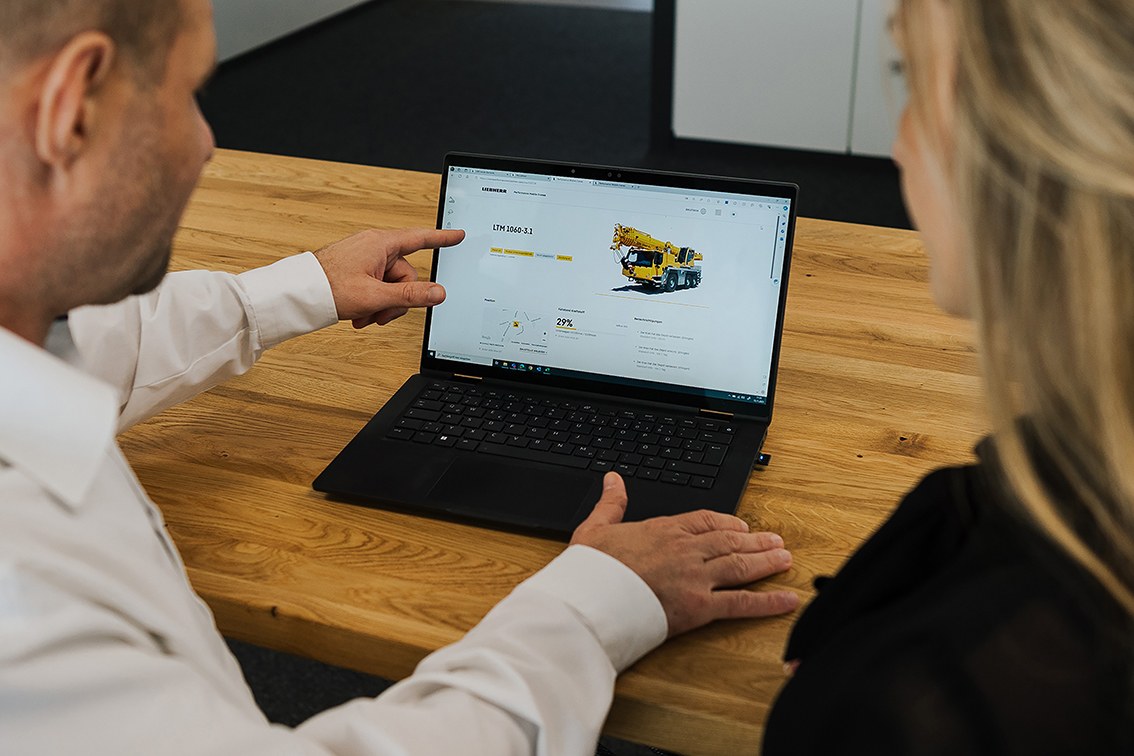
The Tenstar-built mobile crane simulator, available since 2024 and already delivered to customers worldwide, has three screens, a master switch, a moving seat platform and VR goggles. It runs in 25 languages with tutorials for slewing, hoisting, telescoping and luffing, currently simulating superstructure operation on an LTM 1060-3.1. A chassis driving simulation is planned, along with a wider range of crane models.
Related Stories
Manitowoc launches upFLEX RCL upgrade for older Grove cranes
Manitowoc's new upFLEX rated capacity limiter replaces the iFLEX systems on Grove rough-terrain and truck cranes built from…
Potain launches ECS smart control system for tower cranes
Manitowoc's new Ergo Control System pairs a 13.3-inch cab touchscreen with CAN bus wiring and will be standard…
Liebherr extends Fibre rope service life for tower cranes
Liebherr has increased the overall service life of its Fibre tower crane ropes from 14 to 16 years,…