

No screen, just data: Tadano puts telematics and rated-capacity calculation behind an open interface
Tadano’s Lift API Services let third-party software pull crane telematics and rated-load calculations directly, without going through a Tadano interface — a step towards linking cranes to BIM models and lift planning tools.
Two services, no user interface
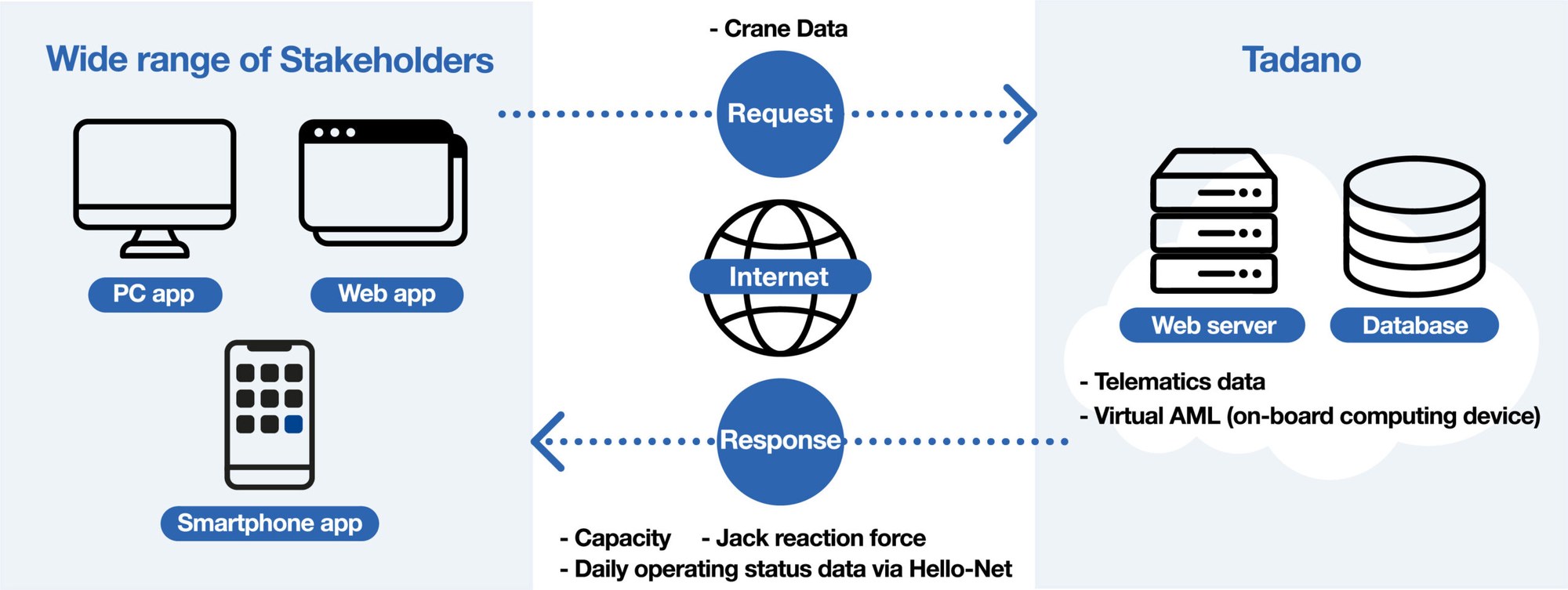
Tadano has been expanding a set of web interfaces it calls Lift API Services, which allow external systems to request crane data and crane calculations directly. There is deliberately no screen: the services are meant to be consumed by web apps, smartphone apps or a customer’s own core systems.
Two are in operation. The telematics API exposes operational data from machines fitted with Tadano’s standard telematics terminal, including last known location, hour meter, odometer, fuel consumption and remaining fuel, with items conforming to ISO 15143-3, the construction machinery telematics standard. It is offered as an option on Hello-Net, the name under which Tadano runs its telematics service, and requires an e-service account and an active communication terminal on the machine.
The second is the LMI API, a performance calculation service. A user sends working conditions — model, boom length, boom angle, presence of a jib — to the API server, and a virtual load moment indicator returns the rated load and the jack reaction force for that configuration. In effect it is a load chart that can be queried in real time from anywhere, rather than read off a laminated sheet.
Feeding lift planning and BIM
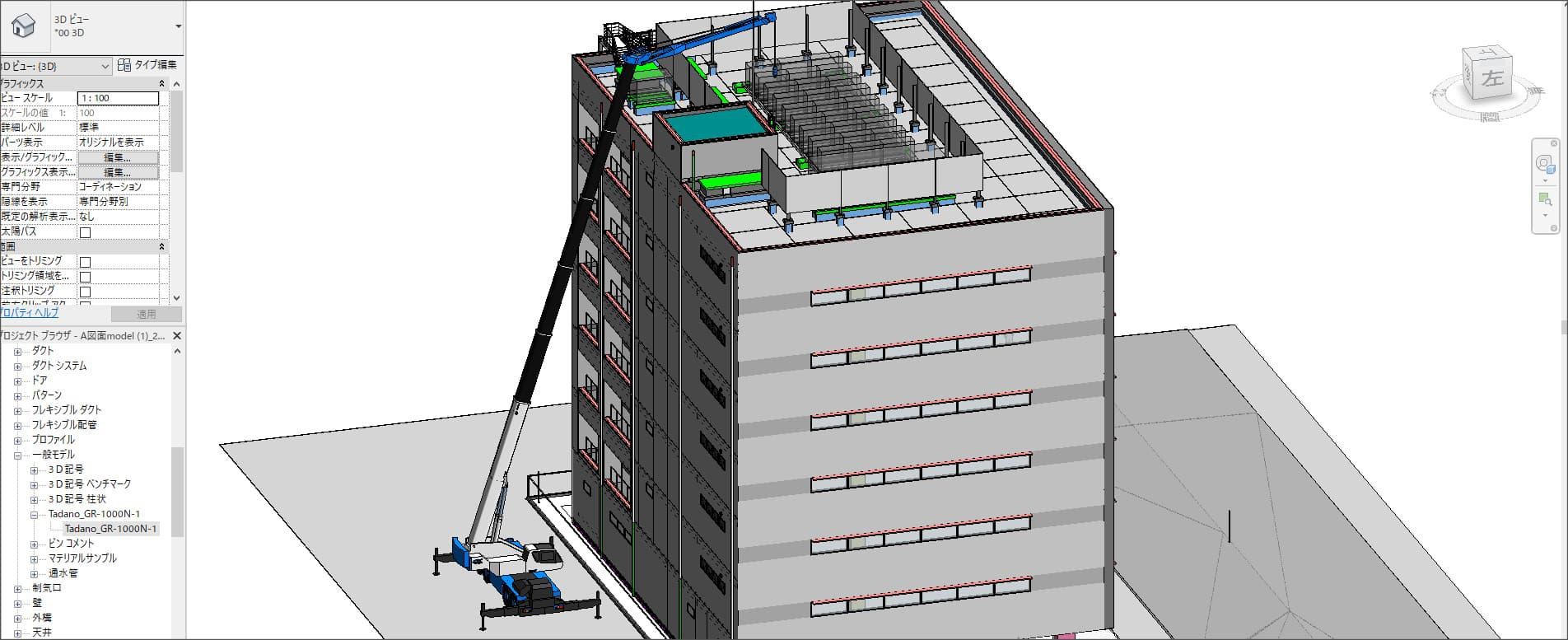
The intended use is integration with construction planning software, machine asset management systems and BIM. Tadano already publishes BIM models of its cranes free of charge for use with Autodesk Revit; the crane can be moved within the 3D model, and by linking to the LMI API a planner can test where to stand the crane and what it will lift from that position.
“We believe that by combining data from the Lift API with other construction planning software, BIM, or machinery asset management software, we can create value for our customers. This will lead to improved business efficiency and quality.”
— Shozo Hirata, assistant manager, Solutions Promotion Department, Tadano Ltd.
An argument against walled gardens
Coverage currently extends to a substantial part of Tadano’s rough terrain, all-terrain and telescopic boom crawler crane ranges. Hirata’s stated reasoning is that every construction machinery manufacturer has built its own closed system, which he argues can slow technological progress and lock customers in. He points to North America, where centralised data management had been discussed by industry associations for years and only accelerated once open platforms and API technology made data genuinely portable.
Tadano says it will continue developing the services. For fleet owners running mixed brands, the practical question is whether other manufacturers follow.
Related Stories
Manitowoc launches upFLEX RCL upgrade for older Grove cranes
Manitowoc's new upFLEX rated capacity limiter replaces the iFLEX systems on Grove rough-terrain and truck cranes built from…
Potain launches ECS smart control system for tower cranes
Manitowoc's new Ergo Control System pairs a 13.3-inch cab touchscreen with CAN bus wiring and will be standard…
Liebherr extends Fibre rope service life for tower cranes
Liebherr has increased the overall service life of its Fibre tower crane ropes from 14 to 16 years,…